Büchsenhausen Castle
Weiherburggasse 3-13
Worth knowing
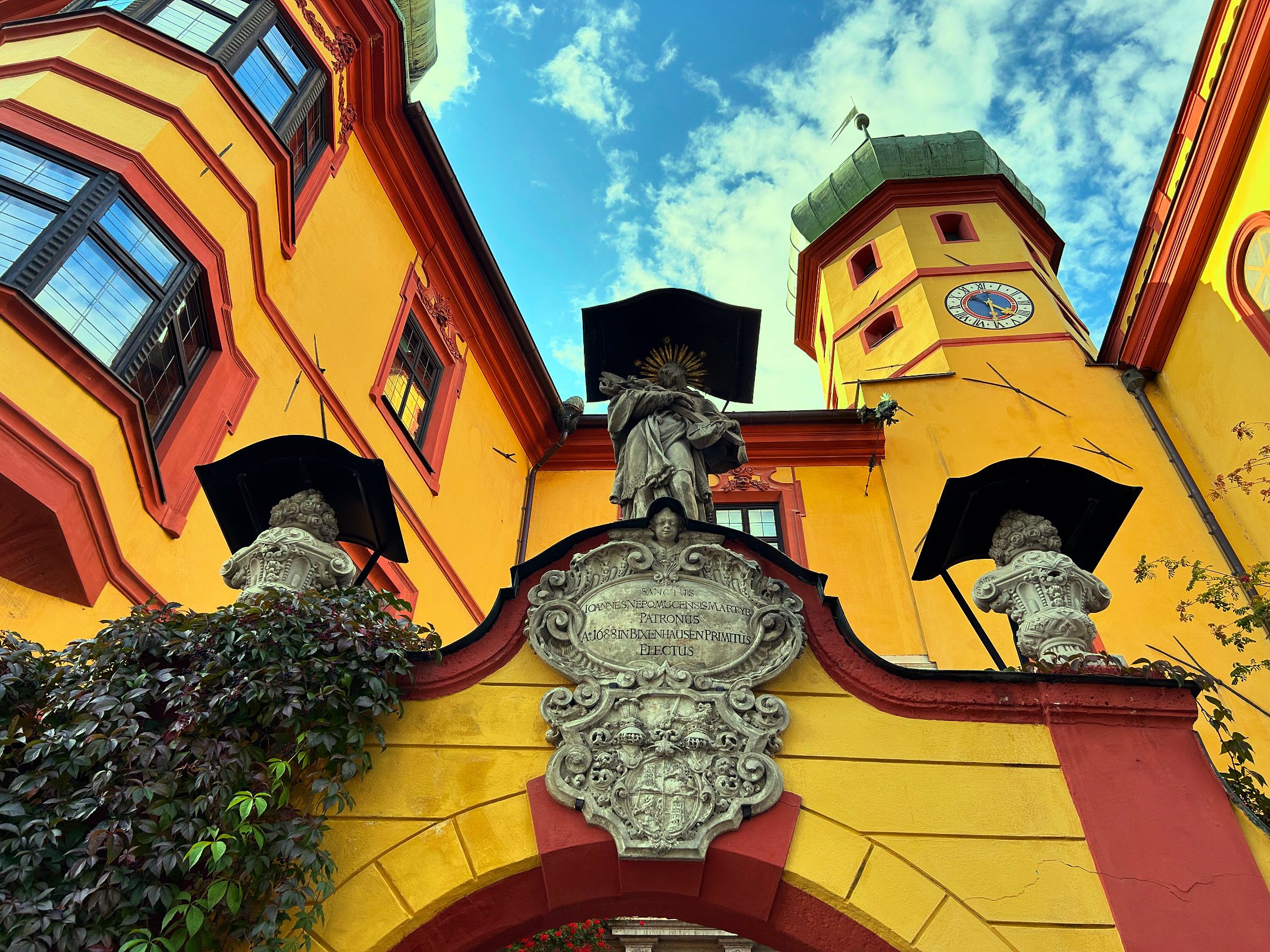
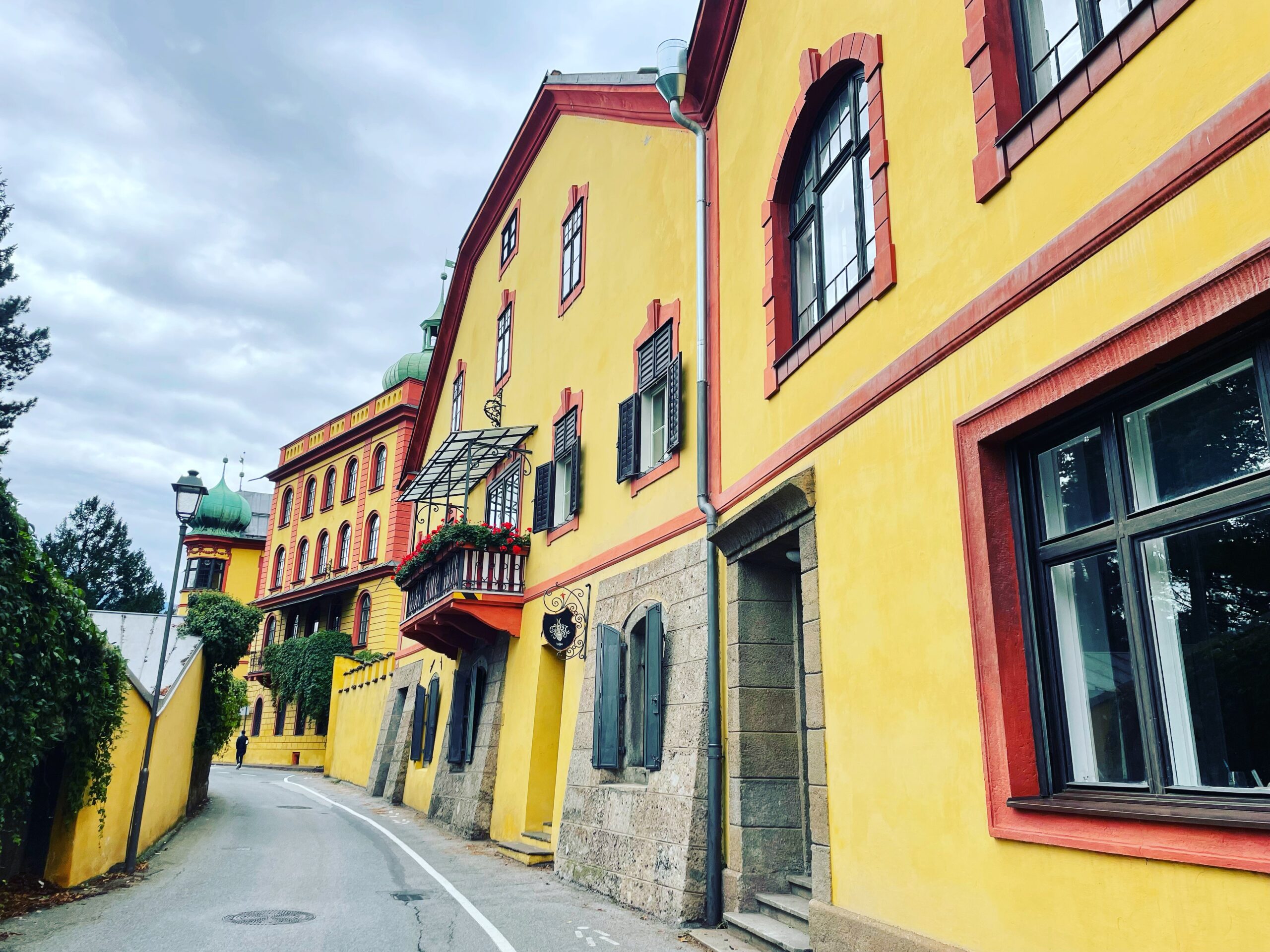
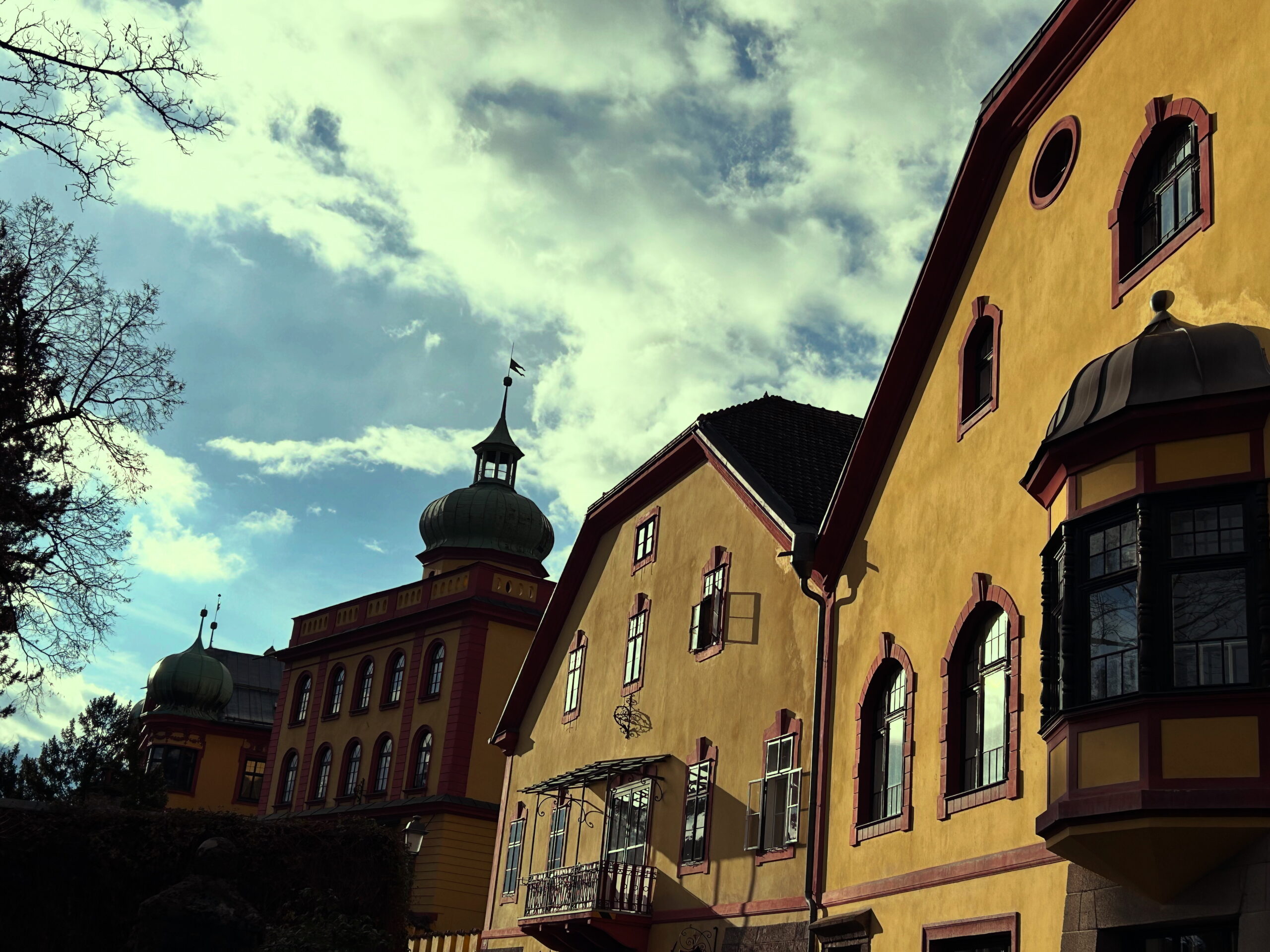
Almost unexpectedly and in radiant yellow, Büchsenhausen greets walkers who toil their way up the steep Weiherburggasse. The castle, which towers majestically over Innsbruck in neo-Gothic style, was once the Pichsen- und Gueßhaus. Peter Löffler, one of the founders of Innsbruck’s early modern armaments industry, produced cannons and bells here in his foundry before Maximilian I had the arsenal in the Saggen district built. His son Georg expanded Büchsenhausen into an estate in 1539. Thanks to their exceptional craftsmanship, the Löffler family had accumulated wealth in early‑capitalist Innsbruck and could afford to hire the well‑known master builder Türing. Unlike the nobility, they did not owe their social status to birthright but to their skill. Their residence was therefore intended to be representative. Anyone looking from Innsbruck toward the Nordkette could see the stately residence perched above the Inn, which only faded into the background once Hötting became densely built up. In the book Die Paläste und Bürgerbauten Innsbrucks, the creation of the castle is described as follows:
“The famous cannon founder Gregor Löffler built an estate in 1539 on an orchard at the Fallbach, purchased from King Ferdinand, and named it Büchsenhausen after his nearby casting house. On a meadow plot acquired in 1545 directly to the east, he erected another building, which served him primarily as a residence.”
Buildings such as Schloss Büchsenhausen or Weiherburg as well as the history of the Löffler family give an idea of the shifting power structures from around 1500 onward. It was the era in which science slowly began to detach itself from its ecclesiastical environment. Rulers such as Maximilian had realized that it took more than soldiers to win wars. Power was rooted in capital—in the case of the Habsburgs, especially the Fuggers—and in innovations such as the Löfflers’ weapons technology. Founders like Löffler were still craftsmen rather than weapons engineers, but their technical know‑how was in high demand. The cannons they cast provided advantages in warfare comparable to the superiority of tanks and flamethrowers over traditional cavalry during World War I. The range of their cannons helped England defeat the Spanish Armada, laying the foundation for the British Empire. The book Der Meister des 7. Siegels recounts the story of the Löffler family, who rose from Innsbruck to fame as international weapons masters. The peak of Innsbruck’s cannon production ended in 1590 when Hans Christoph Löffler moved to Vienna. A plaque along the long stone wall with two portals in Weiherburggasse opposite Büchsenhausen commemorates the foundry that operated here from 1503 to 1854.
In the 17th century, the complex was extended by Court Chancellor Wilhelm Biener, who used Büchsenhausen as his residence. Claudia de Medici had sold the palace to her chancellor for his services and because she needed money to build her new summer residence in today's Hofgarten. In order to utilise his estate as profitably as possible, Biener had a brewery built and served beer. However, he soon had to give up his liquid business, as the sale of tax-free beer meant that the court lost much-needed revenue from the duty on wine. The legend of the Biener-Weibeles zurück. Nach seiner von vielen als ungerechtfertigt empfundenen Hinrichtung fand die Seele der Gattin des streitbaren Politikers keine Ruhe und sucht als Geist Schloss Büchsenhausen bis heute heim.
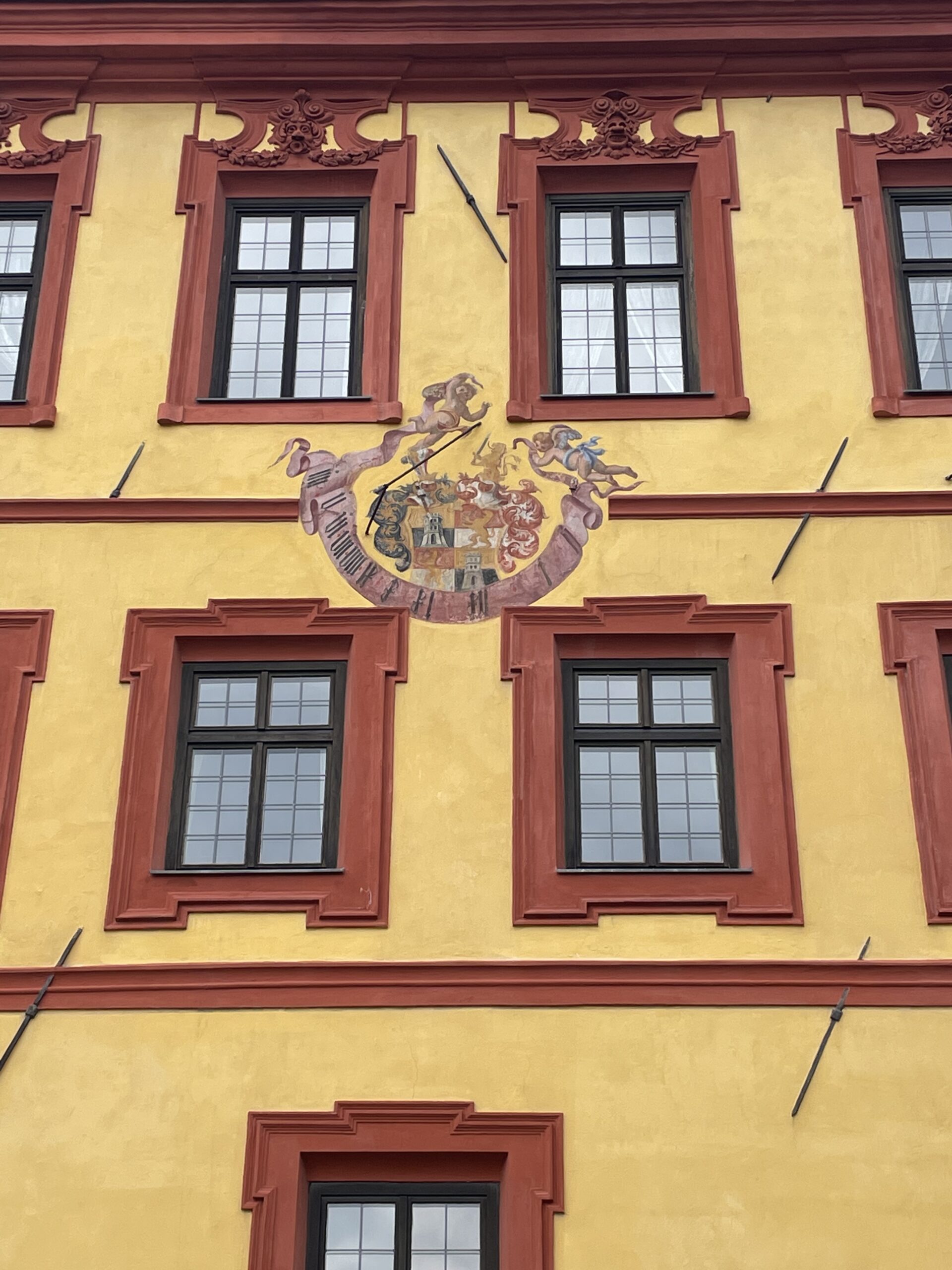
In the following centuries, the building took on its present form under the stewardship of the minor noble family Ritter von Lama. The onion‑shaped tower and the chapel likely stem from the genius of Johann Martin Gumpp. The chapel, consecrated in 1689, features an altarpiece painted by Martin Knoller depicting Saint John of Nepomuk. While the façade still displays a sundial adorned with Baroque putti, the tower carries a later‑added clock. In the 19th century, the aristocratic era of Büchsenhausen came to an end as the second industrial revolution heralded change. The last noble lady of the von Lama family married the commoner Johann Nepomuk Mahl‑Schedl (1806–1873). When she died young in childbirth, the widowed castle owner led an eccentric life. In 1837 he had the estate remodeled in neo‑Gothic style. Mahl‑Schedl, who had grown up in an inn in Upper Austria and was a resourceful businessman, not only established a tavern and coffeehouse, but also opened Tyrol’s first swimming and bathing facility at Büchsenhausen, which remained in operation until the 1960s. In the spirit of bourgeois culture, he organized the Nibelungen literary circle in the castle, where he and his companions composed folk‑style legends with German‑national enthusiasm and collected German‑language sagas. In his second marriage, he wed Emilie von Eliatschek‑Siebenburg, the daughter of a general. In patriotic fervor, he joined the war front in Italy with a privately financed rifle company. Three years after his deployment he was elevated to knighthood, at which time he renamed Büchsenhausen “Alpenburg” and began calling himself Johann Nepomuk Mahl‑Schedl von Alpenburg. In 1865, at an advanced age, he sold his property and emigrated with other adventurers from St. Nikolaus to Peru, where they founded the settlement of Pozuzo, which still exists today. Shortly before his death, he returned to Innsbruck to spend his final days there and was laid to rest in an honorary grave at Innsbruck’s West Cemetery. By this time, Büchsenhausen had been turned into a brewery by its new owner Robert Nissl. From the former noble estate, he supplied his nine inns throughout Innsbruck with beer. He remodeled the castle yet again—the spacious entrance area on the west side still reflects his aristocratic ambitions. Although he never achieved noble status before his death in 1910, he did at least earn the title of honorary citizen thanks to his philanthropy. In 1913, in the final days of the monarchy, the eastern sections of the complex were added. Today, the venerable castle houses art studios, apartments, and spaces for events of all kinds.
Innsbruck's industrial revolutions
Im 15. Jahrhundert begann sich in Innsbruck eine erste frühe Form der Industrialisierung zu entwickeln. Die Metallverarbeitung florierte unter der aufsteigenden Bauwirtschaft in der boomenden Residenzstadt und der Herstellung von Waffen und Rüstungen. Viele Faktoren trafen dafür zusammen. Die verkehrsgünstige Lage der Stadt, die Verfügbarkeit von Wasserkraft, Innsbrucks politischer Aufstieg, das Knowhow der Handwerker und die Verfügbarkeit von Kapital unter Maximilian ermöglichten den Aufbau von Infrastruktur. Glocken- und Waffengießer wie die Löfflers errichteten in Hötting, Mühlau und Dreiheiligen Betriebe, die zu den führenden Werken Europas ihrer Zeit gehörten. Entlang des Sillkanals nutzten Mühlen und Betriebe die Wasserkraft zur Energiegewinnung. Pulverstampfer und Silberschmelzen hatten sich in der Silbergasse, der heutigen Universitätsstraße, angesiedelt. In der heutigen Adamgasse gab es eine Munitionsfabrik, die 1636 explodierte.
Metalworking also boosted other sectors of the economy. At the beginning of the 17th century, there were 270 businesses in Innsbruck, employing master craftsmen, journeymen and apprentices. Although the majority of Innsbruckers were still employed in administration, trade, crafts and the money that could be earned from them attracted a new class of people. There was a reshuffling within the city. Citizens and businesses were pushed out of the new town by the civil service and the nobility. Most of the baroque palazzi that adorn Maria-Theresienstraße today were built in the 17th century, while Dreiheiligen and St. Nikolaus became Innsbruck's industrial and working-class districts. In addition to the metalworking industry around Silbergasse, tanners, carpenters, wainwrights, master builders, stonemasons and other craftsmen of early industrialisation also settled here.
Industry not only changed the rules of the social game with the influx of new workers and their families, it also had an impact on the appearance of Innsbruck. Unlike the farmers, the labourers were not the subjects of any master. Although entrepreneurs were not of noble blood, they often had more capital at their disposal than the aristocracy. The old hierarchies still existed, but were beginning to become at least somewhat fragile. The new citizens brought with them new fashions and dressed differently. Capital from outside came into the city. Houses and churches were built for the newly arrived subjects. The large workshops changed the smell and sound of the city. The smelting works were loud, the smoke from the furnaces polluted the air. Innsbruck had gone from being a small settlement on the Inn bridge to a proto-industrial town.
Growth was slowed for several decades at the end of the 18th century by the Napoleonic Wars. The second wave of industrialisation came late in Innsbruck compared to other European regions. One reason for this was the late establishment of a functioning banking system in the city. Catholics still regarded bankers as „usurers and borrower“ and doing business with money was considered indecent. Without financing, however, even large enterprises could not be founded. In 1715, the Tyrolean provincial government had issued the so-called Banko gegründet und in der Herzog-Friedrich-Straße gab es die Privatbank Bederunger, erst mit der Gründung der ersten Filiale der Sparkasse wurde es möglich, sein Geld nicht mehr unter dem Kopfpolster zu verwahren. Nach 1850 begann man Kredite zu vergeben, was die Gründung heimischer größerer Betriebe ermöglichte. Das Small craftThe town's former craft businesses, which were organised in guilds, came under pressure from the achievements of modern goods production. In St. Nikolaus, Wilten, Mühlau and Pradl, modern factories were built along the Mühlbach stream and the Sill Canal. Many innovative company founders came from outside Innsbruck. Peter Walde, who moved to Innsbruck from Lusatia, founded his company in 1777 in what is now Innstrasse 23, producing products made from fat, such as tallow candles and soaps. Eight generations later, Walde is still one of the oldest family businesses in Austria. Today you can buy the result of centuries of tradition in soap and candle form in the listed main building with its Gothic vaults. Franz Josef Adam came from the Vinschgau Valley to found the city's largest brewery to date in a former aristocratic residence. In 1838, the spinning machine arrived via the Dornbirn company Herrburger & Rhomberg over the Arlberg to Pradl. H&R had acquired a plot of land on the Sillgründe. Thanks to the river's water power, the site was ideal for the heavy machinery used in the textile industry. In addition to the traditional sheep's wool, cotton was now also processed.
Just like 400 years earlier, the Second Industrial Revolution changed the city and the everyday lives of its inhabitants forever. Neighbourhoods such as Mühlau, Pradl and Wilten grew rapidly. The factories were often located in the centre of residential areas. Over 20 businesses were still using the Sill Canal around 1900. The Haidmühle The power plant in Salurnerstraße existed from 1315 to 1907 and supplied a textile factory in Dreiheiligenstraße with energy from the Sill Canal. The noise and exhaust fumes from the engines were hell for the neighbours, as a newspaper article from 1912 shows:
„Entrüstung ruft bei den Bewohnern des nächst dem Hauptbahnhofe gelegenen Stadtteiles der seit einiger Zeit in der hibler´schen Feigenkaffeefabrik aufgestellte Explosionsmotor hervor. Der Lärm, welchen diese Maschine fast den ganzen Tag ununterbrochen verbreitet, stört die ganz Umgebung in der empfindlichsten Weise und muß die umliegenden Wohnungen entwerten. In den am Bahnhofplatze liegenden Hotels sind die früher so gesuchten und beliebten Gartenzimmer kaum mehr zu vermieten. Noch schlimmer als der ruhestörende Lärm aber ist der Qualm und Gestank der neuen Maschine…“
Aristokraten, die sich zu lange auf ihrem Geburtsverdienst auf der faulen Haut ausruhten, während sich die wirtschaftlichen und gesellschaftlichen Spielregeln änderten, mussten ihre Anwesen an den neuen Geldadel verkaufen. Im Palais Sarnthein gegenüber der Triumphpforte, 1689 von Johann Anton Gumpp für David Graf Sarnthein noch als barocker Ansitz geplant, zog die Waffenfabrik und das Geschäft von Johann Peterlongo ein. Geschickte Mitglieder des Adelsstandes nutzten ihre Voraussetzungen und investierten Familienbesitz und Erträge aus der bäuerlichen Grundentlastung von 1848 in Industrie und Wirtschaft. Der steigende Arbeitskräftebedarf wurde von ehemaligen Knechten und Landwirten ohne Land gedeckt. Während sich die neue vermögende Unternehmerklasse Villen in Wilten, Pradl und dem Saggen bauen ließ und mittlere Angestellte in Wohnhäusern in denselben Vierteln wohnten, waren die Arbeiter in Arbeiterwohnheimen und Massenunterkünften untergebracht. Die einen sorgten in Betrieben wie dem Gaswerk, dem Steinbruch oder in einer der Fabriken für den Wohlstand, während ihn die anderen konsumierten. Schichten von 12 Stunden in engen, lauten und rußigen Bedingungen forderten den Arbeitern alles ab. Zu einem Verbot der Kinderarbeit kam es erst ab den 1840er Jahren. Frauen verdienten nur einen Bruchteil dessen, was Männer bekamen. Die Arbeiter wohnten oft in von ihren Arbeitgebern errichteten Mietskasernen und waren ihnen mangels eines Arbeitsrechtes auf Gedeih und Verderb ausgeliefert. Es gab weder Sozial- noch Arbeitslosenversicherungen. Wer nicht arbeiten konnte, war auf die Wohlfahrtseinrichtungen seines Heimatortes angewiesen. Angemerkt sei, dass sich dieser für uns furchterregende Alltag der Arbeiter nicht von den Arbeitsbedingungen in den Dörfern unterschied, sondern sich daraus entwickelte. Auch in der Landwirtschaft waren Kinderarbeit, Ungleichheit und prekäre Arbeitsverhältnisse die Regel.
However, industrialisation did not only affect everyday material life. Innsbruck experienced the kind of gentrification that can be observed today in trendy urban neighbourhoods such as Prenzlauer Berg in Berlin. The change from the rural life of the village to the city involved more than just a change of location. In one of his texts, the Innsbruck writer Josef Leitgeb tells us how people experienced the urbanisation of what was once a rural area:
„…viel fremdes, billig gekleidetes Volk, in wachsenden Wohnblocks zusammengedrängt, morgens, mittags und abends die Straßen füllend, wenn es zur Arbeit ging oder von ihr kam, aus Werkstätten, Läden, Fabriken, vom Bahndienst, die Gesichter oft blaß und vorzeitig alternd, in Haltung, Sprache und Kleidung nichts Persönliches mehr, sondern ein Allgemeines, massenhaft Wiederholtes und Wiederholbares: städtischer Arbeitsmensch. Bahnhof und Gaswerk erschienen als Kern dieser neuen, unsäglich fremden Landschaft.“
For many Innsbruck residents, the revolutionary year of 1848 and the new economic circumstances led to bourgeoisie. There were always stories of people who rose through the ranks with hard work, luck, talent and a little financial start-up aid. Well-known Innsbruck examples outside the hotel and catering industry that still exist today are the Tyrolean stained glass business, the Hörtnagl grocery store and the Walde soap factory. Successful entrepreneurs took over the former role of the aristocratic landlords. Together with the numerous academics, they formed a new class that also gained more and more political influence. Beda Weber wrote in 1851: „Their social circles are without constraint, and there is a distinctly metropolitan flavour that is not so easy to find elsewhere in Tyrol."
The workers also became bourgeois. While the landlord in the countryside was still master of the private lives of his farmhands and maidservants and was able to determine their lifestyle up to and including sexuality via the release for marriage, the labourers were now at least somewhat freer individually. They were poorly paid, but at least they now received their own wages instead of board and lodging and were able to organise their private affairs for themselves without the landlord's guardianship.
The downside of this newfound self-determination was particularly evident in the first decades of industrialisation. There was hardly any state infrastructure for health and family care. Health care, pensions, old people's homes and kindergartens had not yet been invented, and in many cases the extended farming family had taken over these tasks until then. In the working-class neighbourhoods, unsupervised children romped around during the day: the youngest children, who were not yet subject to compulsory schooling, were particularly affected. In 1834, following an appeal by the Tyrolean provincial governor, a women's association was founded, which Child detention centres in the working-class neighbourhoods of St. Nikolaus, Dreiheiligen and Angerzell, now Museumstraße. The aim was not only to keep the children off the streets and provide them with clothing and food, but also to teach them manners, proper expression and virtuous behaviour. With a strict hand for "cleanliness, order and obedience", the wardens ensured that the children received at least a minimum level of care. The former Preservation centre in Paul-Hofhaimer-Gasse behind the Ferdinandeum still exists today. The classicist building now houses the Caritas integration kindergarten and a company kindergarten run by the state of Tyrol.
Innsbruck is not a traditional working-class city. Nevertheless, Tyrol never saw the formation of a significant labour movement as in Vienna. Innsbruck has always been predominantly a commercial and university city. Although there were social democrats and a handful of communists, the number of workers was always too small to really make a difference. May Day marches are only attended by the majority of people for cheap schnitzel and free beer. There are hardly any other memorials to industrialisation and the achievements of the working class. In St.-Nikolaus-Gasse and in many tenement houses in Wilten and Pradl, a few houses have been preserved that give an impression of the everyday life of Innsbruck's working class.
Türing dynasty of master builders: Innsbruck becomes a cosmopolitan city
With Innsbruck’s rise to the status of a residence city, a true building boom began. Anyone who wished to wield influence needed to have a residence in the city, in order to be as close as possible to the centre of power. In the period before newspapers, a regular postal system, fax, and email, politics was conducted primarily through direct personal contact. One family was particularly closely associated with this development and played a decisive role in transforming the settlement at the Inn Bridge into a stone-built city in a contemporary Gothic style. In the fifteenth century, Sigismund the Rich in Coin brought Niklas Türing (1427–1496) to Innsbruck. Türing first appears in the historical record in 1488. The Türings were a family of stonemasons and master builders from Memmingen in what is now Swabia, a region that at the time belonged as part of Further Austria to the Habsburg Monarchy. Innsbruck had already been the seat of the provincial government for several decades, but architectural grandeur north of the Alps had yet to take hold. The city consisted largely of wooden houses and was scarcely representative. Over the course of the late Middle Ages, Gothic and, somewhat later, Renaissance art had enveloped Europe in a new architectural idiom, founded on a new understanding of architecture and aesthetics. Buildings such as Notre Dame or York Minster set a trend that would shape much of Europe until the onset of the Baroque. Pointed towers, ribbed vaults, bay windows, and playful carvings depicting scenes of courtly life are among the typical features that give this heterogeneous style its distinctive character. For craftsmen and builders, golden times dawned—times that would gather even greater momentum under Maximilian.
During this transitional period between the Middle Ages and the Early Modern era, the Türings left a lasting mark on Gothic Innsbruck. Their work can be traced particularly well in the Old Town. Many of the town houses, such as the Trautson House, still preserve Gothic ground plans, inner courtyards, and carved elements today. Thanks to their training, the Türings combined an eye for the overall structure with attention to detail in their building projects. They were renowned for their exceptionally fine stonework, which made it possible to create elaborate portals, arcades, staircases, and vaults. They produced ornamental reliefs with patterns typical of Renaissance art; grotesques, vases, and animal motifs were characteristic forms of embellishment for bay windows and plain walls. The symmetrical arrangement of individual elements is another hallmark of the period. A substantial part of the Golden Roof (Goldenes Dachl) is attributable to Niklas Türing. He also created the statue of the castle giant Haidl, an exceptionally tall member of Sigismund’s bodyguard, which can still be seen today in the City Tower. Emperor Maximilian held him in such high esteem that he permitted him to immortalise both the Türing family coat of arms and that of his wife—a fountain and a fish—in the vaulting of the Golden Roof. His son Gregor likewise left his mark, among other works, with the Trautson House in Herzog-Friedrich-Strasse and the House of the Castle Giant in Domgasse. Thanks to careers that advanced in step with the city’s development, the Türings gained not only fame and honour but also considerable wealth. A record from 1497 reports that Niklas Türing served the provincial ruler as a “salaried court mason.” When he died—either in 1517 or 1518, the precise year is unknown—his gravestone titled him “Chief Master Builder to His Roman Imperial Majesty.” Together with his son Gregor, he was listed as a master stonemason. The building boom also enabled the Türings to acquire citizenship in Innsbruck. By 1506 at the latest, they owned a house in the workers’ and artisans’ quarter of Anbruggen. In 1509 they were able to purchase the building that today houses the Gasthof zum Lamm in Mariahilfstrasse, and they later acquired additional property at what is now Schlossergasse 21.
The last member of the Türing family to exert a formative influence on Innsbruck’s building scene was Niklas Türing the Younger, who, together with Andrea Crivelli, began the planning work on the Hofkirche. During the sixteenth and seventeenth centuries, the influence of Gothic architecture—particularly in what is now Austria—began to wane. In the course of the Counter-Reformation, churches in particular were increasingly rebuilt or newly constructed in the Baroque style. Today, Türingstrasse in eastern Innsbruck commemorates this early modern dynasty of master builders.
The master builders Gumpp and the baroqueisation of Innsbruck
The works of the Gumpp family still strongly characterise the appearance of Innsbruck today. The baroque parts of the city in particular can be traced back to them. The founder of the dynasty in Tyrol, Christoph Gumpp (1600-1672), was actually a carpenter. However, his talent had chosen him for higher honours. The profession of architect or artist did not yet exist at that time; even Michelangelo and Leonardo da Vinci were considered craftsmen. After working on the Holy Trinity Church, the Swabian-born Gumpp followed in the footsteps of the Italian master builders who had set the tone under Ferdinand II. At the behest of Leopold V, Gumpp travelled to Italy to study theatre buildings and to learn from his contemporary style-setting colleagues his expertise for the planned royal palace. Comedihaus aufzupolieren. Seine offizielle Tätigkeit als Hofbaumeister begann 1633. Neue Zeiten bedurften eines neuen Designs, abseits des architektonisch von der Gotik geprägten Mittelalters und den Schrecken des Dreißigjährigen Krieges. Über die folgenden Jahrzehnte wurde Innsbruck unter der Regentschaft Claudia de Medicis einer kompletten Renovierung unterzogen. Gumpp vererbte seinen Titel an die nächsten beiden Generationen innerhalb der Familie weiter. Die Gumpps traten nicht nur als Baumeister in Erscheinung. Sie waren Tischler, Maler, Kupferstecher und Architekten, was ihnen erlaubte, ähnlich der Bewegung der Tiroler Moderne rund um Franz Baumann und Clemens Holzmeister Anfang des 20. Jahrhunderts, Projekte ganzheitlich umzusetzen. Auch bei der Errichtung der Schanzwerke zur Landesverteidigung während des Dreißigjährigen Krieges waren sie als Planer beteiligt. Christoph Gumpps Meisterstück aber war die Errichtung des Comedihaus im ehemaligen Ballhaus. Die überdimensionierten Maße des damals richtungsweisenden Theaters, das in Europa zu den ersten seiner Art überhaupt gehörte, erlaubte nicht nur die Aufführung von Theaterstücken, sondern auch Wasserspiele mit echten Schiffen und aufwändige Pferdeballettaufführungen. Das Comedihaus war ein Gesamtkunstwerk an und für sich, das in seiner damaligen Bedeutung wohl mit dem Festspielhaus in Bayreuth des 19. Jahrhunderts oder der Elbphilharmonie in Hamburg heute verglichen werden muss.
His descendants Johann Martin Gumpp the Elder, Georg Anton Gumpp and Johann Martin Gumpp the Younger were responsible for many of the buildings that still characterise the townscape today. The Wilten collegiate church, the Mariahilfkirche, the Johanneskirche and the Spitalskirche were all designed by the Gumpps. In addition to designing churches and their work as court architects, they also made a name for themselves as planners of secular buildings. Many of Innsbruck's town houses and city palaces, such as the Taxispalais or the Altes Landhaus in Maria-Theresien-Straße, were designed by them. With the loss of the city's status as a royal seat, the magnificent large-scale commissions declined and with them the fame of the Gumpp family. Their former home is now home to the Munding confectionery in the historic city centre. In the Pradl district, Gumppstraße commemorates the Innsbruck dynasty of master builders.
Baroque: art movement and art of living
Anyone traveling through Austria is familiar with the domes and onion-shaped towers of churches in towns and villages. They are the characteristic hallmark of the Baroque architectural style, which reached its peak during the Counter-Reformation and continues to shape the cityscape of Innsbruck to this day. The most prominent churches—such as the Cathedral, St. John’s Church, or the Jesuit Church—are built in the Baroque style. Places of worship were meant to be splendid and magnificent, symbols of the triumph of the true faith. The exuberant, all-encompassing piety of elites and subjects alike was reflected in art and culture: great drama, pathos, suffering, splendor, and glory combined to form the Baroque—a style that left a lasting imprint on the entire Catholic sphere of influence of the Habsburgs and their allies between Spain and Hungary. From the seventeenth century onward, the Gumpp family of master builders and Johann Georg Fischer fundamentally transformed Innsbruck’s cityscape. The Old Provincial Government Building in the Old Town, the New Provincial Government Building on Maria-Theresien-Strasse, countless palazzi, paintings, and sculptures—the Baroque was the defining stylistic force of the House of Habsburg in the seventeenth and eighteenth centuries and became embedded in everyday life. The bourgeoisie did not wish to lag behind the nobility and princes and therefore had their private residences built in the Baroque style as well. Farmhouses were adorned with images of saints, depictions of the Virgin Mary, and representations of the Sacred Heart of Jesus.
Yet the Baroque was more than an architectural style; it was a way of life that emerged in the aftermath of the Thirty Years’ War. The Ottoman threat from the east, culminating in the two sieges of Vienna, dominated the empire’s foreign policy, while the Reformation shaped domestic affairs. Baroque culture became a central element of Catholicism and its political self-representation in public space—a countermodel to the austere and rigorous way of life advocated by Calvin and Luther. Christian holidays were introduced to brighten everyday life. Architecture, music, and painting were rich, full, and exuberant. In theatres such as the Comedihaus in Innsbruck, dramas with religious themes were performed. Ways of the Cross with chapels and representations of the crucified Christ crisscrossed the landscape. Popular piety, expressed through pilgrimages and the veneration of Mary and the saints, became firmly embedded in everyday church life. Multiple crises shaped daily existence. In addition to war and famine, plague epidemics occurred particularly frequently in the seventeenth century. Baroque piety was used as a means of educating subjects, teaching them to interpret these calamities as expressions of God’s dissatisfaction—misfortunes that could be remedied through a devout and virtuous way of life. Although the sale of indulgences was no longer common practice in the Catholic Church after the sixteenth century, vivid notions of heaven and hell persisted. Through a virtuous life—that is, living in accordance with Catholic values and displaying proper conduct as a subject within the divine order—one could come significantly closer to paradise. So-called Christian devotional literature became the most popular reading material following the educational reforms of the eighteenth century and the rising literacy of the population. The suffering of the Crucified for humanity was regarded as a symbol of the hardship endured by subjects on earth within the feudal system. Through votive paintings, people sought assistance in times of hardship or expressed gratitude—most often to the Virgin Mary—for surviving dangers and illnesses. Particularly impressive votive paintings can be admired in the Wilten Basilica. The historian Ernst Hanisch described the Baroque and its influence on the Austrian way of life as follows:
“Austria emerged in its modern form as a crusading imperialism—externally against the Turks and internally against the Reformers. This brought bureaucracy and the military, and externally a multiethnic society. State and Church attempted to control the intimate sphere of citizens’ lives. Everyone had to reform themselves through the confessional; sexuality was restricted, norm-compliant sexuality enforced. People were systematically trained to dissemble.”
Rituals and submissive behavior toward authority left deep traces in everyday culture, distinguishing Catholic countries such as Austria and Italy to this day from Protestant-influenced regions such as Germany, England, or Scandinavia. Austrians’ passion for academic titles has its roots in Baroque hierarchies. The term Baroque prince refers to a particularly patriarchal and patronizing politician who knows how to captivate an audience with grand gestures. While political sobriety is valued in Germany, the style of Austrian politicians remains theatrical—entirely in keeping with the Austrian adage “Schaumamal” (“let’s see”).
Leopold V & Claudia de Medici: Glamour and splendour in Innsbruck
While the Thirty Years’ War was ravaging half of Europe, a charismatic princely couple set out to reshape the face of Innsbruck forever in the Baroque manner. The Habsburg who entered the history of the land as Leopold V (1586–1632) assumed sovereign governmental responsibilities in the Upper Austrian regency of Tyrol and the Further Austrian territories after turbulent early years. Unlike many firstborn members of his rank, his career had long appeared uncertain. In his youth he received the classical humanist education customary for young aristocrats, under the guidance of the Jesuits. In Graz and Judenburg he studied philosophy and theology in preparation for a career within the ecclesiastical sphere of power—an established path for younger sons with little prospect of secular thrones. Leopold’s early career within the power structures of the Church epitomised precisely those features of Catholicism rejected by Protestants and Church reformers. At the age of twelve he was elected Bishop of Passau; at thirteen he was appointed coadjutor of the Bishopric of Strasbourg in Lorraine. He never, however, received holy orders; the spiritual duties were carried out by a prince‑bishop appointed for that purpose. A passionate politician, Leopold travelled extensively between his dioceses and supported the imperial side during the conflict between Rudolf II and Matthias—later immortalised by Franz Grillparzer in Bruderzwist im Hause Habsburg. These activities, scarcely befitting a churchman, nonetheless preserved Leopold’s chances of attaining a secular princely title.
That opportunity arose in 1618, when the unmarried Maximilian III died childless. At the behest of his brother, Leopold assumed the role of Habsburg governor and ruler of the Upper and Further Austrian lands and their incorporated peoples and territories. In the early years of his regency he continued to shuttle between his bishoprics in southern and western Germany, threatened by the upheavals of the Thirty Years’ War. Although the ambitious power politician found satisfaction in the excitement of high politics, the status of governor did not suffice. He sought recognition as territorial prince, complete with homage and dynastic inheritance. What he lacked were a suitable bride, time, and money. Costly conflicts had depleted his coffers.
Money arrived with the bride—and with her, time. Claudia de’ Medici (1604–1648), from the wealthy Tuscan merchant‑princely dynasty, was selected to bestow dynastic fortune upon the aspiring territorial prince, now approaching forty. As a child, Claudia had already been promised to the Duke of Urbino, whom she married at seventeen, despite a proposal from Emperor Ferdinand II. Her husband died after only two years of marriage. The ties between the Medici and the Habsburgs remained intact. Since the marriage of Francesco de’ Medici to Johanna of Habsburg, a daughter of Ferdinand I, the two dynasties had been closely interwoven. Leopold and Claudia likewise proved a perfect match of title, power, Baroque piety, and wealth. Leopold’s sister Maria Magdalena, who as a Medici bride had become Grand Duchess of Tuscany, resided in Florence and sent her brother a painted portrait of the young widow, remarking that she was “beautiful in face, body, and virtue.” After a delicate dance of mutual conditions—the bride’s family seeking assurance of the groom’s title, while the Emperor required proof of a suitable marriage before granting the ducal dignity—the moment finally arrived. In 1625 Leopold, now raised to duke and well nourished and mature in years, relinquished his ecclesiastical possessions and titles in order to marry and, together with his nearly twenty‑years‑younger bride, found a new Tyrolean line of the House of Habsburg.
The relationship between the prince and the Italian woman was to characterise Innsbruck. The Medici had made a fortune from the cotton and textile trade, but above all from financial transactions, and had risen to political power. Under the Medici, Florence had become the cultural and financial centre of Europe, comparable to the New York of the 20th century or the Arab Emirates of the 21st century. The Florentine cathedral, which was commissioned by the powerful wool merchants' guild, was the most spectacular building in the world in terms of its design and size. Galileo Galilei was the first mathematician of Duke Cosimo II. In 1570, Cosimo de Medici was appointed the first Grand Duke of Tuscany by the Pope. Thanks to generous loans and donations, the Tuscan moneyed aristocracy became European aristocracy. In the 17th century, the city on the Arno had lost some of its political clout, but in cultural terms Florence was still the benchmark. Leopold did everything in his power to catapult his royal seat into this league.
In February 1622 the wedding celebrations of Emperor Ferdinand II and Eleonore of Mantua had taken place in Innsbruck; for the northern Italian bridal entourage Innsbruck was easier to reach than Vienna. Tyrol was religiously unified and had been spared the initial devastations of the Thirty Years’ War. Whereas the imperial wedding concluded within five days, Leopold and Claudia celebrated for two full weeks. Their official marriage ceremony had taken place in Florence Cathedral without the groom present. The subsequent festivities celebrating the Habsburg–Medici union became one of the most magnificent events in Innsbruck’s history, holding the city in thrall for a fortnight. After a wintry procession descending from the snow‑covered Brenner Pass, Innsbruck welcomed its new princess and her family. Prior to her arrival, the groom and his subjects had prayed for inner purification to seek divine blessing. Like the Emperor before them, the bridal couple entered the city in a grand procession through two specially erected gates. Fifteen hundred marksmen fired volleys from all their weapons. Drummers, pipers, and the bells of the Hofkirche accompanied the procession of 750 participants passing the astonished populace. A broad programme of entertainment—hunts, theatre, dances, music, and exotic spectacles including “bears, Turks, and Moors”—filled guests and townspeople alike with amazement and delight. From a modern perspective, one particularly inglorious attraction was the cat race, in which riders attempted to sever the head of a cat suspended by its legs as they galloped past.
Leopold’s early years of rule were far less glorious for his subjects. His policies were marked by frequent conflicts with the estates of the realm. A hardliner of the Counter‑Reformation, he supported imperial troops. The Lower Engadine, over which Leopold exercised jurisdiction, was a persistent source of unrest. Under the pretext of protecting Catholic subjects from Protestant attacks, Leopold occupied the region. Although he repeatedly suppressed uprisings successfully, the resources required drove both population and estates to the brink of despair. The northern border with Bavaria was likewise unstable and demanded Leopold’s attention as military commander. Duke Bernhard of Saxe‑Weimar had taken Füssen and was positioned at the Ehrenberg Pass on the Tyrolean frontier. Innsbruck was spared direct combat, but its proximity to the fronts nevertheless made it part of the Thirty Years’ War. Financially, Leopold funded these efforts through comprehensive tax reforms to the disadvantage of the middle classes. Wartime inflation, caused by disruptions in trade critical to Innsbruck, worsened living conditions. In 1622 a weather‑related crop failure further aggravated the situation, already strained by debt from earlier obligations. His insistence on enforcing modern Roman law across the territory, at the expense of traditional customary law, also earned him little affection among his subjects.
None of this prevented Leopold and Claudia from maintaining a splendid court in absolutist fashion. Under Leopold’s rule Innsbruck underwent extensive Baroque transformation. Court festivals attracted the European high nobility. Spectacles such as lion fights, featuring exotic animals from the ducal menagerie established by Ferdinand II in the Hofgarten, as well as theatre and concerts, served to entertain court society. The morals and manners of the rugged Alpine population were to be refined. It was a delicate balance between lavish court festivities and prohibitions on carnival celebrations for ordinary citizens. Divine wrath—manifest in plague and war—was to be averted through virtuous conduct. Swearing, shouting, and the carrying of firearms in public streets were prohibited. Pimps, prostitution, adultery, and moral decay were prosecuted rigorously at the pious court. Jews likewise faced harsh conditions under Leopold and Claudia. Long‑standing hostility towards the Hebrew population gave rise to one of the most disturbing traditions of Tyrolean piety. In 1642 Hippolyt Guarinoni, an Italian‑born physician at the Abbey of Hall and founder of the Karlskirche in Volders, composed the legend of the child martyr Anderle of Rinn. Inspired by the alleged ritual murder of Simon of Trent in 1475, Guarinoni wrote the Anderl‑Lied in verse. In Rinn near Innsbruck an antisemitic cult emerged around the remains of Andreas Oxner—supposedly murdered by Jews in 1462, a date revealed to Guarinoni in a dream. This cult was only banned in 1989 by the Bishop of Innsbruck. Innsbruck was not only morally but also physically “cleansed.” Waste, particularly problematic during dry periods when no water flowed through the canals, was regularly removed by princely decree. Livestock were forbidden to roam within the city walls. Memories of the recent plague epidemic remained vivid; foul smells and miasmas were to be eliminated at all cost.
Around the midpoint of the Thirty Years’ War, one of the most powerful women in Tyrolean history came to prominence. After Leopold’s early death, Claudia ruled the country on behalf of her minor son, together with her chancellor Wilhelm Biener (1590–1651), employing a modern, confessionally driven, early absolutist policy and a firm hand. She relied on an efficient administrative apparatus. The young widow surrounded herself with Italians and Italian‑speaking Tyroleans who introduced new ideas while displaying uncompromising severity in the fight against Lutheranism. To prevent fires—after the Lion House and Ferdinand II’s estate Ruhelust had burned down directly in front of the Hofburg in 1636—stables and other wooden buildings within the city walls were demolished. Silkworm breeding in Trentino and early considerations regarding a Tyrolean university flourished under Claudia’s regency. Chancellor Biener centralised parts of the administration, above all aiming to replace the fragmented legal systems of the Tyrolean territories with a uniform code. This required further curtailing the power of the often arbitrary local nobility in favour of the territorial prince. The system was intended to finance not only the expensive court but also territorial defence. It was not only Protestant troops from southern Germany that threatened the Habsburg lands. France—nominally a Catholic power—sought compensation at the expense of the Casa de Austria in Spain, Italy, and the Further Austrian territories, today’s Benelux countries. Innsbruck became one of the centres of the Habsburg war council. Situated at the fringes of the German battlefields and midway between Vienna and Tuscany, the city was an ideal meeting place for Austrians, Spaniards, and Italians alike. The notoriously brutal Swedish forces threatened Tyrol directly but were kept at bay. Fortifications protecting Tyrol were constructed through forced labour by unwanted inhabitants of the land—beggars, Roma, and deserters. Defensive works near Scharnitz on today’s German border were named Porta Claudia after the ruler. When Claudia de’ Medici died in 1648, around the conclusion of the Thirty Years’ War, events unfolded much as they did in England at almost the same time under Cromwell: the estates rose against the central authority. Claudia, who never learned the German vernacular and even after more than twenty years remained unfamiliar with local customs, had never been particularly popular. Nonetheless, her removal was unthinkable. The role of scapegoat passed to her chancellor. Wilhelm Biener, now persona non grata, was imprisoned by her successor Archduke Ferdinand Karl and the estates, and in 1651—like Charles I two years after a show trial—was beheaded.
A trace of Florence and the Medici still shapes Innsbruck today. The family coat of arms, with its red balls and lilies, can still be seen both in the Jesuit Church, where Claudia and Leopold were laid to rest, and in the parish church of Mariahilf. The Old Town Hall is also known as the Claudiana. Remains of the Porta Claudia near Scharnitz likewise survive. Leopold’s name is particularly associated with theatre in Innsbruck. The Leopold Fountain in front of the House of Music commemorates him. Anyone undertaking the ascent of the striking Serles mountain begins the hike at the monastery of Maria Waldrast, which Leopold devotedly founded in 1621—to the wondrous image of Our Beloved Lady at Waldrast—for the Servite Order, and which Claudia subsequently expanded. Chancellor Wilhelm Biener is commemorated by a street name in the Saggen district.
The year 1848 and its consequences
The year 1848 occupies a mythical place in European history. Although the hotspots were not to be found in secluded Tyrol, but in the major metropolises such as Paris, Vienna, Budapest, Milan and Berlin, even in the Holy Land however, the revolutionary year left its mark. In contrast to the rural surroundings, an enlightened educated middle class had developed in Innsbruck. Enlightened people no longer wanted to be subjects of a monarch or sovereign, but citizens with rights and duties towards the state. Students and freelancers demanded political participation, freedom of the press and civil rights. Workers demanded better wages and working conditions. Radical liberals and nationalists in particular even questioned the omnipotence of the church.
In March 1848, this socially and politically highly explosive mixture erupted in riots in many European cities. In Innsbruck, students and professors celebrated the newly enacted freedom of the press with a torchlight procession. On the whole, however, the revolution proceeded calmly in the leisurely Tyrol. It would be foolhardy to speak of a spontaneous outburst of emotion; the date of the procession was postponed from 20 to 21 March due to bad weather. There were hardly any anti-Habsburg riots or attacks; a stray stone thrown into a Jesuit window was one of the highlights of the Alpine version of the 1848 revolution. The students even helped the city magistrate to monitor public order in order to show their gratitude to the monarch for the newly granted freedoms and their loyalty.
The initial enthusiasm for bourgeois revolution was quickly replaced by German nationalist, patriotic fervour in Innsbruck. On 6 April 1848, the German flag was waved by the governor of Tyrol during a ceremonial procession. A German flag was also raised on the city tower. Tricolour was hoisted. While students, workers, liberal-nationalist-minded citizens, republicans, supporters of a constitutional monarchy and Catholic conservatives disagreed on social issues such as freedom of the press, they shared a dislike of the Italian independence movement that had spread from Piedmont and Milan to northern Italy. Innsbruck students and marksmen marched to Trentino with the support of the k.k. The Innsbruck students and riflemen moved into Trentino to nip the unrest and uprisings in the bud. Well-known members of this corps were Father Haspinger, who had already fought with Andreas Hofer in 1809, and Adolf Pichler. Johann Nepomuk Mahl-Schedl, wealthy owner of Büchsenhausen Castle, even equipped his own company with which he marched across the Brenner Pass to secure the border.
The city of Innsbruck, as the political and economic centre of the multinational crown land of Tyrol and home to many Italian speakers, also became the arena of this nationality conflict. Combined with copious amounts of alcohol, anti-Italian sentiment in Innsbruck posed more of a threat to public order than civil liberties. A quarrel between a German-speaking craftsman and an Italian-speaking Ladin got so heated that it almost led to a pogrom against the numerous businesses and restaurants owned by Italian-speaking Tyroleans.
The relative tranquillity of Innsbruck suited the imperial house, which was under pressure. When things did not stop boiling in Vienna even after March, Emperor Ferdinand fled to Tyrol in May. According to press reports from this time, he was received enthusiastically by the population.
"Wie heißt das Land, dem solche Ehre zu Theil wird, wer ist das Volk, das ein solches Vertrauen genießt in dieser verhängnißvollen Zeit? Stützt sich die Ruhe und Sicherheit hier bloß auf die Sage aus alter Zeit, oder liegt auch in der Gegenwart ein Grund, auf dem man bauen kann, den der Wind nicht weg bläst, und der Sturm nicht erschüttert? Dieses Alipenland heißt Tirol, gefällts dir wohl? Ja, das tirolische Volk allein bewährt in der Mitte des aufgewühlten Europa die Ehrfurcht und Treue, den Muth und die Kraft für sein angestammtes Regentenhaus, während ringsum Auflehnung, Widerspruch. Trotz und Forderung, häufig sogar Aufruhr und Umsturz toben; Tirol allein hält fest ohne Wanken an Sitte und Gehorsam, auf Religion, Wahrheit und Recht, während anderwärts die Frechheit und Lüge, der Wahnsinn und die Leidenschaften herrschen anstatt folgen wollen. Und während im großen Kaiserreiche sich die Bande überall lockern, oder gar zu lösen drohen; wo die Willkühr, von den Begierden getrieben, Gesetze umstürzt, offenen Aufruhr predigt, täglich mit neuen Forderungen losgeht; eigenmächtig ephemere- wie das Wetter wechselnde Einrichtungen schafft; während Wien, die alte sonst so friedliche Kaiserstadt, sich von der erhitzten Phantasie der Jugend lenken und gängeln läßt, und die Räthe des Reichs auf eine schmähliche Weise behandelt, nach Laune beliebig, und mit jakobinischer Anmaßung, über alle Provinzen verfügend, absetzt und anstellt, ja sogar ohne Ehrfurcht, den Kaiaer mit Sturm-Petitionen verfolgt; während jetzt von allen Seiten her Deputationen mit Ergebenheits-Addressen mit Bittgesuchen und Loyalitätsversicherungen dem Kaiser nach Innsbruck folgen, steht Tirol ganz ruhig, gleich einer stillen Insel, mitten im brausenden Meeressturme, und des kleinen Völkchens treue Brust bildet, wie seine Berge und Felsen, eine feste Mauer in Gesetz und Ordnung, für den Kaiser und das Vaterland."
In June, a young Franz Josef, not yet emperor at the time, also stayed at the Hofburg on his way back from the battlefields of northern Italy instead of travelling directly to Vienna. Innsbruck was once again the royal seat, if only for one summer. While blood was flowing in Vienna, Milan and Budapest, the imperial family enjoyed life in the Tyrolean countryside. Ferdinand, Franz Karl, his wife Sophie and Franz Josef received guests from foreign royal courts and were chauffeured in four-in-hand carriages to the region's excursion destinations such as Weiherburg Castle, Stefansbrücke Bridge, Kranebitten and high up to Heiligwasser. A little later, however, the cosy atmosphere came to an end. Under gentle pressure, Ferdinand, who was no longer considered fit for office, passed the torch of regency to Franz Josef I. In July 1848, the first parliamentary session was held in the Court Riding School in Vienna. The first constitution was enacted. However, the monarchy's desire for reform quickly waned. The new parliament was an imperial council, it could not pass any binding laws, the emperor never attended it during his lifetime and did not understand why the Danube Monarchy, as a divinely appointed monarchy, needed this council.
Nevertheless, the liberalisation that had been gently set in motion took its course in the cities. Innsbruck was given the status of a town with its own statute. Innsbruck's municipal law provided for a right of citizenship that was linked to ownership or the payment of taxes, but legally guaranteed certain rights to members of the community. Birthright citizenship could be acquired by birth, marriage or extraordinary conferment and at least gave male adults the right to vote at municipal level. If you got into financial difficulties, you had the right to basic support from the town.
Thanks to the census-based majority voting system, the Greater German liberal faction prevailed within the city government, in which merchants, tradesmen, industrialists and innkeepers set the tone. On 2 June 1848, the first edition of the liberal and Greater German-minded Innsbrucker Zeitungfrom which the above article on the emperor's arrival in Innsbruck is taken. Conservatives, on the other hand, read the Volksblatt for Tyrol and Vorarlberg. Moderate readers who favoured a constitutional monarchy preferred to consume the Bothen for Tyrol and Vorarlberg. However, the freedom of the press soon came to an end. The previously abolished censorship was reintroduced in parts. Newspaper publishers had to undergo some harassment by the authorities. Newspapers were not allowed to write against the state government, monarchy or church.
"Anyone who, by means of printed matter, incites, instigates or attempts to incite others to take action which would bring about the violent separation of a part from the unified state... of the Austrian Empire... or the general Austrian Imperial Diet or the provincial assemblies of the individual crown lands.... Imperial Diet or the Diet of the individual Crown Lands... violently disrupts... shall be punished with severe imprisonment of two to ten years."
After Innsbruck officially replaced Meran as the provincial capital in 1849 and thus finally became the political centre of Tyrol, political parties were formed. From 1868, the liberal and Greater German orientated party provided the mayor of the city of Innsbruck. The influence of the church declined in Innsbruck in contrast to the surrounding communities. Individualism, capitalism, nationalism and consumerism stepped into the breach. New worlds of work, department stores, theatres, cafés and dance halls did not supplant religion in the city either, but the emphasis changed as a result of the civil liberties won in 1848.
Perhaps the most important change to the law was the Basic relief patent. In Innsbruck, the clergy, above all Wilten Abbey, held a large proportion of the peasant land. The church and nobility were not subject to taxation. In 1848/49, manorial rule and servitude were abolished in Austria. Land rents, tithes and roboters were thus abolished. The landlords received one third of the value of their land from the state as part of the land relief, one third was regarded as tax relief and the farmers had to pay one third of the relief themselves. They could pay off this amount in instalments over a period of twenty years.
The after-effects can still be felt today. The descendants of the then successful farmers enjoy the fruits of prosperity through inherited land ownership, which can be traced back to the land relief of 1848, as well as political influence through land sales for housing construction, leases and public sector redemptions for infrastructure projects. The land-owning nobles of the past had to resign themselves to the ignominy of pursuing middle-class labour. The transition from birthright to privileged status within society was often successful thanks to financial means, networks and education. Many of Innsbruck's academic dynasties began in the decades after 1848.
Das bis dato unbekannte Phänomen der Freizeit kam, wenn auch für den größten Teil nur spärlich, auf und begünstigte gemeinsam mit frei verfügbarem Einkommen einer größeren Anzahl an Menschen Hobbies. Zivile Organisationen und Vereine, vom Lesezirkel über Sängerbünde, Feuerwehren und Sportvereine, gründeten sich. Auch im Stadtbild manifestierte sich das Revolutionsjahr. Parks wie der Englische Garten beim Schloss Ambras oder der Hofgarten waren nicht mehr exklusiv der Aristokratie vorbehalten, sondern dienten den Bürgern als Naherholungsgebiete vom beengten Dasein. In St. Nikolaus entstand der Waltherpark als kleine Ruheoase. Einen Stock höher eröffnete im Schloss Büchsenhausen Tirols erste Schwimm- und Badeanstalt, wenig später folgte ein weiteres Bad in Dreiheiligen. Ausflugsgasthöfe rund um Innsbruck florierten. Neben den gehobenen Restaurants und Hotels entstand eine Szene aus Gastwirtschaften, in denen sich auch Arbeiter und Angestellte gemütliche Abende bei Theater, Musik und Tanz leisten konnten.
Tourism: From Alpine summer retreat to Piefke Saga
In the 1990s, an Austrian television series caused a scandal. The Piefke Saga written by the Tyrolean author Felix Mitterer, describes the relationship between the German holidaymaker family Sattmann and their hosts in a fictitious Tyrolean holiday resort in four bizarrely amusing episodes. Despite all the scepticism about tourism in its current, sometimes extreme, excesses, it should not be forgotten that tourism was an important factor in Innsbruck and the surrounding area in the 19th century, driving the region's development in the long term, and not just economically.
The first travellers to Innsbruck were pilgrims and business people. Traders, journeymen on the road, civil servants, soldiers, entourages of aristocratic guests at court, skilled workers from various trades, miners, clerics, pilgrims and scientists were the first tourists to be drawn to the city between Italy and Germany. Travelling was expensive, dangerous and arduous. In addition, a large proportion of the subjects were not allowed to leave their own land without the permission of their landlord or abbot. Those who travelled usually did so on the cobbler's pony. Although Innsbruck's inns and innkeepers were already earning money from travellers in the Middle Ages and early modern times, there was no question of tourism as we understand it today. It began when a few crazy travellers were drawn to the mountain peaks for the first time. In addition to a growing middle class, this also required a new attitude towards the Alps. For a long time, the mountains had been a pure threat to people. It was mainly the British who set out to conquer the world's mountains after the oceans. From the late 18th century, the era of Romanticism, news of the natural beauty of the Alps spread through travelogues. The first foreign-language travel guide to Tyrol, Travells through the Rhaetian Alps by Jean Francois Beaumont was published in 1796.
In addition to the alpine attraction, it was the wild and exotic Natives Tirols, die international für Aufsehen sorgten. Der bärtige Revoluzzer namens Andreas Hofer, der es mit seinem Bauernheer geschafft hatte, Napoleons Armee in die Knie zu zwingen, erzeugte bei den Briten, den notorischen Erzfeinden der Franzosen, ebenso großes Interesse wie bei deutschen Nationalisten nördlich der Alpen, die in ihm einen frühen Protodeutschen sahen. Die Tiroler galten als unbeugsamer Menschenschlag, archetypisch und ungezähmt, ähnlich den Germanen unter Arminius, die das Imperium Romanum herausgefordert hatten. Die Beschreibungen Innsbrucks aus der Feder des Autors Beda Weber (1798 – 1858) und andere Reiseberichte in der boomenden Presselandschaft dieser Zeit trugen dazu bei, ein attraktives Bild Innsbrucks zu prägen.
Nun mussten die wilden Alpen nur noch der Masse an Touristen zugänglich gemacht werden, die zwar gerne den frühen Abenteurern auf ihren Expeditionen nacheifern wollten, deren Risikobereitschaft und Fitness mit den Wünschen nicht schritthalten konnten. Der German Alpine Club eröffnete 1869 eine Sektion Innsbruck, nachdem der 1862 Österreichische Alpenverein was not very successful. Driven by the Greater German idea of many members, the two institutions merged in 1873. Alpine Club is still bourgeois to this day, while its social democratic counterpart is the Naturfreunde. The network of paths grew as a result of its development, as did the number of huts that could accommodate guests. The transit country of Tyrol had countless mule tracks and footpaths that had existed for centuries and served as the basis for alpinism. Small inns, farms and stations along the postal routes served as accommodation. The Tyrolean theologian Franz Senn (1831 - 1884) and the writer Adolf Pichler (1819 - 1900) were instrumental in the surveying of Tyrol and the creation of maps. Contrary to popular belief, the Tyroleans were not born mountaineers, but had to be taught the skills to conquer the mountains. Until then, mountains had been one thing above all: dangerous and arduous in everyday agricultural life. Climbing them had hardly occurred to anyone before. The Alpine clubs also trained mountain guides. From the turn of the century, skiing came into fashion alongside hiking and mountaineering. There were no lifts yet, and to get up the mountains you had to use the skins that are still glued to touring skis today. It was not until the 1920s, following the construction of the cable cars on the Nordkette and Patscherkofel mountains, that a wealthy clientele was able to enjoy the modern luxury of mountain lifts while skiing.
New hotels, cafés, inns, shops and means of transport were needed to meet the needs of guests. Anyone who had running water and a telephone connection at home in London or Paris did not want to make do with an outhouse in the corridor or in front of the house when on holiday. The so-called first and second class inns were suitable for transit traffic, but they were not equipped to receive upscale tourists. Until the 19th century, innkeepers in the city and in the villages around Innsbruck belonged to the upper middle class in terms of income. They were often farmers who ran a pub on the side and sold food. As the example of Andreas Hofer shows, they also had a good reputation and influence within local society. As meeting places for the locals and hubs for postal and goods traffic, they were often well informed about what was happening in the wider world. However, as they were neither members of a guild nor counted among the middle classes, the profession of innkeeper was not one of the most honourable professions. This changed with the professionalisation of the tourism industry. Entrepreneurs such as Robert Nißl, who took over Büchsenhausen Castle in 1865 and converted it into a brewery, invested in the infrastructure. Former aristocratic residences such as Weiherburg Castle became inns and hotels. The revolution in Innsbruck did not take place on the barricades in 1848, but in tourism a few decades later, when resourceful citizens replaced the aristocracy as owners of castles such as Büchsenhausen and Weiherburg.
Opened in 1849, the Österreichischer Hof was long regarded as the top dog of the modern hotel industry, but was officially just a copy of a grand hotel. Only with the Grand Hotel Europa had opened a first-class establishment in Innsbruck in 1869. The heyday of the inns in the old town was over. In 1892, the zeitgeisty Reformhotel Habsburger Hof a second large business. Where the Metropolkino cinema stands today, the Kaiserhof was built as a new building. The Habsburg Court already offered its guests electric light, an absolute sensation. Also on the previously unused area in front of the railway station was the Arlberger Hof settled. What would be seen as a competitive disadvantage today was a selling point at the time. Railway stations were the centres of modern cities. Station squares were not overcrowded transport hubs as they are today, but sophisticated and well-kept places in front of the architecturally sophisticated halls where the trains arrived.
The number of guests increased slowly but steadily. Shortly before the outbreak of the First World War, Innsbruck had 200,000 guests. In June 1896, the Innsbrucker Nachrichten:
„Der Fremdenverkehr in Innsbruck bezifferte sich im Monat Mai auf 5647 Personen. Darunter befanden sich (außer 2763 Reisenden aus Oesterreich-Ungarn) 1974 Reichsdeutsche, 282 Engländer, 65 Italiener, 68 Franzosen, 53 Amerikaner, 51 Russen und 388 Personen aus verschiedenen anderen Ländern.“
In addition to the number of travellers who had an impact on life in the small town of Innsbruck, it was also the internationality of the visitors who gradually gave Innsbruck a new look. In addition to the purely touristic infrastructure, the development of general innovations was also accelerated. The wealthy guests could hardly socialise in pubs with cesspits behind their houses. Of course, a sewerage system would have been on the agenda anyway, but the economic factor of tourism made it possible and accelerated the release of funds for the major projects at the turn of the century. This not only changed the appearance of the town, but also people's everyday and working lives. Resourceful entrepreneurs such as Heinrich Menardi managed to expand the value chain to include paid holiday pleasures in addition to board and lodging. In 1880, he opened the Lohnkutscherei und Autovermietung Heinrich Menardi for excursions in the Alpine surroundings. Initially with carriages, and after the First World War with coaches and cars, wealthy tourists were chauffeured as far as Venice. The company still exists today and is now based in the Menardihaus at Wilhelm-Greil-Strasse 17 opposite Landhausplatz, even though over time the transport and trading industry shifted to the more lucrative property sector. Local trade also benefited from the wealthy clientele from abroad. In 1909, there were already three dedicated Tourist equipment shops next to the fashionable department stores that had just opened a few years earlier.
Innsbruck and the surrounding towns were also known for spa holidays, the predecessor of today's wellness, where well-heeled clients recovered from a wide variety of illnesses in an Alpine environment. The Igler Hof, back then Grandhotel Igler Hof and the Sporthotel Igls, still partly exude the chic of that time. Michael Obexer, the founder of the spa town of Igls and owner of the Grand Hotel, was a tourism pioneer. There were two spas in Egerdach near Amras and in Mühlau. The facilities were not as well-known as the hotspots of the time in Bad Ischl, Marienbad or Baden near Vienna, as can be seen on old photos and postcards, but the treatments with brine, steam, gymnastics and even magnetism were in line with the standards of the time, some of which are still popular with spa and wellness holidaymakers today. Bad Egerdach near Innsbruck had been known as a healing spring since the 17th century. The spring was said to cure gout, skin diseases, anaemia and even the nervous disorder known in the 19th century as neurasthenia, the predecessor of burnout. The institution's chapel still exists today opposite the SOS Children's Village. The bathing establishment in Mühlau has existed since 1768 and was converted into an inn and spa in the style of the time in the course of the 19th century. The former bathing establishment is now a residential building worth seeing in Anton-Rauch-Straße. However, the most spectacular tourist project that Innsbruck ever experienced was probably Hoch Innsbruck, today's Hungerburg. Not only the Hungerburg railway and hotels, but even its own lake was created here after the turn of the century to attract guests.
One of the former owners of the land of the Hungerburg and Innsbruck tourism pioneer, Richard von Attlmayr, was significantly involved in the predecessor of today's tourism association. Since 1881, the Innsbruck Beautification Association to satisfy the increasing needs of guests. The association took care of the construction of hiking and walking trails, the installation of benches and the development of impassable areas such as the Mühlauer Klamm or the Sillschlucht gorge. The striking green benches along many paths are a reminder of the still existing association. 1888 years later, the profiteers of tourism in Innsbruck founded the Commission for the promotion of tourismthe predecessor of today's tourism association. By joining forces in advertising and quality assurance at the accommodation establishments, the individual businesses hoped to further boost tourism.
„Alljährlich mehrt sich die Zahl der überseeischen Pilger, die unser Land und dessen gletscherbekrönte Berge zum Verdrusse unserer freundnachbarlichen Schweizer besuchen und manch klingenden Dollar zurücklassen. Die Engländer fangen an Tirol ebenso interessant zu finden wie die Schweiz, die Zahl der Franzosen und Niederländer, die den Sommer bei uns zubringen, mehrt sich von Jahr zu Jahr.“
Postkarten waren die ersten massentauglichen Influencer der Tourismusgeschichte. Viele Betriebe ließen ihre eigenen Postkarten drucken. Verlage produzierten unzählige Sujets der beliebtesten Sehenswürdigkeiten der Stadt. Es ist interessant zu sehen, was damals als sehenswert galt und auf den Karten abgebildet wurde. Anders als heute waren es vor allem die zeitgenössisch modernen Errungenschaften der Stadt: der Leopoldbrunnen, das Stadtcafé beim Theater, die Kettenbrücke, die Zahnradbahn auf die Hungerburg oder die 1845 eröffnete Stefansbrücke an der Brennerstraße, die als Steinbogen aus Quadern die Sill überquerte, waren die Attraktionen. Auch Andreas Hofer war ein gut funktionierendes Testimonial auf den Postkarten: Der Gasthof Schupfen in dem Andreas Hofer sein Hauptquartier hatte und der Berg Isel mit dem großen Andreas-Hofer-Denkmal waren gerne abgebildete Motive.
1914 gab es in Innsbruck 17 Hotels, die Gäste anlockten. Dazu kamen die Sommer- und Winterfrischler in Igls und dem Stubaital. Der Erste Weltkrieg ließ die erste touristische Welle mit einem Streich versanden. Gerade als sich der Fremdenverkehr Ende der 1920er Jahre langsam wieder erholt hatte, kamen mit der Wirtschaftskrise und Hitlers 1000 Mark blockThe next setback came in 1933, when he tried to put pressure on the Austrian government to end the ban on the NSDAP.
It required the Economic miracle in the 1950s and 1960s to revitalise tourism in Innsbruck after the destruction. Between 1955 and 1972, the number of overnight stays in Tyrol increased fivefold. After the arduous war years and the reconstruction of the European economy, Tyrol and Innsbruck were able to slowly but steadily establish tourism as a stable source of income, even away from the official hotels and guesthouses. Many Innsbruck families moved together in their already cramped flats to supplement their household budgets by renting out beds to guests from abroad. Tourism not only brought in foreign currency, but also enabled the locals to create a new image of themselves both internally and externally. At the same time, the economic upturn made it possible for more and more Innsbruck residents to go on holiday abroad. The beaches of Italy were particularly popular. The wartime enemies of previous decades became guests and hosts.