Johanneskirche
Bischof-Reinhold-Stecher-Platz
Worth knowing
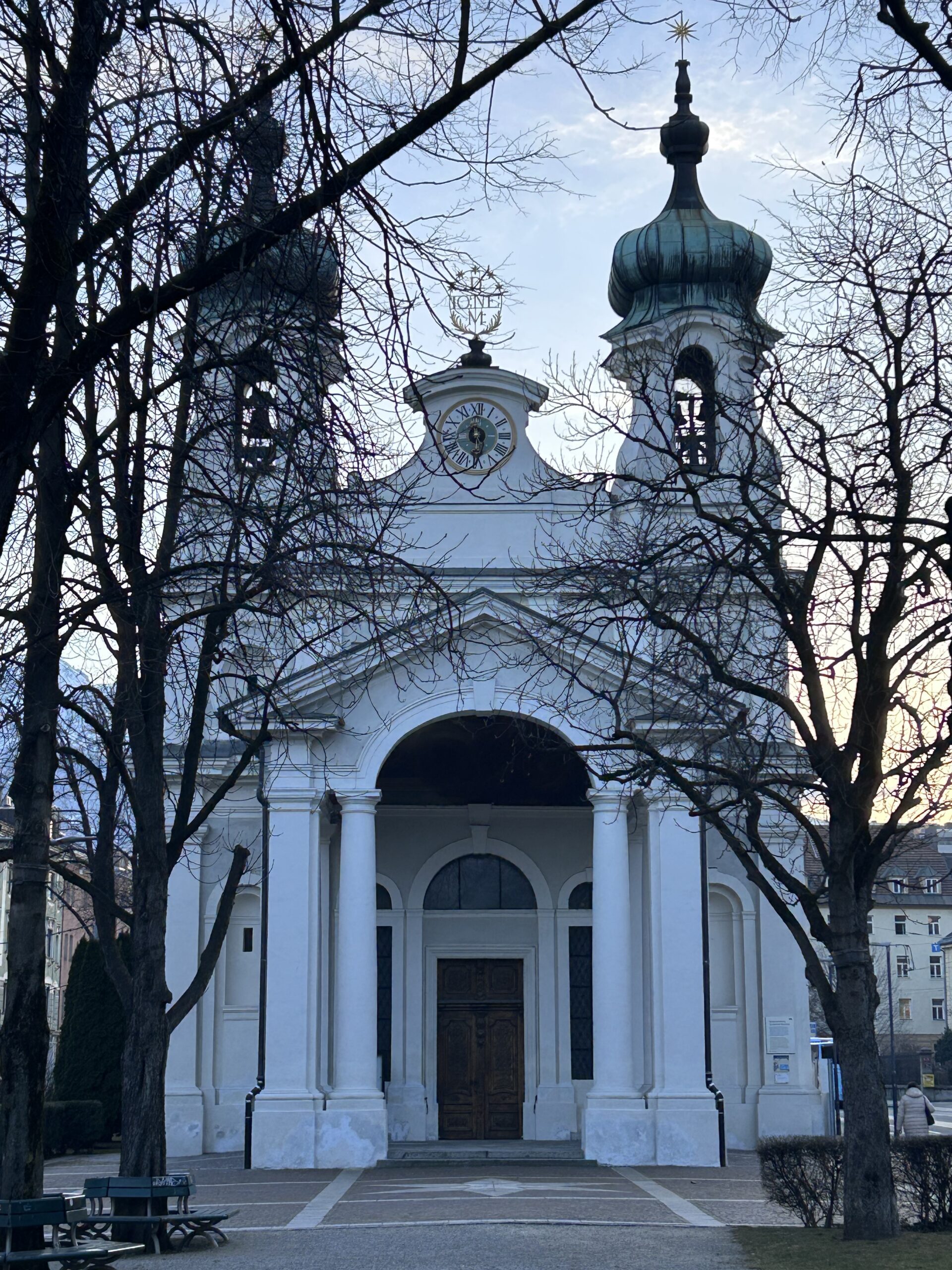
As Innsbruck grew in the 16th century, new residential areas had to be developed outside the walled medieval city center and the Neustadt. Innrain, today a busy thoroughfare with dense development, became in the 16th century the preferred residential district for the expanding administrative class of the princely residence city. The construction of the Church of St. John was owed less to concerns for the spiritual well‑being of the new residents than to false accusations made against a civil servant. In 1721, the court construction clerk Josef Dörflinger had a small chapel built. The reason was his rehabilitation following dismissal proceedings. In keeping with the spirit of the time, he had vowed to build a chapel if only his reputation were restored. In his search for a patron saint whose story matched his own situation, he chose the then‑modern Bohemian priest John of Nepomuk (1350–1393). According to legend, John of Nepomuk refused to break the Seal of Confession when King Wenceslaus IV of Bohemia demanded details of his wife’s confessions. Angered by his refusal, the king had the pious priest tortured in Prague and then drowned in the Vltava River. A few years later, construction began on the Church of St. John at that very site, following plans by Georg Anton Gumpp. In 1735, the church was solemnly consecrated and officially dedicated to John of Nepomuk, who had meanwhile been canonized by the Pope. He suited not only the newly exonerated court construction clerk Dörflinger but, as the patron saint of bridges, was also a fitting choice for Innsbruck.
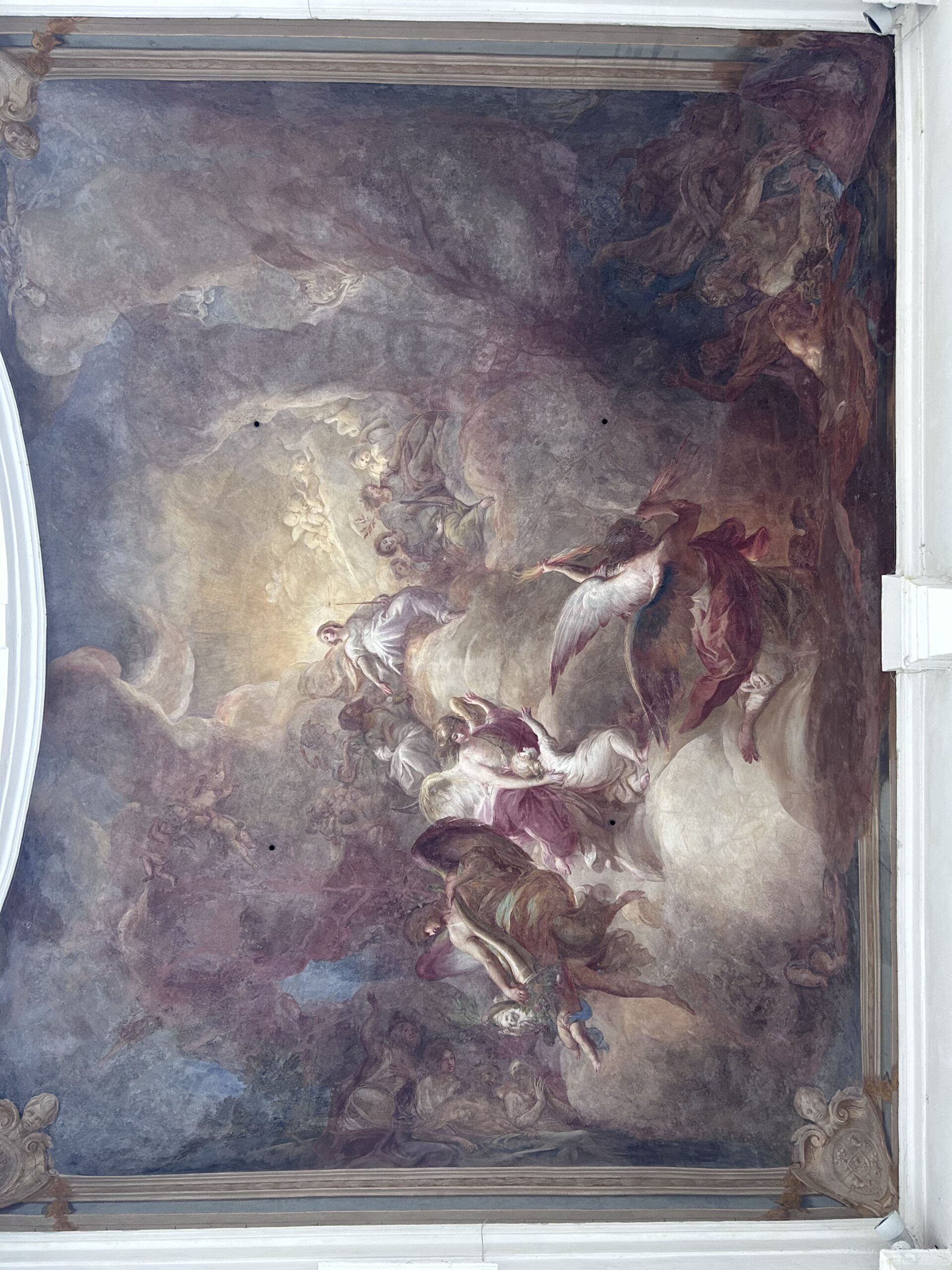
Architecturally, Gumpp embraced the High Baroque style with its characteristic onion‑shaped towers. The temple‑like entrance area of the church is adorned with a beautiful ceiling fresco by Josef Schöpf. The painting depicts the Providentia Divina, divine providence. While the cornucopia pours out wealth and abundance upon the righteous, the lower right section shows Hell, where sinners suffer God’s punishment for their dissolute earthly lives. The church interior is also richly decorated and shines in dazzling white. On the north side of the church’s exterior façade, a commemorative plaque honors the members of the Catholic student fraternity Leopoldina who died in the world wars. The Church of St. John is also known as the “New University Church.” When the university emerged from the Jesuit College in 1669, the powerful Jesuit order oversaw higher education in Innsbruck. For a long time, university services were held in the Jesuit Church. When the main university later relocated to Innrain, the Church of St. John became geographically closer to the students, even though it belonged to a different order than the university itself. In 1993, Bishop Reinhold Stecher (1921–2013), after whom the square in front of the church is named, elevated the Church of St. John to the status of University Church. The square in front of the church commemorates Reinhold Stecher, who remains very popular in Tyrol to this day, and offers a lovely view of the freestanding church. Until 1985, this small inner‑city oasis was a parking lot. Converting it into a car‑free zone was an early decision by Innsbruck standards, considering how long it took to turn Maria‑Theresien‑Straße into a pedestrian area.
Innsbruck - city of bureaucrats and civil servants
Innsbrucker brüsten sich stolz der vielen Titulierungen ihrer Heimatstadt. Für jeden Geschmack ist etwas dabei: Hauptstadt der Alpen, Universitätsstadt, Österreichs Sportstadt oder Heimat des weltbesten Krankenhauses. Wirft man einen Blick auf die Liste der größten Arbeitgeber der Region oder in die Geschichte, ist Innsbruck vor allem eins: Beamtenstadt. Universität und Landeskrankenhaus sind zwar die größten einzelnen Arbeitgeber, rechnet man aber die öffentlichen Bediensteten aller Ebenen, Stadt, Land und Bund zusammen und nimmt die ausgelagerten Unternehmen im Besitz der öffentlichen Hand wie die ÖBB, TIWAG oder die Innsbrucker Kommunalbetriebe hinzu sowie Lehrer und Polizei, sind die Beamten klar in der Überzahl. Diese Titel hat auch die längste Tradition. Spätestens seit der Übersiedlung der landesfürstlichen Residenz unter Friedrich IV. machte die Beamtenschaft nicht nur einen beträchtlichen quantitativen Teil der Bürgerschaft aus, sie bestimmt die Geschicke der Stadt in einflussreicher, wenn auch unauffälliger Manier. Bis heute sind es Beamten, die den Laden am Laufen halten. Sie setzen Gesetze durch, kümmern sich um die Planung und Instandhaltung von Infrastruktur, machen eifrig Aufzeichnungen über die Bevölkerung, um Steuern ein- und Soldaten auszuheben. Die erste Welle der Bürokratie kam wohl bereits mit dem Roman Empire. Den Römern folgten im frühen Mittelalter die Brüder des Stiftes Wilten. Die schreibkundigen Männer verwalteten nicht nur die herzoglichen und eigenen Besitztümer durch ihre Urbare und hoben die Abgaben bei den bäuerlichen Untertanen ein, sondern legten Taufmatrikel, Heiratsverzeichnisse und Sterbebücher an. Die Feudalherrschaft erforderte zwar einen Panoramablick über das, was sich innerhalb ihres Herrschaftsbereichs abspielte, vor allem in der Stadt war das Leben aber eher von den Beschränkungen der Zünfte als von denen der Obrigkeit bestimmt. Ein Magistrat war nur oberflächlich vorhanden. Es gab Gesetze, aber keine Polizei, Steuern aber kein Finanzamt. Städtische Infrastruktur war praktisch nicht vorhanden, schließlich gab es weder fließend Wasser, elektrischen Strom, Kanalisation, städtische Kindergarten, ein Arbeitsamt oder eine Krankenkasse. Die zur Stadt erhobene Gemeinde Innsbruck wurde lange von einem Stadtrichter, ab dem 14. Jahrhundert von einem Bürgermeister mit Gemeinderat regiert. Es handelte sich dabei nicht um hauptberufliche Beamte, sondern Mitglieder der städtischen Elite. Nur wenige Menschen wie Zöllner, Kornmesser, Schreiber oder Turmwächter standen bei der Stadt unter Lohn und Brot.
In the 15th century, professional life and society became more differentiated, armies grew larger, and tax burdens increased. Traditional customary law was replaced by modern Roman law, which was more difficult for laypeople to understand. As the city grew, so did the bureaucratic apparatus. Between the early 15th century and the reign of Leopold V, Innsbruck had developed from a trading and transport settlement into a civil servants’ city. Of the approximately 5,500 inhabitants, more than half belonged to the court, the municipal administration, the university, or the clergy. Court life, administration, customs, taxation, long-distance trade, and finance required literate personnel. Administration had become the city’s most important economic sector, ahead of crafts, transport, and hospitality. Civil servants distinguished themselves socially. If at all, citizens usually encountered these foreign people only in unpleasant situations. The reins were tightened particularly firmly under Maximilian I. Laws decided centrally were implemented locally by the Imperial Circles. Salaried officials penetrated the lives of individuals in a way unknown in the Middle Ages. To make matters worse, these officials often came from abroad. Italians and Burgundians in particular were sought-after key personnel, but they remained alien to the local population. Not only did they often not speak German; they could read and write, were employees rather than subject peasants. They had more money, dressed differently, followed different customs, and ate different foods. Unlike the territorial prince, they did not invoke God, but rules written by humans and inspired by antiquity and reason. Depending on the fashions, customs, and moral concepts of the time, laws changed. Just as nature conservation or speed limits on motorways are repeatedly debated today despite their obvious sense, prohibitions against spitting, disposing of chamber pots, wooden buildings, and keeping livestock within the city walls were criticized at the time—even though they drastically improved hygiene and safety.
While it had long been customary for citizens to take certain liberties in the absence of the ruler—whether in logging, construction, hunting, or fishing—the bureaucracy was always present. Whereas the territorial prince was seen as a benevolent father of his subjects, and bishops and abbots, though strict landlords, could at least offer salvation in return, the new administrative authority appeared anonymous, aloof, faceless, foreign, and distant. The basis for negotiation that a subject once had in direct contact with his lord was buried by merciless law—at least if one could not pay bribes or did not know someone in a higher position. When the unconditional faith in an increasingly corrupt clergy began to crumble and Ferdinand I appointed the Spaniard Salamanca as the country’s supreme financial administrator, the simmering dissatisfaction erupted into open rebellion in 1525. The subjects did not demand the deposition of the prince, but a change in the rule of the clergy and the foreign bureaucracy. Even in the 17th century, it was the head of Wilhelm Biener, the highest-ranking official in the country, that rolled—not that of the sovereign.
Bureaucracy, the rule of the administration, also had advantages for the subjects. It established fixed rules where arbitrariness often prevailed. The law, harmonised across different territories, was more predictable. And with a bit of luck and talent, it was possible to climb the social ladder by serving the public authorities, even without belonging to the nobility. Michael Gaismair, one of the leaders of the 1525 rebellion, was the son of a mining entrepreneur and had been in the service of the provincial governor before his career as a revolutionary.
The next modernization of administration took place in the 18th century. Under the enlightened absolutist monarchs Maria Theresa and Joseph II, a new wind blew down to the municipal level. Innsbruck received a police force for the first time. The city administration was modernized in 1784. Instead of the old town council with its community assembly, a mayor now governed, supported by a council and above all by civil servants. This magistrate consisted of salaried experts who were still largely members of the lower nobility, but who now had to qualify for office through examinations. Bureaucracy gained more power at the operational political level. While the office of mayor was limited in time, civil servants enjoyed lifelong, non-terminable positions. This tenure and a renewed surge of new laws—often contradicting tradition—reinforced the image of civil servants as aloof and distant from citizens. When the element of foreign rule was added with the Bavarian occupation of Tyrol—modeled on French administration—another uprising broke out in 1809. The mass conscription of young men for military service, regulation of religious life, and compulsory vaccination, enforced by Bavarian officials, was too much for the Tyrolean psyche.
After 1809, bureaucracy expanded into ever more areas of life as part of industrialization and new technologies. Not only the state through taxation and the military, but also universities, schools, construction, railways, the postal system, and institutions such as the Chamber of Trade and Commerce required administrative staff. The city grew in population and businesses alike. New infrastructure—gas, sewer systems, and electricity—and new ideas about hygiene, food inspection, health, and education demanded new employees in the municipal administration. The old town hall in the Old Town became too small, and an extension proved impossible. In 1897, the civil servants moved into the new town hall on Maria-Theresien-Straße. The move was made possible by the generous donation of the industrialist and hotelier Leonhard Lang. He had converted the former Palais Künigl into the Hotel d’Autriche before the mayor and his entourage moved in.
When the monarchy collapsed in 1918, the transition was not seamless, but thanks to the structures in place, it was unimaginably smooth. However, it was no longer the emperor who carried the burden of the state, but a host of civil servants and guardians of order who provided water, electricity and a functioning railway network. With Eduard Klingler and Theodor Prachensky, two heads of building authorities in the first half of the 20th century left their mark on Innsbruck's cityscape, which is still clearly visible today. With agendas such as public housing, the labour office, education, urban infrastructure, road construction, public transport, registration and weddings, the Republic took over more or less all the tasks of daily life from the monarchy and the church. So for anyone who is annoyed by excessive officialdom and agonisingly slow bureaucracy on their next visit to the New Town Hall, it is worth remembering that the welfare state in the person of its civil servants manages the social welfare and public infrastructure of thousands of people from the cradle to the grave, mostly unnoticed.
University City of Innsbruck
1669 is considered the official founding year of one of the most important institutions in Innsbruck's city history. On 15 October, Emperor Leopold I granted the Tyroleans the privilege of „Haller Salzaufschlags“. Diese Steuer auf die begehrte Handelsware aus der hauseigenen Saline machte es möglich, eine Universität zu finanzieren. Die Basis für eine Hochschule war zu diesem Zeitpunkt bereits gelegt. Die Universität ging aus der Lateinschule hervor, die von den Jesuiten etwas mehr als hundert Jahre zuvor unter Ferdinand I. gegründet worden war. Der Schwerpunkt am Gymnasium lag auf der klassischen humanistischen Bildung. Latein und Griechisch waren notwendige Schwerpunkte im Unterricht, um dem intellektuellen und politischen Diskurs folgen zu können. Wissenschaftliche Bücher und viele andere Schriftstücke wurden in der Frühen Neuzeit noch immer auf Latein verfasst. Auch für höhere Posten im öffentlichen Dienst war Latein Voraussetzung. Die Universität brachte neue Ausbildungsmöglichkeiten nach Innsbruck. Die erste Fakultät, die den Lehrbetrieb aufnahm, war die Philosophie. Theologie, Recht und Medizin folgten kurz darauf. Als Papst Innozenz XI. der Universität 1677 seinen Segen gab, war der Betrieb schon voll angelaufen. Professoren und Studenten verschiedenster Nationalität tummelten sich in Innsbruck. Der Jesuitenorden war mit mehreren Lehrstühlen vertreten, andere Professoren wurden von der Diözese Brixen bestellt. Das führte zu Spannungen innerhalb der Universität, vertraten doch die Jesuiten vor allem die Interessen des Landesfürsten und Monarchen, während die Professoren der Diözese die politischen Interessen des Bischofs wahren wollten. Von einer Trennung von Staat, Kirche und Wissenschaft war man in dieser frühen Phase der Aufklärung noch weit entfernt. Dabei ging es um Posten, Macht, Geld und Einfluss, nicht nur innerhalb der Stadt.
A university degree usually took seven years before the graduate was permitted to slip a ring onto his finger as a symbol of his doctoral status. During the first two years, every student had to dedicate himself to philosophy before selecting a specialized field. In addition to humanities coursework, church services, theatrical performances, music-making, and practical pursuits like fencing and horseback riding were integral components of an educated young man's life. The university, however, was far more than an educational institution. In 1665, Innsbruck lost its status as a residence city, relinquishing much of its prestige and splendor. The university's presence offset this downgrade to some extent, ensuring that the aristocracy remained present in the city, at least in the form of students. Students and professors reshaped the city's social fabric. In the first decade following its founding, roughly 50 different men from all corners of the world taught philosophy in Innsbruck to a student body of over 300. These intellectuals were a remarkable group. Internally, they organized themselves into Landsmannschaften—fraternities based on nationality or language group. Every Landsmannschaft with sufficient members had its own distinct attire, badges, and insignia, and maintained its own unique traditions. At public and social occasions such as processions, delegations like the Congregation of the Blessed Virgin, drawn from the Jesuit-influenced university, stood out prominently. Professors made a habit of appearing in velvet gowns, color-coded according to their respective faculties. Carrying a sword, the gladius deambulatoris, was granted to students upon completing their first year at the university. Unlike the strictly and demurely dressed locals of Innsbruck, these young men of privileged backgrounds made colorful, flamboyant appearances reminiscent of medieval dandies. They conversed in a jargon that sounded strange and unintelligible to outsiders, while official matters were conducted entirely in Latin.
The strictly supervised daily life of students in the assembly hall and lecture halls was lightened by booze-filled evening entertainment, excursions into the countryside surrounding Innsbruck, music-making, church processions, and theatrical performances. Time and again, friction arose between ordinary citizens and members of the university. Despite their social standing, students were frequently far from diligent model pupils; rather, they were young men accustomed to a certain lifestyle and status. To keep them under control, a dedicated legal system was required. Students were subject to university law, which was entirely separate from municipal law. The university itself could impose imprisonment, fines, and even banishment from the territory. Only cases involving capital punishment required appealing to the regional government. For instance, students were officially forbidden from drinking to excess. If this occurred in one of Innsbruck's taverns anyway, the young offender received an admonition. Should he be unable or unwilling to settle his bill, the aggrieved innkeeper could not file a formal complaint with the courts, as serving excessive amounts of alcohol to the student body was prohibited. Insults to honor within university circles could lead to duels, much like in the military. Especially when combined with alcohol, riots and disturbances were not uncommon. Thus, in January 1674, "not only were nuisances, rumors, and absurd acts committed at night," but "students of the university were apprehended carrying all kinds of forbidden weapons such as matchlocks, pistols, pocket pistols, stilettos, sabers, and knives..." To enforce the law, the university rectorate maintained its own force. The Scharwache (watchmen) was armed with halberds and tasked with preventing student disturbances as effectively as possible. Six armed men were on duty day and night to maintain order. There was even a dedicated university prison (Carcer) to detain wrongdoers on bread and water. The costs for this were split between the city of Innsbruck and the university.
The university has always served as a political focal point and a reflection of the prevailing zeitgeist. Since the mid-18th century, its primary purpose was to train loyal, Catholic civil servants for the state. The name Leopold-Franzens-Universität traces back to the two emperors, Leopold I and Francis I, under whom it was originally founded and re-established, respectively. On two separate occasions, the university was downgraded to a lyceum or abolished entirely. Emperor Joseph II closed the gates of the Jesuit-influenced educational institution, as did the Bavarian administration during the Napoleonic Wars. Emperor Francis I, who pivoted back to the traditionally Catholic line of the Habsburgs during the Restoration, re-founded the institution in 1826. However, the university remained under close surveillance during Metternich's police state, as authorities feared nationalistic and liberal students who were beginning to form fraternities. Secret state police operated in lecture halls and student circles alike to nip the problematic ideas of young agitators in the bud as early as possible. Industrialization and its accompanying economic, political, and societal demands on education reshaped university life. Reflecting the spirit of the era, the inaugural address by the Dean of the Faculty of Philosophy, Prof. Dr. Joachim Suppan (1794–1864), addressed a practical physics problem aimed at achieving "a more precise knowledge of the so important and useful invention of the steam engine, also for domestic industry, where it has so far found no application." The fact that Suppan was an ordained priest alongside his degrees in philosophy and mathematics highlights the continuing influence of the Church on education during the 19th century. Suppan's closing admonition to the students—urging them "to one day render fruitful services to the fatherland through knowledge and virtue"—underscores how closely bound the university remained to state authority alongside ecclesiastical power. The nationalistic conflicts of the late monarchy were similarly mirrored in the university's history. Academic life in the late 19th century was defined by competing student corps, Burschenschaften, and fraternities. Students and professors grew increasingly radicalized, leading to recurring clashes between different factions and changing alliances. The only issues on which liberals, conservatives, and Pan-German nationalists could consistently agree were antisemitism and a shared hostility toward Italians. The interwar period brought a continuation of these old conflicts. Many students and faculty members had served in the First World War and were accustomed to resolving disputes through force. The apparatus of the Corporate State (Ständestaat) in the 1930s drew its ranks from Catholic fraternities, whereas Pan-German Burschenschaften served as a major pillar for National Socialism. The democratic Republic of Austria and the broader emancipation that accompanied it held little appeal for the traditionally elitist academics on both sides. Young men suddenly no longer had academia to themselves. While women and the sons of working-class artisan families had long been barred from university studies, it now became theoretically possible to advance socially through higher education. The university celebrated its first female Doctor of Law five years after the founding of the Republic. The press noted:
“This coming Saturday, Miss Mitzi Fischer will be awarded the degree of Doctor of Law at the University of Innsbruck. Miss Fischer is a native of Vienna. She also completed her secondary education in Vienna. After her matriculation examination, she pursued the study of law at the University of Innsbruck. The future doctor passed all examinations with distinction and would therefore, according to former custom, have to be promoted sub auspiciis imperatoris. In any case, Miss Fischer is the first woman to earn the doctoral degree in law at the University of Innsbruck.”
With the annexation to the German Reich in 1938, the university was renamed once again. After the war, the Deutsche Alpenuniversität reverted back to Leopold-Franzens-Universität. Surprisingly quiet, much like in 1848, were the students in Innsbruck during the year 1968. While students were the drivers of change in other European cities, Innsbruck remained calm. In Paris, cobblestones flew; in Innsbruck, people settled for boycotts and sit-ins. Although there were individual groups in the late 1960s and 1970s such as the Kommunistische Gruppe Innsbruck, the Committee for Solidarity with Vietnam, the socialist VSStÖ, or the liberal-Catholic Aktion within the ÖH (Austrian Students' Association), no mass movement materialized. The vast majority of students came from the upper class and had completed their Matura at a Catholic-oriented grammar school. Beethoven's old adage that "as long as the Austrian still has brown beer and sausages, he does not revolt" proved true. Only a few students could summon enthusiasm for solidarity with Vietnam, Mao Zedong, or Fidel Castro. Who wanted to risk their own career in a region dominated by the holy trinity of the Tiroler Tageszeitung, Bishop Paulus Rusch, and the regional parliament (Landtag) with an absolute majority held by the ÖVP? Anyone who dared to distribute rebellious flyers or leftist literature anyway had to expect media defamation, a reprimand from the rectorate, or even a visit from state authorities. The professors—who in the 20th century often still exuded the detachment and aloof aura of the Early Modern era or made little secret of their political leanings—were rarely criticized. Rather, criticism was directed at the inadequate equipment of the modest lecture halls for the ever-increasing number of students. The major transformation in universities was not fought for in Austria, but voted for. Under Chancellor Bruno Kreisky, tuition fees were abolished. Education became affordable and conceivable for a larger number of young people. As a result, the number of students at Austrian universities rose from 50,000 to over 73,000 between 1968 and 1974.
Despite all adversities and curiosities over the centuries, the University of Innsbruck has, since its earliest days, generally enjoyed an excellent reputation. In the 20th and 21st centuries, faculty and students repeatedly achieved internationally acclaimed research results. Victor Franz Hess was awarded the Nobel Prize in Physics for his work on cosmic radiation. Quantum physicist Anton Zeilinger was also associated with the University of Innsbruck, though not at the time of his award in 2022. Professors Fritz Pregl, Adolf Windaus, and Hans Fischer likewise received the Nobel Prize in Chemistry, though none of them were active in Innsbruck at the time. The university hospital has likewise delivered outstanding achievements in both research and education, as well as in the daily medical care of the city, and is considered one of Innsbruck’s flagship institutions. The university is of great importance to the city not only intellectually and economically. Around 30,000 students populate and shape life between the Nordkette mountain range and the Patscherkofel.
Baroque: art movement and art of living
Anyone traveling through Austria is familiar with the domes and onion-shaped towers of churches in towns and villages. They are the characteristic hallmark of the Baroque architectural style, which reached its peak during the Counter-Reformation and continues to shape the cityscape of Innsbruck to this day. The most prominent churches—such as the Cathedral, St. John’s Church, or the Jesuit Church—are built in the Baroque style. Places of worship were meant to be splendid and magnificent, symbols of the triumph of the true faith. The exuberant, all-encompassing piety of elites and subjects alike was reflected in art and culture: great drama, pathos, suffering, splendor, and glory combined to form the Baroque—a style that left a lasting imprint on the entire Catholic sphere of influence of the Habsburgs and their allies between Spain and Hungary. From the seventeenth century onward, the Gumpp family of master builders and Johann Georg Fischer fundamentally transformed Innsbruck’s cityscape. The Old Provincial Government Building in the Old Town, the New Provincial Government Building on Maria-Theresien-Strasse, countless palazzi, paintings, and sculptures—the Baroque was the defining stylistic force of the House of Habsburg in the seventeenth and eighteenth centuries and became embedded in everyday life. The bourgeoisie did not wish to lag behind the nobility and princes and therefore had their private residences built in the Baroque style as well. Farmhouses were adorned with images of saints, depictions of the Virgin Mary, and representations of the Sacred Heart of Jesus.
Yet the Baroque was more than an architectural style; it was a way of life that emerged in the aftermath of the Thirty Years’ War. The Ottoman threat from the east, culminating in the two sieges of Vienna, dominated the empire’s foreign policy, while the Reformation shaped domestic affairs. Baroque culture became a central element of Catholicism and its political self-representation in public space—a countermodel to the austere and rigorous way of life advocated by Calvin and Luther. Christian holidays were introduced to brighten everyday life. Architecture, music, and painting were rich, full, and exuberant. In theatres such as the Comedihaus in Innsbruck, dramas with religious themes were performed. Ways of the Cross with chapels and representations of the crucified Christ crisscrossed the landscape. Popular piety, expressed through pilgrimages and the veneration of Mary and the saints, became firmly embedded in everyday church life. Multiple crises shaped daily existence. In addition to war and famine, plague epidemics occurred particularly frequently in the seventeenth century. Baroque piety was used as a means of educating subjects, teaching them to interpret these calamities as expressions of God’s dissatisfaction—misfortunes that could be remedied through a devout and virtuous way of life. Although the sale of indulgences was no longer common practice in the Catholic Church after the sixteenth century, vivid notions of heaven and hell persisted. Through a virtuous life—that is, living in accordance with Catholic values and displaying proper conduct as a subject within the divine order—one could come significantly closer to paradise. So-called Christian devotional literature became the most popular reading material following the educational reforms of the eighteenth century and the rising literacy of the population. The suffering of the Crucified for humanity was regarded as a symbol of the hardship endured by subjects on earth within the feudal system. Through votive paintings, people sought assistance in times of hardship or expressed gratitude—most often to the Virgin Mary—for surviving dangers and illnesses. Particularly impressive votive paintings can be admired in the Wilten Basilica. The historian Ernst Hanisch described the Baroque and its influence on the Austrian way of life as follows:
“Austria emerged in its modern form as a crusading imperialism—externally against the Turks and internally against the Reformers. This brought bureaucracy and the military, and externally a multiethnic society. State and Church attempted to control the intimate sphere of citizens’ lives. Everyone had to reform themselves through the confessional; sexuality was restricted, norm-compliant sexuality enforced. People were systematically trained to dissemble.”
Rituals and submissive behavior toward authority left deep traces in everyday culture, distinguishing Catholic countries such as Austria and Italy to this day from Protestant-influenced regions such as Germany, England, or Scandinavia. Austrians’ passion for academic titles has its roots in Baroque hierarchies. The term Baroque prince refers to a particularly patriarchal and patronizing politician who knows how to captivate an audience with grand gestures. While political sobriety is valued in Germany, the style of Austrian politicians remains theatrical—entirely in keeping with the Austrian adage “Schaumamal” (“let’s see”).
The master builders Gumpp and the baroqueisation of Innsbruck
The works of the Gumpp family still strongly characterise the appearance of Innsbruck today. The baroque parts of the city in particular can be traced back to them. The founder of the dynasty in Tyrol, Christoph Gumpp (1600-1672), was actually a carpenter. However, his talent had chosen him for higher honours. The profession of architect or artist did not yet exist at that time; even Michelangelo and Leonardo da Vinci were considered craftsmen. After working on the Holy Trinity Church, the Swabian-born Gumpp followed in the footsteps of the Italian master builders who had set the tone under Ferdinand II. At the behest of Leopold V, Gumpp travelled to Italy to study theatre buildings and to learn from his contemporary style-setting colleagues his expertise for the planned royal palace. Comedihaus aufzupolieren. Seine offizielle Tätigkeit als Hofbaumeister begann 1633. Neue Zeiten bedurften eines neuen Designs, abseits des architektonisch von der Gotik geprägten Mittelalters und den Schrecken des Dreißigjährigen Krieges. Über die folgenden Jahrzehnte wurde Innsbruck unter der Regentschaft Claudia de Medicis einer kompletten Renovierung unterzogen. Gumpp vererbte seinen Titel an die nächsten beiden Generationen innerhalb der Familie weiter. Die Gumpps traten nicht nur als Baumeister in Erscheinung. Sie waren Tischler, Maler, Kupferstecher und Architekten, was ihnen erlaubte, ähnlich der Bewegung der Tiroler Moderne rund um Franz Baumann und Clemens Holzmeister Anfang des 20. Jahrhunderts, Projekte ganzheitlich umzusetzen. Auch bei der Errichtung der Schanzwerke zur Landesverteidigung während des Dreißigjährigen Krieges waren sie als Planer beteiligt. Christoph Gumpps Meisterstück aber war die Errichtung des Comedihaus im ehemaligen Ballhaus. Die überdimensionierten Maße des damals richtungsweisenden Theaters, das in Europa zu den ersten seiner Art überhaupt gehörte, erlaubte nicht nur die Aufführung von Theaterstücken, sondern auch Wasserspiele mit echten Schiffen und aufwändige Pferdeballettaufführungen. Das Comedihaus war ein Gesamtkunstwerk an und für sich, das in seiner damaligen Bedeutung wohl mit dem Festspielhaus in Bayreuth des 19. Jahrhunderts oder der Elbphilharmonie in Hamburg heute verglichen werden muss.
His descendants Johann Martin Gumpp the Elder, Georg Anton Gumpp and Johann Martin Gumpp the Younger were responsible for many of the buildings that still characterise the townscape today. The Wilten collegiate church, the Mariahilfkirche, the Johanneskirche and the Spitalskirche were all designed by the Gumpps. In addition to designing churches and their work as court architects, they also made a name for themselves as planners of secular buildings. Many of Innsbruck's town houses and city palaces, such as the Taxispalais or the Altes Landhaus in Maria-Theresien-Straße, were designed by them. With the loss of the city's status as a royal seat, the magnificent large-scale commissions declined and with them the fame of the Gumpp family. Their former home is now home to the Munding confectionery in the historic city centre. In the Pradl district, Gumppstraße commemorates the Innsbruck dynasty of master builders.
Glaube, Kirche und Obrigkeit
The abundance of churches, chapels, crucifixes, statues, and paintings in public spaces strikes many visitors to Innsbruck from other countries as unusual. Not only places of worship, but also many private houses are decorated with depictions of Jesus, Mary, saints, and biblical scenes. For centuries, the Christian faith and its institutions shaped everyday life throughout Europe, and Innsbruck—as a residence city of the strictly Catholic Habsburgs and the capital of the self-proclaimed Holy Land of Tyrol—was particularly richly endowed with ecclesiastical buildings. In terms of number and scale relative to the conditions of earlier times, churches appear as gigantic features in the cityscape. In the 16th century, Innsbruck, with its approximately 5,000 inhabitants, possessed several churches whose splendor and size surpassed every other building, including the palaces of the aristocracy. Wilten Abbey was a vast complex in the midst of a small farming village that had developed around it.
The spatial dimensions of these places of worship reflect their importance within the political and social structure. For many inhabitants of Innsbruck, the Church was not only a moral authority but also a secular landowner. The Bishop of Brixen was formally equal in rank to the territorial prince. Peasants worked on the bishop’s estates just as they did on those of a secular ruler. The clergy exercised both taxation and judicial authority over their subjects, and ecclesiastical landowners were often regarded as particularly demanding. At the same time, it was also the clergy in Innsbruck who were largely responsible for social welfare, healthcare, care for the poor and orphans, food distribution, and education. The Church’s influence extended into the material world in a way comparable to how the modern state operates today through tax offices, police, schools, and employment services. What democracy, parliament, and the market economy represent for us today, bishops, the Bible, Christian devotional literature, and parish priests represented for people of earlier centuries: a reality that maintained order.
It would be incorrect to believe that all clergymen were cynical power-hungry figures who exploited their uneducated subjects. The majority of both clergy and nobility were devout and God-fearing, albeit in a manner that is difficult to comprehend from today’s perspective. It was not the case that every superstition was blindly accepted or that people were arbitrarily executed based on anonymous accusations. In the early modern period, violations of religion and morals were tried before secular courts and punished severely. Charges were brought under the term heresy, which encompassed a wide range of offenses. Sodomy—meaning any sexual act not serving reproduction—sorcery, witchcraft, and blasphemy, in short any deviation from the correct faith, could be punished by burning. The act of burning was intended both to purify the condemned and to destroy them and their sinful behavior completely, thereby removing evil from the community. For a long time, the Church regulated everyday social life down to the smallest details. Church bells structured people’s daily schedules. Their sound called people to work or worship, or informed the community of a death through tolling. People were able to distinguish individual bell signals and their meanings. Sundays and holidays structured time. Fasting days regulated diet. Family life, sexuality, and individual behavior were expected to conform to Church-prescribed morality. For many people, salvation in the afterlife was more important than happiness on earth, which was seen as predetermined by the course of time and divine will. Purgatory, the Last Judgment, and the torments of hell were real and served to frighten and discipline even adults.
While parts of Innsbruck’s bourgeoisie were at least gently awakened by the ideas of the Enlightenment after the Napoleonic Wars, the majority of the population remained deeply attached to a blend of conservative Catholicism and superstitious folk piety. Religiosity was not necessarily a question of background and social status, as the social, media, and political debates along the fault line between liberals and conservatives repeatedly demonstrated. Although the freedom of religious practice had been legally enshrined since the December Constitution (Dezemberverfassung) of 1867, state and religion remained closely intertwined. Thanks to the 1855 concordat between the Pope and the Emperor, marriage law and the school system were under the control of the Catholic Church. It was only under pressure from liberals in parliament that these bastions of everyday social life began to crumble, yet particularly in Tyrol, the pastor's word remained sacrosanct. In the First Republic, a conservative backlash occurred. Ignaz Seipel, a Christian Social politician who went down in history as the Iron Prelate (Eiserner Prälat), rose to the highest office of the state in the 1920s. Federal Chancellor Engelbert Dollfuß saw his Corporate State (Ständestaat)—a construct built on a Catholic foundation—as a bulwark against socialism. In 1933, the concordat with the Vatican was renewed. Even after World War II, church and politics in Tyrol formed a powerful double act in the persons of Bishop Rusch and Governor Wallnöfer. In 1957, the government of the Second Republic reconfirmed the agreement, which formally remains valid to this day. A genuine separation of church and state did not begin until the 1970s. Although people leaving the church in recent decades have dented official membership figures and recreational events draw larger crowds than Sunday masses, faith and the church still hold a fixed place in the daily lives of Innsbruck’s residents, even if often unnoticed. The Roman Catholic Church still owns a vast amount of land in and around Innsbruck, even beyond the walls of its monasteries and educational institutions. A number of schools in and around Innsbruck also remain under the influence of conservative forces and the church. And whoever enjoys a public holiday, cracks Easter eggs against one another, or lights a candle on a Christmas tree does not have to be a Christian to act in the name of Jesus—disguised as tradition.