Fraternity House Austria
Josef-Hirn-Straße
Worth knowing
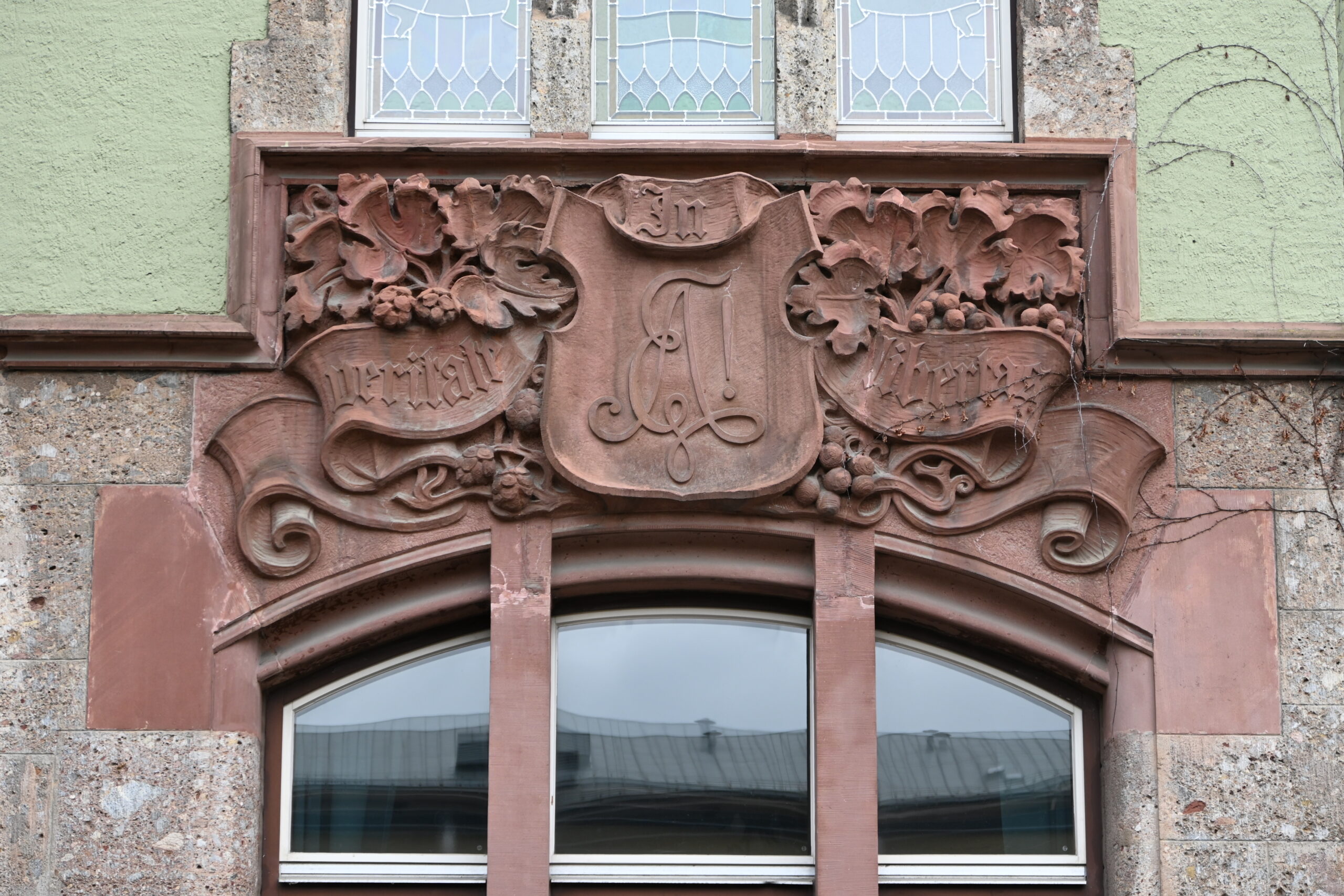
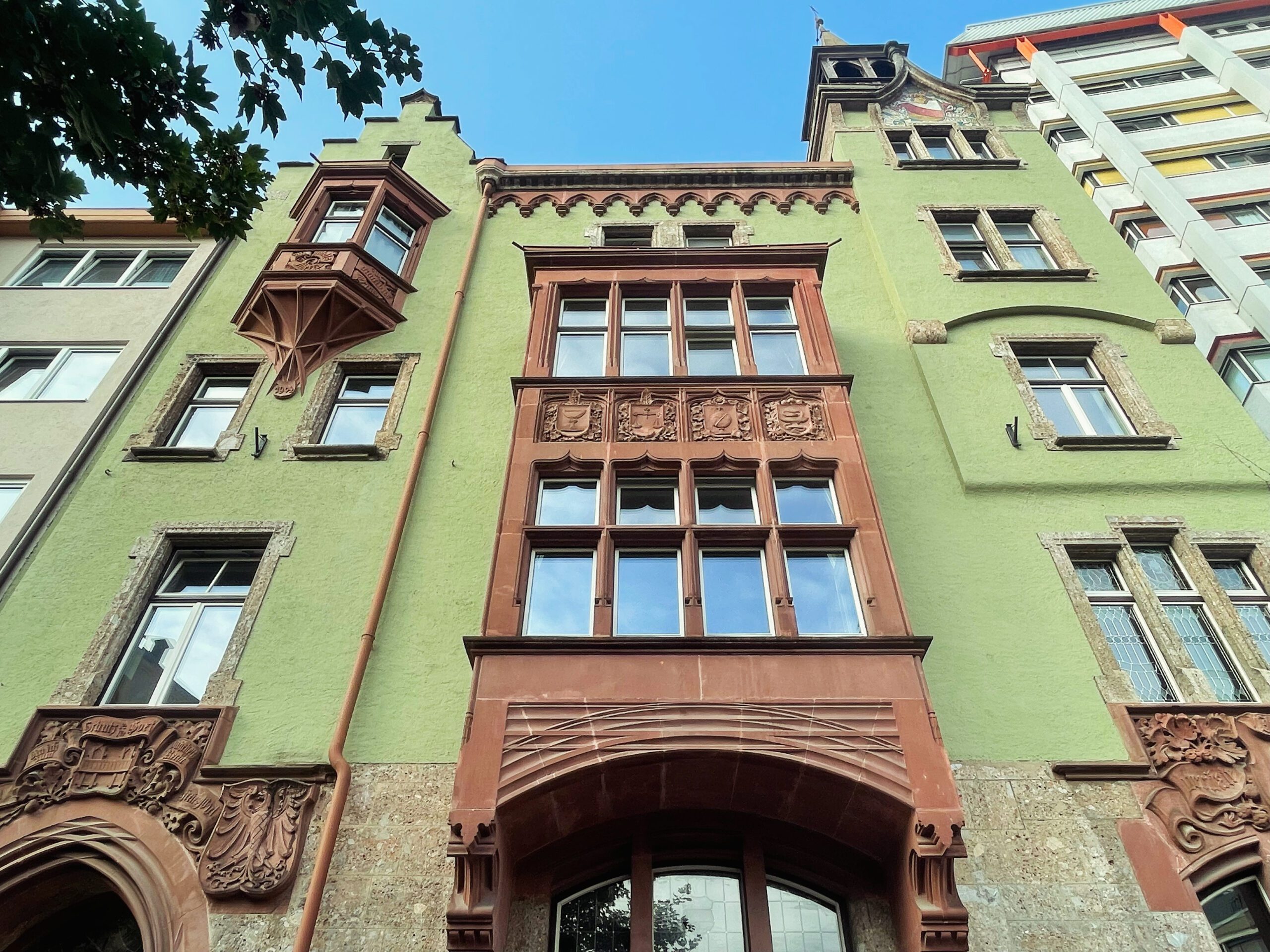
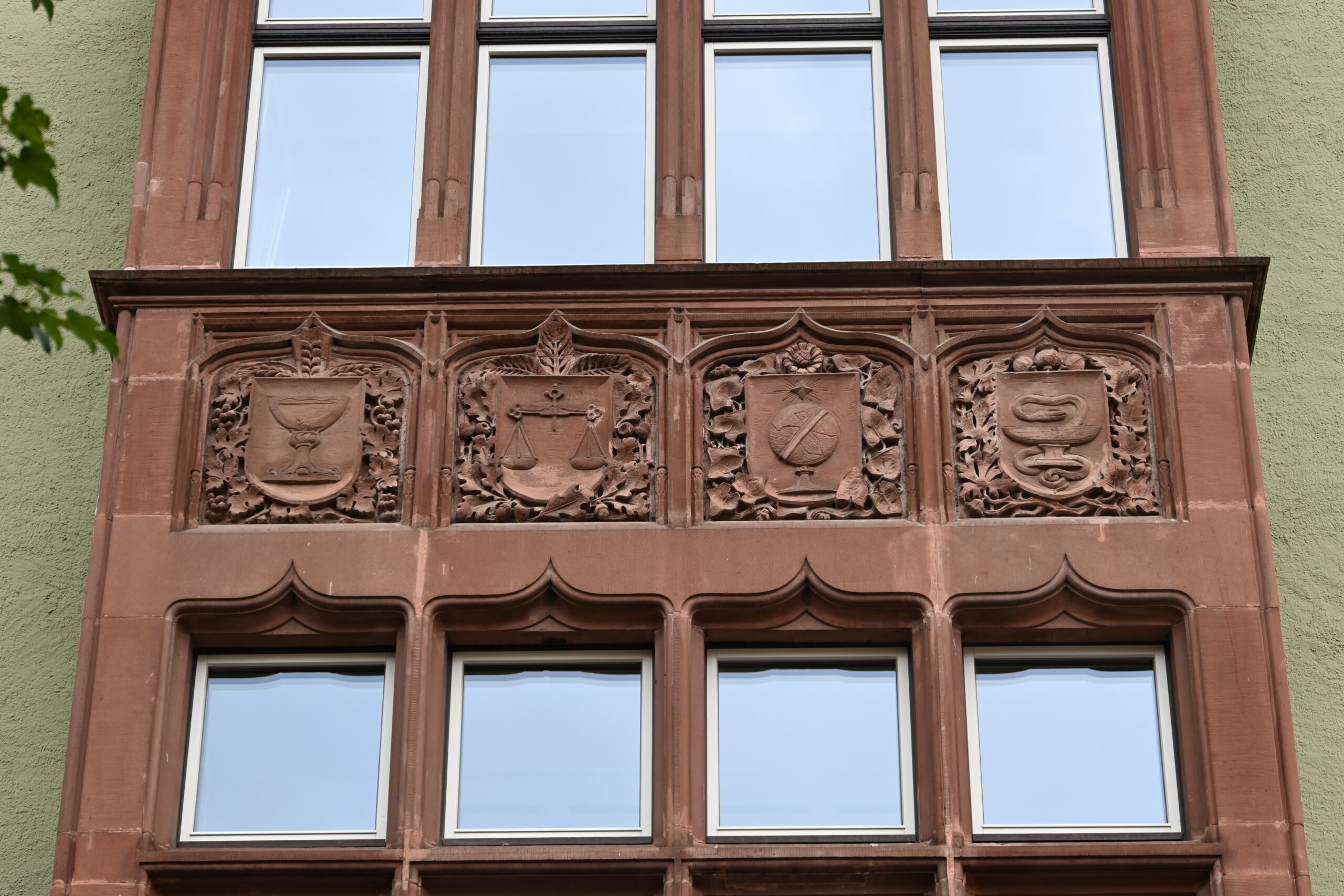
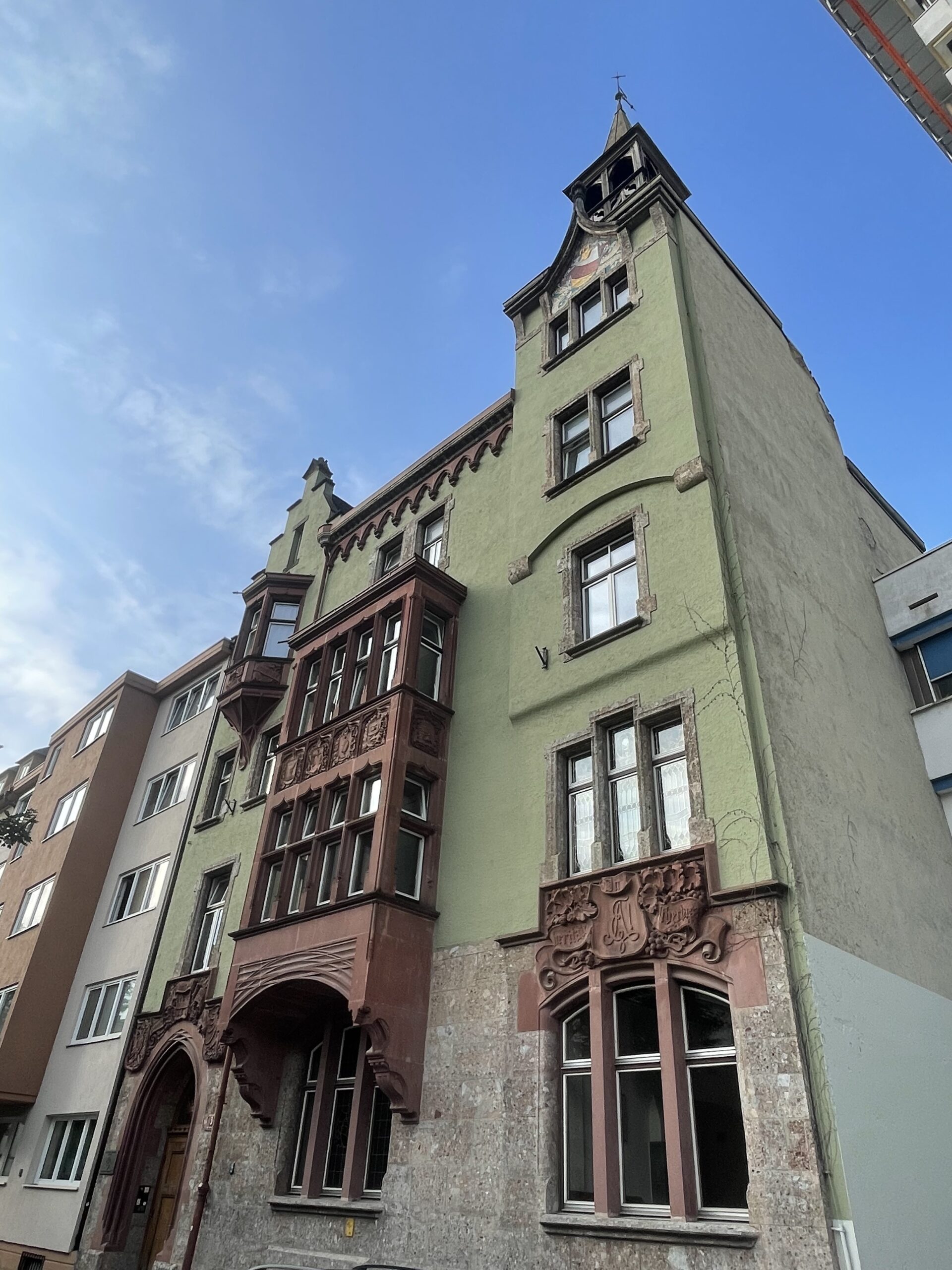
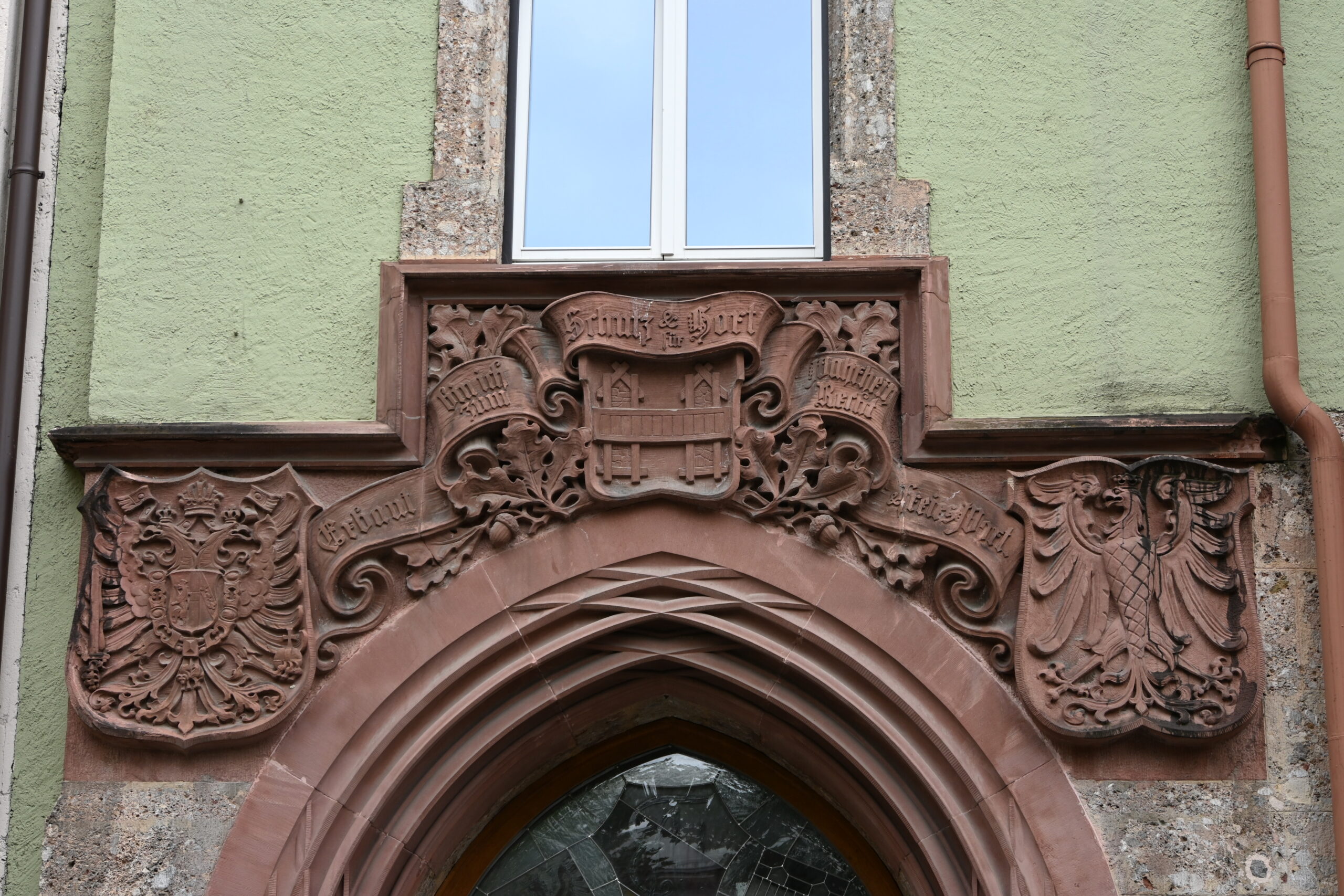
The narrow building with its striking façade on Josef‑Hirn‑Straße houses Innsbruck’s largest student fraternity, Austria. Next to the entrance, a bronze plaque commemorates the fraternity’s founding on 9 June 1864 and bears its motto “In Veritate Libertas” (“In truth there is freedom”). This makes Austria one of the oldest of Innsbruck’s many student fraternities, whose often imposing fraternity houses can still be encountered, especially in Wilten and St. Nikolaus. Austria’s own “Bude” (fraternity house), however, is of more recent date. The building was financed and constructed by the members themselves in 1902. Old photographs show that it initially stood alone and was only gradually surrounded by other houses. With its distinguished appearance, turrets, and bay windows, it stands out markedly among the surrounding residential buildings. During the First World War it served as a military hospital. Today, the fraternity house contains several parlours, bars, and rooms for studying and celebrating together.
How did myth-enshrouded student fraternities such as Austria come into being? In the second half of the 19th century, political ambitions were also pursued among students and professors at the University of Innsbruck. Students in particular were supporters of the 1848 revolution, which had turned out rather mild in Innsbruck. Following the relaxation of the Association Act, they banded together in student fraternities modeled after those of their German peers. Although these associations were not state organizations, with few exceptions they certainly had a political background. Catholicism, monarchy, the multi-ethnic state, German nationalism—definitions of the fatherland were diverse within the various student leagues. Unlike the dueling (schlagende) German-nationalist Burschenschaften, which viewed the Austro-Hungarian monarchy as a dusty state entity to be overcome, Austria considered itself loyal to the Emperor and Catholic. The four principles of Austria, which remain valid to this day, are faith (Religio), fatherland (Patria), science/learning (Scientia), and friendship (Amicitia). From the 19th century onwards, Catholic student fraternities formed the connecting link between the church, politics, and the university. Looking at the list of former members of Austria, one finds bishops over the decades as well as top politicians from the conservative camp. Several provincial governors (Landeshauptmänner), mayors of Innsbruck, and Federal Chancellor Julius Raab were members. The antics involving sabers, ribbons, and caps at events and processions may seem ridiculous at first glance to uninitiated observers. The customs, traditions, and practices are certainly antiquated and not to everyone's taste. For outsiders, the mindset of these fraternities is also difficult to fathom and full of contradictions. Members of Austria were involved in the Catholic resistance against National Socialism. Fittingly, the bon mot "Built am I as a shield and refuge for human rights and free speech" is written above the portal. On the other hand, Engelbert Dollfuß and Kurt Schuschnigg—both chancellors of that brief era that would go down in Austrian history as Austrofascism—were also members of Austria.
University City of Innsbruck
1669 is considered the official founding year of one of the most important institutions in Innsbruck's city history. On 15 October, Emperor Leopold I granted the Tyroleans the privilege of „Haller Salzaufschlags“. Diese Steuer auf die begehrte Handelsware aus der hauseigenen Saline machte es möglich, eine Universität zu finanzieren. Die Basis für eine Hochschule war zu diesem Zeitpunkt bereits gelegt. Die Universität ging aus der Lateinschule hervor, die von den Jesuiten etwas mehr als hundert Jahre zuvor unter Ferdinand I. gegründet worden war. Der Schwerpunkt am Gymnasium lag auf der klassischen humanistischen Bildung. Latein und Griechisch waren notwendige Schwerpunkte im Unterricht, um dem intellektuellen und politischen Diskurs folgen zu können. Wissenschaftliche Bücher und viele andere Schriftstücke wurden in der Frühen Neuzeit noch immer auf Latein verfasst. Auch für höhere Posten im öffentlichen Dienst war Latein Voraussetzung. Die Universität brachte neue Ausbildungsmöglichkeiten nach Innsbruck. Die erste Fakultät, die den Lehrbetrieb aufnahm, war die Philosophie. Theologie, Recht und Medizin folgten kurz darauf. Als Papst Innozenz XI. der Universität 1677 seinen Segen gab, war der Betrieb schon voll angelaufen. Professoren und Studenten verschiedenster Nationalität tummelten sich in Innsbruck. Der Jesuitenorden war mit mehreren Lehrstühlen vertreten, andere Professoren wurden von der Diözese Brixen bestellt. Das führte zu Spannungen innerhalb der Universität, vertraten doch die Jesuiten vor allem die Interessen des Landesfürsten und Monarchen, während die Professoren der Diözese die politischen Interessen des Bischofs wahren wollten. Von einer Trennung von Staat, Kirche und Wissenschaft war man in dieser frühen Phase der Aufklärung noch weit entfernt. Dabei ging es um Posten, Macht, Geld und Einfluss, nicht nur innerhalb der Stadt.
Ein Studium dauerte für gewöhnlich sieben Jahre, bevor sich der Absolvent als Zeichen seines Status als Doktor einen Ring über den Finger streifen durfte. In den ersten beiden Jahren musste jeder Student der Philosophie widmen, bevor er sich für ein Gebiet entschied. Zum geisteswissenschaftlichen Unterricht kamen Kirchendienste, Theateraufführungen, Musizieren und praktische Dinge wie Fechten und Reiten, die im Leben eines gebildeten jungen Mannes nicht fehlen durften. Die Universität war aber mehr als ein Bildungsinstitut. 1665 hatte Innsbruck den Rang einer Residenzstadt verloren und damit an Prestige und Glanz verloren. Der Universitätsbetrieb machte diese Degradierung etwas wett, blieb die Aristokratie so zumindest in Form von Studenten erhalten. Studenten und Professoren veränderten das soziale Gefüge der Stadt. Im ersten Jahrzehnt nach der Gründung lehrten knapp 50 unterschiedliche Intellektuelle aus aller Herren Länder Philosophie in Innsbruck vor über 300 Studenten. Bei gesellschaftlichen Anlässen wie Prozessionen stachen Abordnungen wie die Congregation of the Blessed Virgin, die sich aus Mitgliedern der jesuitisch geprägten Universität speiste, hervor. Die Professoren pflegten in ihren je nach Fachgebiet verschiedenfarbigen Samtmänteln aufzutreten, die Studenten mit den Schwertern, die sie tragen durften. Die Akademiker sprachen auch auf Deutsch anders als die einheimische Bevölkerung, offizielles wurde ohnehin meist auf Latein erledigt. Work hard, play hard galt auch damals als Motto. Der von den Professoren streng überwachte studentische Alltag in Aula und den Hörsälen wurde von einem bunten Mix aus feuchtfröhlicher Abendunterhaltung, Ausflügen in die Umgebung Innsbrucks, Musizieren, kirchlichen Prozessionen und Theateraufführungen aufgelockert. Die jungen Männer aus besserem Hause traten, anders als die streng und sittlich gekleideten Einwohner Innsbrucks, bunt und keck nach der Art mittelalterlicher Gecken in Erscheinung. Sie sprachen in einer Art und Weise miteinander, die Uneingeweihten als vollkommen lächerlich erscheinen musste.
Bei den Studenten handelte es sich trotz ihres gesellschaftlichen Ranges häufig genug nicht um strebsame Musterschüler, sondern um junge Burschen, die einen gewissen Lebensstil und Status gewohnt waren. Um den jungen Eliten Herr zu werden, bedurfte es eines eigenen Rechtssystems. Studenten unterlagen bis zu einem gewissen Grad dem Universitätsrecht, das vom Stadtrecht losgelöst war. Nur für die Blutgerichtsbarkeit musste die Landesregierung angerufen werden. Das schaffte ein diffuses und oft widersprüchliches System, in dem ein Teil der Gesellschaft zumindest in manchen Situationen etwas machen durfte, was einem anderen Teil verboten war. Zusammentreffen privilegierter Jugendlicher mit Bürgern, Dienstboten und Handwerkern lief nicht immer reibungsfrei ab. Die Upper-Class-Teenager waren es gewohnt, Waffen zu tragen und auch zu benutzen. Ehrverletzungen konnten, ähnlich wie beim Militär, auch in studentischen Kreisen zu Duellen führen. Besonders in Paarung mit Alkohol waren Ausschreitungen nicht ungewöhnlich. So begaben sich im Januar 1674 „nit allein zu nächtlicher Zeit sich Ungelegenheiten, Rumores und ungereimte Handlungen“ und es wurden „Studenten der Universität angetroffen, die allerlei verbotene Waffen wie Feuerrohr, Pistolen, Terzerol, Stilett, Säbel, Messer…“ bei sich hatten. Studenten war es zum Beispiel offiziell auch verboten, über den Durst zu trinken. Geschah dies doch in einer der Wirtschaften Innsbrucks, so wurde der junge Delinquent ermahnt. Konnte oder wollte er die Rechnung nicht begleichen, konnte der geschädigte Wirt bei Gericht keine Anzeige einbringen, da übermäßiger der Ausschank alkoholischer Getränke an die Studentenschaft verboten war. Um das Recht durchzusetzen, stellte das Rektorat eine eigene Truppe aus. Die Scharwache war mit Hellebarden bewaffnet und sollte die Rumours the students as much as possible. Six men were on armed duty day and night to maintain order. The costs were shared between the city of Innsbruck and the university. There was also a separate Carcer, um Übeltäter bei Wasser und Brot zu verwahren. Freiheitsentzug, Geldbußen und sogar Landesverweise konnten von der Universität ausgesprochen werden.
Throughout its history, the university was also a political institution and always a mirror of the prevailing spirit of the age. From the mid‑18th century onward, it served to educate loyal, Catholic civil servants for the state. The name Leopold‑Franzens University refers to the emperors Leopold and Francis, under whom the university was founded and later re-established. Twice, the university was downgraded to a lyceum or abolished altogether. Emperor Joseph II closed it, as did the Bavarian administration during the Napoleonic Wars. The Jesuit-influenced students and professors were viewed with suspicion and were excluded from the education system. Emperor Francis I, who during the Restoration again adhered more closely to the traditionally Catholic line of the Habsburgs, re-founded the university in 1826. Nevertheless, the university remained under observation even within Metternich’s police state. During the pre‑March period (Vormärz), nationalist and liberal forces were regarded with suspicion. The secret state police were present not only in lecture halls but also within student circles, in order to suppress potentially subversive ideas among young agitators at an early stage. Industrialization and the accompanying new economic, political, and social rules also transformed university life. In keeping with the spirit of the age, the inaugural lecture by the dean of the Faculty of Philosophy, Prof. Dr. Joachim Suppan (1794–1864), addressed a practical problem in physics so that “a more precise knowledge of the highly important and useful invention of the steam engine might also be achieved for domestic industry, where it has hitherto found no application.” The fact that Suppan, in addition to his degrees in philosophy and mathematics, was also an ordained priest illustrates the influence the Church still exerted on education in the 19th century. How closely the university remained connected to state authority as well as to the Church is shown by Suppan’s concluding admonition to the students to “one day render beneficial service to the fatherland through knowledge and virtue.” The national conflicts of the late Habsburg monarchy were likewise reflected in the university’s history. The 19th century was the age of associations—in the case of the university, student fraternities. In Innsbruck, conflicts between German-speaking and Italian-speaking students repeatedly caused tensions, reaching their climax in the Fatti di Innsbruck. Students with German nationalist leanings continued to play a major role at the university thereafter. Many of these young men had grown up in the Habsburg Empire and had served in the First World War. The ponderous parliamentary Republic of Austria appealed less to many young academics than the new political movements that likewise emerged during this period. Male elites were suddenly no longer among themselves alone. Women and sons of craftsmen had long been barred from studying at the university; now it at least became theoretically possible to advance socially through education. Five years after the founding of the Republic, the university celebrated its first female Doctor of Law. The press reported:
“This coming Saturday, Miss Mitzi Fischer will be awarded the degree of Doctor of Law at the University of Innsbruck. Miss Fischer is a native of Vienna. She also completed her secondary education in Vienna. After her matriculation examination, she pursued the study of law at the University of Innsbruck. The future doctor passed all examinations with distinction and would therefore, according to former custom, have to be promoted sub auspiciis imperatoris. In any case, Miss Fischer is the first woman to earn the doctoral degree in law at the University of Innsbruck.”
The enthusiasm of the young men—some of whom had returned from the fronts of the First World War—was partly directed toward fascist Italy, perceived as modern and dynamic, and later toward National Socialist Germany, both of which upheld traditional role models. With the Anschluss to the German Reich in 1938, the university was renamed once again. After the war, the German Alpine University became once more the Leopold‑Franzens University. The relative calm with which Innsbruck’s students behaved in 1968 was striking, much as it had been in 1848. While students in other European cities were the driving force of change, Innsbruck remained unruffled. In Paris, paving stones were thrown; in Innsbruck, boycotts and sit-ins sufficed. Although there were individual groups in the late 1960s and 1970s—such as the Communist Group Innsbruck, the Committee for Solidarity with Vietnam, the socialist VSStÖ, or the liberal‑Catholic Action within the Austrian National Union of Students—no mass movement emerged. The vast majority of students came from the upper classes and had completed their secondary education at Catholic-oriented grammar schools. Beethoven’s old observation that “as long as the Austrian still has his brown beer and sausages, he will not revolt” proved true. Only a few students could be inspired by solidarity with Vietnam, Mao Zedong, or Fidel Castro. Who would risk their own career in a country dominated by the trinity of the Tiroler Tageszeitung, Bishop Paulus Rusch, and a provincial parliament with an absolute ÖVP majority? Those who nevertheless dared to distribute rebellious leaflets or leftist literature had to reckon with media defamation, reprimands by the rectorate, or even visits from state authorities. Professors were seldom criticized, many of them still exuding in the 20th century the aloofness and unapproachable aura of Early Modern times, or making little effort to conceal their political convictions. More frequently criticized was the inadequate equipment of the modest lecture halls, given the constantly growing number of students. The great transformation of Austrian universities was not fought for but voted for. Under Federal Chancellor Bruno Kreisky, tuition fees were abolished. Education became attainable and conceivable for a larger number of young people. As a result, the number of students at Austrian universities rose from around 50,000 in 1968 to more than 73,000 by 1974.
Despite all adversities and curiosities over the centuries, the University of Innsbruck has, since its earliest days, generally enjoyed an excellent reputation. In the 20th and 21st centuries, faculty and students repeatedly achieved internationally acclaimed research results. Victor Franz Hess was awarded the Nobel Prize in Physics for his work on cosmic radiation. Quantum physicist Anton Zeilinger was also associated with the University of Innsbruck, though not at the time of his award in 2022. Professors Fritz Pregl, Adolf Windaus, and Hans Fischer likewise received the Nobel Prize in Chemistry, though none of them were active in Innsbruck at the time. The university hospital has likewise delivered outstanding achievements in both research and education, as well as in the daily medical care of the city, and is considered one of Innsbruck’s flagship institutions. The university is of great importance to the city not only intellectually and economically. Around 30,000 students populate and shape life between the Nordkette mountain range and the Patscherkofel.
The year 1848 and its consequences
The year 1848 occupies a mythical place in European history. Innsbruck was not one of the hotspots like Paris, Vienna, Budapest, Milan or Berlin, but even in the “Holy Land” of Tyrol the revolutionary year left its mark. In contrast to the rural surroundings, an enlightened educated bourgeoisie had developed in Innsbruck. Enlightened people no longer wanted to be subjects of a monarch or territorial prince, but citizens with rights and duties in relation to a modern state. Students and members of the liberal professions demanded political participation, freedom of the press and civil rights. Workers demanded better wages and working conditions. Particularly radical liberals and nationalists even questioned the absolute authority of the Church. In March 1848 this socially and politically highly explosive mixture erupted in uprisings and street fighting in many cities. In Innsbruck, some students and professors celebrated the newly granted freedom of the press with a torchlight procession. On the whole, however, the revolution proceeded quietly in the rather leisurely Tyrol. To speak of a spontaneous outburst of emotion or even a revolution would already be an exaggeration: the date of the procession was postponed from 20 to 21 March because of bad weather. There were hardly any anti-Habsburg riots or violent incidents; a stray stone thrown into a Jesuit window was one of the highlights of the Alpine version of the Revolution of 1848. The students even supported the city magistrate in maintaining public order, thereby demonstrating their gratitude to the monarch for the newly granted freedoms and their loyalty.
The initial enthusiasm for change among the bourgeois elites was soon replaced in Innsbruck by a surge of German-national patriotism. On April 6, 1848, the governor of Tyrol led a ceremonial procession in which the German flag was displayed. A German tricolour was also hoisted on the city tower. While students, workers, liberal-national citizens, republicans, supporters of a constitutional monarchy, and Catholic conservatives could not agree on social issues such as press freedom, they shared a common hostility toward the Italian independence movement, which had spread across northern Italy from Piedmont and Milan. Innsbruck students and riflemen, with the support of the imperial army leadership, marched into the Trentino to suppress unrest and uprisings at an early stage. Notable members of this corps included the already elderly Father Haspinger, who had fought alongside Andreas Hofer in 1809, and Adolf Pichler. Johann Nepomuk Mahl-Schedl, a wealthy owner of Büchsenhausen Castle, even equipped his own company and marched over the Brenner Pass to secure the border. However, the war did not remain confined to the southern borders. Innsbruck itself, as the political and economic center of the multinational crown land of Tyrol and home to many Italian speakers, became an arena of the conflict between nationalities. Combined with ample alcohol consumption, anti-Italian sentiment posed a greater threat to public order than the demand for civil liberties. A dispute between a German-speaking craftsman and an Italian-speaking Ladin escalated to such an extent that it nearly triggered a pogrom against the numerous businesses and inns of Italian-speaking Tyroleans.
The relative calm of Innsbruck suited the imperial court in Vienna, which was under pressure. As unrest in the capital continued after March, Emperor Ferdinand fled to Tyrol in May. According to contemporary press reports, he was enthusiastically welcomed by the population.
"“What is the name of the land to which such an honour falls, what is the people that enjoys such trust in these fateful times? Does the peace and security here rest solely on legend from ancient times, or is there also in the present a foundation on which one can build, which the wind cannot blow away and the storm cannot shake? This Alpine land is called Tyrol, do you like it? Yes, the Tyrolean people alone prove, in the midst of a shaken Europe, reverence and loyalty, courage and strength for their hereditary ruling house, while all around rebellion, contradiction, defiance and demands, often even revolt and upheaval rage; Tyrol alone stands firmly without wavering in custom and obedience, in religion, truth and law, while elsewhere insolence and falsehood, madness and passions prevail …”"
In June, a young Franz Joseph—still not yet emperor—also stopped at the Hofburg on his return from the battlefields of northern Italy instead of traveling directly to Vienna. Innsbruck once again became a royal residence, albeit only for one summer. While blood was shed in Vienna, Milan, and Budapest, the imperial family enjoyed rural Tyrolean life. Ferdinand, Franz Karl, his wife Sophie, and Franz Joseph received guests from foreign courts and were driven by carriage to excursion destinations such as Weiherburg, Stefansbrücke, Kranebitten, and even up to Heiligwasser, and went on hikes. This calm did not last long. Ferdinand, considered no longer fit to rule, handed over power under gentle pressure to Franz Joseph I. In July 1848, the first parliamentary session was held in Vienna, and a constitution came into force. However, the monarchy’s willingness to reform soon waned. The new parliament—the Reichsrat—could not pass binding laws, the emperor never attended it, and he did not understand why a monarchy ordained by God needed such a council.
Nevertheless, liberalization continued, especially in cities. Innsbruck was granted the status of a city with its own statute. Municipal law introduced a form of citizenship tied to property or tax payments, granting certain rights. Local voting rights were extended to adult male citizens. Innsbruck politics came to be dominated by a greater German liberal faction of merchants, traders, industrialists, and innkeepers. On June 2, 1848, the first issue of the liberal, pro-German Innsbrucker Zeitung was published. Conservative readers preferred the Volksblatt für Tirol und Vorarlberg, while moderates read the Bothen für Tirol und Vorarlberg. Press freedom, however, was soon restricted again. Censorship was partially reintroduced, and newspapers were not allowed to write against the provincial government, monarchy, or Church.
"Anyone who, by means of printed matter, incites, instigates or attempts to incite others to take action which would bring about the violent separation of a part from the unified state... of the Austrian Empire... or the general Austrian Imperial Diet or the provincial assemblies of the individual crown lands.... Imperial Diet or the Diet of the individual Crown Lands... violently disrupts... shall be punished with severe imprisonment of two to ten years."
After Innsbruck had officially replaced Meran as the provincial capital in 1849 and had thus finally become the political centre of Tyrol, parties began to form. With the establishment of the Catholic-conservative faction and the liberals, a pair of opposing ideas emerged that would shape politics not only until the First World War. Associations of all kinds as political organisations in advance of parties, and newspapers, formed the lines along which society split in all questions of life from the cradle to the grave. From 1868 onwards, the liberal, greater German-oriented party provided the mayor of the city of Innsbruck. The influence of the Church declined in Innsbruck in contrast to the surrounding municipalities. Individualism, capitalism, nationalism and consumption stepped into the breach. New worlds of work, department stores, theatres, cafés and dance halls did not displace religion entirely even in the city, but the weighting shifted as a result of the civil freedoms won in 1848.
The probably most important legal change of 1848 was the land relief patent. In Innsbruck the clergy, especially Wilten Abbey, owned a large part of the agricultural land. The Church and the nobility were exempt from taxes. In 1848/49 feudal lordship and the relationship of subjection were abolished in Austria. Ground rents, tithes and compulsory labour were thus removed. The landowners received one third of the value of their land from the state within the framework of the reform, one third was regarded as tax relief, and one third of the compensation had to be borne by the peasants themselves. They could pay this amount in instalments over twenty years. The after-effects can still be felt today. The descendants of the peasants who were successful at the time enjoy, through inherited land ownership resulting from the 1848 reforms, the fruits of prosperity and also political influence through land sales for housing, leases and compensation payments by public authorities for infrastructure projects. The landowning nobility of the past had to come to terms with the humiliation of taking up bourgeois occupations. The transition from privilege by birth to privileged status within society through financial means, networks and education often succeeded. Many Innsbruck dynasties of academics have their origins in the decades after 1848.
Life also changed for the broader population. The previously unknown phenomenon of leisure time emerged and, together with disposable income available to a greater number of people, fostered hobbies. Civil organisations and associations—from reading circles to choral societies, fire brigades and sports clubs—were founded. The revolutionary year also manifested itself in the cityscape. Parks such as the English Garden at Ambras Castle or the Hofgarten were no longer reserved exclusively for the aristocracy but served citizens as local recreational areas. In St. Nikolaus the Waltherpark was created as a small oasis of calm. One floor above, the first swimming and bathing facility in Tyrol opened at Büchsenhausen Castle; soon afterwards another bath followed in Dreiheiligen. Excursion inns around Innsbruck flourished. Alongside high-end restaurants and hotels, a scene of taverns emerged in which workers and employees could also afford pleasant evenings with theatre, music and dancing.
1796 - 1866: Vom Herzen Jesu bis Königgrätz
The period between the French Revolution and the Battle of Königgrätz in 1866 was a highly warlike era. Many of the later political attitudes, animosities toward other groups, and the European nationalism of the nineteenth and twentieth centuries—which would also shape the history of Innsbruck—had their roots in the conflicts of this time. The monarchies of Europe, led by the Catholic Habsburgs, declared war on the French Republic. Although revolutionary Paris was far away and no comprehensive press system existed for the dissemination of news, the alleged godlessness of the murderers of Marie Antoinette was effectively spread through pamphlets and sermons from church pulpits. Fear arose that the revolutionary slogan “Liberté, Égalité, Fraternité,” along with its principles, might spread throughout Europe. During the Coalition Wars, a young general named Napoleon Bonaparte advanced across the Alps in 1796 with his Italian army and encountered Austrian troops. This was not merely a war over territory and power—it was a clash of systems. The Grande Armée of revolutionary France confronted the forces of the conservative and Catholic Habsburgs. Tyrolean riflemen (Schützen) actively participated in the fighting, defending the province’s borders against the advancing French. The men were accustomed to handling weapons and were considered skilled marksmen. The historian Ludwig Denk described this in a publication from 1860:
"...The Tyrolean's main passion is shooting. Early on, the father takes his son hunting. It is not uncommon to see boys running around with loaded rifles, climbing high mountains and shooting birds or squirrels..."
The strength of units such as the Hötting Rifle Company, established in 1796, lay not in open field battles but in guerrilla warfare. Moreover, they believed they had a secret weapon against the most advanced army of the time: the Sacred Heart of Jesus. Since 1719, Jesuit missionaries had spread devotion to the Sacred Heart even in the most remote valleys, successfully establishing it as a unifying force in the struggle against pagan customs and Protestantism. Faced with the godless revolutionary French, it seemed only natural that the Sacred Heart would once again—after 1703—watch protectively over the Tyrolean warriors of God. In desperate circumstances, the Tyrolean troops renewed their covenant. Against all odds, the riflemen succeeded in their defensive efforts. The abbot of Stams Abbey petitioned the provincial estates that, henceforth, “the Feast of the Divine Heart of Jesus should be celebrated annually with a solemn church service, if Tyrol were freed from the threat of enemy danger.”
Victory in this battle did not change the outcome of the war against Napoleon’s overwhelming forces, nor did it alter the territorial expansion of Tyrol—while Innsbruck’s population declined. During the turmoil of war, the Habsburg territory had expanded without notable military success—and likely without the help of the Sacred Heart. The archiepiscopal territory of Trentino became part of the crown lands through a territorial settlement known as the Reichsdeputationshauptschluss in the final phase of the Holy Roman Empire before its dissolution in 1803. Innsbruck, however, shrank. Fallen soldiers and war-related economic hardship led to a decline in the population from over 9,500 around 1750 to approximately 8,800 in the early decades of the nineteenth century. While this may seem modest in absolute numbers, the consequences were severe: stagnation in urban life. Young men were missing—as labourers, husbands, and fathers. This wartime recession remains largely underrepresented in the city’s historiography. Perhaps the near absence of Biedermeier architecture in Innsbruck can be seen as a subtle reminder of these difficult years.
After the Napoleonic Wars and the reorganisation of Europe at the Congress of Vienna, Tyrol’s borders remained largely peaceful for around thirty years. This changed with the Italian Risorgimento, the national movement led by Sardinia‑Piedmont and France. In 1848, 1859, and 1866, the so‑called Italian Wars of Unification took place. Over the course of the nineteenth century—at the latest since 1848—a fervent nationalist enthusiasm spread among young men of the upper classes across Europe. Volunteer armies sprang up everywhere. Students and academics formed associations; gymnasts and riflemen alike sought to prove their newfound national identity on the battlefield, supporting official armies against their respective enemies. During this time, Innsbruck served as an important logistical hub as a garrison town. Following the Congress of Vienna, the Tyrolean Jäger Corps became the Imperial and Royal Tyrolean Kaiserjäger Regiment, an elite unit deployed in these conflicts. Volunteer formations such as the Innsbruck Academics and the Stubai Riflemen also fought in Italy. Thousands fell in battle against a coalition consisting of the traditional enemy France, the particularly “godless” Redshirts under Giuseppe Garibaldi, and the emerging Kingdom of Italy, formed at Austria’s expense under the leadership of the Francophile House of Savoy from Piedmont. The media further inflamed sentiment behind the front lines. The Innsbrucker Zeitung preached loyalty to the emperor and a Greater German‑Tyrolean nationalism, railed against Italians and the French, and celebrated the bravery of Tyrolean soldiers. One report stated:
“The strong occupation of the heights at the exit of the Valsugana near Primolano and Le Tezze has often given the Innsbruck Academics I and the Stubai riflemen cause to undertake voluntary excursions against Le Tezze, Fonzago, and Fastro, as well as to the right bank of the Brenta and the heights opposite the small camps of the Sette Comuni… On the 19th, the Stubai riflemen had already struck down several enemies when they ventured down for the first time, creeping up on them…”
Probably the most famous battle of the Wars of unification fand in Solferino 1859 in der Nähe des Gardasees statt. Entsetzt vom blutigen Geschehen entschloss sich Henry Durant das Rote Kreuz zu gründen. Der Schriftsteller Joseph Roth beschrieb das Geschehen auf den ersten Seiten seines Romans Radetzkymarsch.
"In the battle of Solferino, he (note: Lieutenant Trotta) commanded a platoon as an infantry lieutenant. The battle had been going on for half an hour. Three paces in front of him he saw the white backs of his soldiers. The first row of his platoon was kneeling, the second was standing. Everyone was cheerful and certain of victory. They had eaten copiously and drunk brandy at the expense and in honour of the emperor, who had been in the field since yesterday. Here and there one fell out of line."
The year 1866 proved particularly catastrophic for the Austrian Empire. In Italy, Venetia and Lombardy were lost. In the north, the Habsburg army suffered a devastating defeat at the Battle of Königgrätz. After this short “brother’s war,” Prussia took over leadership of the German Confederation from the Habsburgs. Austria’s reorientation toward the east meant that Innsbruck definitively became a city on the western periphery of the empire. This shift was accompanied by a resurgence of nationalist ideas, particularly among Innsbruck’s liberal upper bourgeoisie. Support for the “Greater German solution”—a united state with the German Empire rather than the Austro‑Hungarian Monarchy—was especially strong. The extent to which this German Question divided the city became apparent more than thirty years later, when the Innsbruck city council proposed naming a street after Otto von Bismarck. While conservative loyalists reacted with outrage, the liberal Greater German faction around Mayor Wilhelm Greil welcomed the idea. After the Second World War, the defeat at Königgrätz supported Austria’s narrative of being the first victim of National Socialism, as it had already been excluded from a unified German state in 1866.
To this day, the conflicts at Tyrol’s southern borders continue to shape tradition and the cityscape. The Sacred Heart celebrations were long marked by great pomp and, especially in the nineteenth and early twentieth centuries, developed into a volatile mixture of superstition, Catholicism, and ethnic nationalism directed against French and Italian influences. Countless soldiers continued to entrust their fate to the Sacred Heart even amidst the shellfire of the First World War. Alongside Cranach’s Madonna of Mercy, the flaming Sacred Heart remains one of the most popular Christian motifs in Tyrol and adorns the façades of countless buildings. With sites such as the Tummelplatz, the Pradl Military Cemetery, and the Kaiserjäger Museum on Bergisel, Innsbruck preserves several places of remembrance for these bloody conflicts, in which many of its residents marched off to war and never returned.
The First World War
An Innsbruck student nearly changed the course of world history instead of Gavrilo Princip. In 1913, the young man boasted to a waitress about his plans to shoot the heir to the throne, but he was arrested before he could carry them out. Only when the world-changing shots were actually fired in Sarajevo a year later did an article appear in the Innsbrucker Nachrichten on June 30 about the events. The consequences that the First World War, which subsequently broke out, would have for the world and for people's everyday lives could not yet be foreseen after the assassination of Franz Ferdinand on June 28. Two days after the murder of the Habsburg heir in Sarajevo, readers in Innsbruck were already reading prophetic words in their newspaper: “We have arrived at a turning point – perhaps the turning point – in the destiny of this empire.” In Innsbruck, too, enthusiasm for war was widespread in 1914. Driven by the slogan of the time, “God, Emperor, and Fatherland,” the vast majority of people unanimously welcomed the attack on Serbia. Politicians, the clergy, and the press fuelled the general jubilation. Particularly “deserving” in promoting the war were the two theologians Joseph Seeber (1856–1919) and Anton Müllner, known as Brother Willram (1870–1919), who, through their sermons and writings such as The Bloody Year, elevated the war into a crusade against France and Italy. In addition to the imperial proclamation To My Peoples, which appeared throughout the media of the Empire, the Innsbrucker Nachrichten published an article on July 29, the day after Austria-Hungary declared war on Serbia, about Prince Eugene's capture of Belgrade in 1717. The tone in the media was celebratory, although not entirely without dark forebodings of what was to come.
"The Emperor's appeal to his people will be deeply felt. The internal strife has been silenced and the speculations of our enemies about unrest and similar things have been miserably put to shame. Above all, the Germans stand by the Emperor and the Empire in their old and well-tried loyalty: this time, too, they are ready to stand up for dynasty and fatherland with their blood. We are facing difficult days; no one can even guess what fate will bring us, what it will bring to Europe, what it will bring to the world. We can only trust with our old Emperor in our strength and in God and cherish the confidence that, if we find unity and stick together, we must be granted victory, for we did not want war and our cause is that of justice!"
Many Innsbruck residents volunteered for the campaign against Serbia, which was believed to be a matter of only a few weeks or months. So many volunteers poured into Innsbruck from outside the city to report to the recruitment commissions that the city was almost bursting at the seams. No one could imagine how differently things would turn out. After the first battles in distant Galicia, it became clear that this would not be over within a few months. The Imperial Riflemen (Kaiserjäger) and other Tyrolean troops were effectively sacrificed. Poor equipment, inadequate supplies, and the catastrophic leadership of the High Command under Conrad von Hötzendorf led thousands either to their deaths or into captivity, where hunger, abuse, and forced labour awaited them. In 1915, Italy entered the war on the side of France and Britain. Under the infamous secret Treaty of London, the young kingdom had been promised generous territorial gains in return for supporting the Entente against Germany and Austria. On May 23, the former ally declared war on the Habsburg Empire. Until regular troops could be transferred from the Eastern Front, regional defence depended on the Standschützen, a force consisting of men under 21, over 42, or those deemed unfit for regular military service. Correspondingly, casualties were high. Fighting in the mountain war stretched from the Ortler in the west across the northern shore of Lake Garda to the Sexten Dolomites. Innsbruck itself was not directly affected by military operations. At the very least, however, the sounds of war could be heard in the provincial capital, as reported in the newspaper of July 7, 1915:
“Soon after the Italians commenced hostilities, cannon fire could clearly be heard in the region of the Serles peak, coming from one of the battlefields in southern Tyrol, probably the Vielgereut plateau. In recent days, the sound of artillery fire has also undoubtedly been detected in Innsbruck itself and in the northeastern parts of the city — individual powerful blasts, dull rather than rolling and resonant, echoing across the Brenner Pass. There can be no mistake. In Innsbruck itself, the thunder of the guns is more difficult to detect because of the noise of the city, but on one occasion, around 9 p.m., when there was some degree of quiet, this unmistakable thunder, originating from our mortars, was clearly heard.”
Although the front was far away, the war increasingly penetrated civilian life. This total involvement of society in warfare was a new phenomenon. The mass mobilization of a large proportion of the working male population brought many businesses to a complete standstill. Shop shelves remained empty, public transport services ceased, and craftsmen and labourers were called up for military service. Companies still able to operate were subordinated to the wartime economy. By the “Hunger Winter” of 1917, Innsbruck’s economy had almost completely collapsed. Food, coal, and firewood were in short supply, and hunger and cold became bitter enemies of women, children, the wounded, and those unfit for military service. During the final years of the war, provisions were distributed through ration cards. The basic weekly allowance per person amounted to 500 grams of meat, 60 grams of butter, and 2 kilograms of potatoes. Archive photographs show long queues of desperate and hungry people outside food shops. Protests and strikes repeatedly broke out. Politicians, trade unionists, workers, and returning soldiers saw an opportunity for change. Under the slogan “Peace, Bread, and Suffrage,” parties of many different political backgrounds united in opposition to the war. The cityscape also changed. Barracks were erected in Höttinger Au to house prisoners of war. Wounded soldiers arrived in such large numbers that civilian buildings, including the university library then under construction and Ambras Castle, were converted into military hospitals. A predecessor of today’s Tram Line 3 was established to transport the wounded from the railway station to the new garrison hospital, today’s Conrad Barracks in Pradl. To cope with the large number of fallen soldiers, the Pradl Military Cemetery was created.
As the war neared its end, the front also drew closer. In February 1918, the Italian air force succeeded in dropping three bombs on Innsbruck. The Neue Freie Presse reported for the first time on the secret Treaty of London, heightening Tyrolean anxiety over the threatened loss of territory south of the Brenner Pass. By then, most people already knew the war was lost and sensed the fate that awaited Tyrol, as this article of October 6, 1918, demonstrates:
“External and internal enemies are gambling today with the land of Andreas Hofer. The latest throw of the dice is even more cruel; never before has a free land been bartered away so disgracefully. The blood of our fathers, sons, and brothers has been shed in vain if this shameful plan becomes reality. The final throw has not yet been made. Therefore, Tyroleans, attend the Tyrolean People’s Assembly in Brixen on October 13, 1918 (next Sunday). German soil must remain German; Tyrolean soil must remain Tyrolean. Tyroleans, decide your own future!”
On November 4, Austria-Hungary and the Kingdom of Italy finally agreed to an armistice. Part of the agreement granted Italy the right to occupy territory of the monarchy. Alarm bells immediately rang among Austria-Hungary’s allies in the German Empire. On the very next day, Bavarian troops entered Innsbruck. Germany was still at war with Italy and feared that the front might shift into North Tyrol, bringing it closer to German territory. Fortunately for Innsbruck and the surrounding region, Germany also capitulated one week later on November 11. As a result, major military engagements between regular armies were avoided.
Nevertheless, Innsbruck remained in danger. Massive convoys of military vehicles, trains packed with soldiers, and thousands of exhausted troops making their way home on foot passed through the city. Anyone who could jumped onto overcrowded trains or military vehicles to leave the front behind and return home. In November 1918 alone, more than 270 soldiers lost their lives during these reckless attempts or had to be admitted to one of the city’s hospitals. The city not only had to maintain order among its own citizens and ensure food supplies but also protect itself against looting. To preserve public order, the Tyrolean National Council established a citizens’ militia on November 5 composed of pupils, students, workers, and ordinary citizens. On November 23, 1918, Italian troops occupied the city and its surroundings. More than 80,000 Italian soldiers were stationed in Tyrol, around 5,000 of whom required accommodation in the starving and destitute city. Schools were turned into barracks. Mayor Greil’s conciliatory appeal to surrender the city peacefully succeeded. There were isolated disturbances, food riots, and incidents of looting, but there were no armed clashes with the occupation troops and no Bolshevik revolution such as the one that occurred in Munich.
The consequences of the First World War for Innsbruck’s population were devastating. More than 1,200 people lost their lives on battlefields or in military hospitals, while approximately 600 were wounded. Memorials to the First World War and its victims can be found throughout Innsbruck, particularly at churches and cemeteries. The Kaiserjäger Museum on Bergisel displays uniforms, weapons, and photographs from the war. The theologians Anton Müllner and Josef Seeber have streets named after them in Innsbruck. A street was also named after Archduke Eugene, commander-in-chief of the Austro-Hungarian Army on the Southern Front. A monument to the unsuccessful military leader stands in front of the Hofgarten. The eastern section of the Amras Military Cemetery commemorates the Italian occupation.
The Bocksiedlung and Austrofascism
Political violence, alongside hunger and a severe housing shortage, shaped Austria throughout the 1920s and 1930s. The two major mass parties of the young republic, the Social Democrats and the Christian Socials, regarded each other with hostility. Both parties established paramilitary organizations to enforce their political agendas on the streets if necessary. The Republikanischer Schutzbund on the Social Democratic side and various Christian Social or even monarchist-oriented Heimwehr groups, which for simplicity may be grouped under this collective term, watched one another like opposing sides in a civil war. Many politicians and functionaries on both sides had fought on the front during the war and had become deeply militarized as a result. The Tyrolean Heimwehr enjoyed superior infrastructure and political connections due to the support of the Catholic Church. On November 12, 1928, the tenth anniversary of the founding of the Republic, 18,000 Heimwehr members marched through the city in the first nationwide Heimwehr rally, demonstrating their strength on what was the most important holiday for Austrian Social Democrats. From 1930 onward, the Nazi Party (NSDAP) also became increasingly visible in public life. It found supporters particularly among students and disillusioned young workers. By 1932, the party already had 2,500 members in Innsbruck. Violent clashes between the hostile political factions occurred repeatedly. The most notorious of these became known as the Hötting Hall Battle (Höttinger Saalschlacht) of May 27, 1932. At that time, Hötting was still independent and not yet part of Innsbruck. The community was inhabited mainly by workers. In this “red” stronghold of Tyrol, National Socialists planned a rally at the Goldener Bär Inn, a traditional meeting place of Social Democrats. This provocation escalated into a fight that left more than thirty people injured and one National Socialist dead. The violence spread across the entire city; even in the hospital, the injured continued fighting each other. Only the intervention of the gendarmerie and the army succeeded in separating the opposing sides.
After these years that resembled a civil war, the Christian Social Party prevailed in 1933 under Chancellor Engelbert Dollfuß (1892–1934). His goal was the establishment of the so-called Austrian Corporate State (Österreichischer Ständestaat), today better known under the term Austrofascism. The entire state apparatus was to be unified under the Fatherland Front (Vaterländische Front), modeled on Mussolini’s fascism in Italy: anti-socialist, authoritarian, socially conservative, anti-democratic, antisemitic, and militarized. Quite a few people welcomed the replacement of parliament and the multi-party system by a strong leader who promised peace and order. In Innsbruck, unlike in many Austrian cities where this political upheaval was at times accompanied by bloodshed, no significant fighting occurred. On 15 March, the headquarters of the Tyrolean Social Democratic Workers' Party (Sozialdemokratische Arbeiterpartei Tirol) in the Hotel Sonne was cleared out. The leader of the Republican Protection League (Republikanischer Schutzbund), Gustav Kuprian, was arrested on charges of high treason, and the individual units of the Schutzbund were disarmed. The Tiroler Wochenzeitung was established as the party newspaper. Innsbruck’s municipal council was reduced from forty to twenty-eight members. Instead of being elected through free elections, council members were appointed by the provincial governor. The Social Democrats, who had previously held strong representation, were removed from the city government. Dollfuß was extraordinarily popular in Tyrol, as photographs of the crowded square in front of the Hofburg during one of his speeches in 1933 demonstrate. His policies came closer than any other contemporary system to the traditions of the Habsburg Monarchy. As early as 1931, several Tyrolean mayors had joined forces in an effort to lift the ban on the Habsburg family entering Austria. This policy was supported by the Catholic Church and was even incorporated into the Constitution of 1934: “In the name of God, the Almighty, from whom all law proceeds, the Austrian people receive this Constitution for their Christian, German federal state founded on a corporative basis.” The close relationship with the Church provided the government with access to infrastructure, media organizations, and affiliated institutions. The Fatherland Front, together with its paramilitary units, took harsh action against the despised Socialists. It did not hesitate to employ repression and violence against both individuals and institutions associated with the political opposition. Suspected and actual Socialists, Social Democrats, trade unionists, and Communists were repeatedly arrested. The press was politically controlled and censored, while newspaper articles glorified the idyllic nature of rural life. Large families received financial support. Schools were segregated by gender, and the curricula differed accordingly: domestic work for girls and pre-military training for boys. Cultural policy deliberately distinguished itself from that of the National Socialist and anti-clerical neighbor to the north. Theatre and music were intended to present Austria as the “better and more civilized” German state.
tion Austrofascism, however, brought peace and order only briefly, if at all. On 25 July 1934, a coup attempt by the banned National Socialists took place in Vienna, during which Chancellor Engelbert Dollfuß was killed. Hitler, who had not ordered the attacks, initially distanced himself publicly from the events, helping to suppress the planned overthrow before it could gain momentum. An attempted coup also occurred in Innsbruck. During an effort by a group of National Socialists to seize control of the city, a police officer was shot and killed in Herrengasse. In memory of the murdered Federal Chancellor, who was subsequently elevated to the status of a martyr, the square in front of the theatre, where he had met with Richard Steidl only two weeks earlier, was renamed Dollfuß Square (Dollfußplatz) by “order of the Government Commissioner of the Provincial Capital of Tyrol.” Dollfuß’s successor as head of state was Kurt Schuschnigg (1897–1977), a native Tyrolean. The war veteran, who came from the lower nobility of the former Austro-Hungarian Empire, was a member of the Innsbruck student fraternity Austria. In 1930, Schuschnigg, then a lawyer and member of parliament, founded the Ostmärkische Sturmschar, a Catholic and antisemitic paramilitary organization intended to serve as a counterweight to the more radical Heimwehr groups. As Minister of Education and Minister of Justice, Schuschnigg played a key role in the rightward shift of society under the Corporate State. Among other measures, he reintroduced the death penalty. For the people of Innsbruck, however, little changed under the new Chancellor in terms of everyday hardship. Economically, the Corporate State was unable to reverse the situation during the 1930s. Government investment in major infrastructure projects came to a halt following the economic crisis of 1931. By 1933, the unemployment rate had reached 25 percent. The reduction of social welfare measures that had been introduced at the beginning of the First Republic had dramatic consequences. Long-term unemployed individuals were excluded from receiving social benefits as so-called “Ausgesteuerte” (persons whose entitlement to benefits had expired). Poverty led to rising crime rates, and assaults, robberies, and thefts became commonplace. As in previous decades, housing remained a particularly serious problem. Despite the city's efforts to provide modern housing, many Innsbruck residents still lived in dilapidated dwellings. Private bathrooms or even a separate bedroom for each person were rare exceptions. Since Innsbruck’s rapid growth beginning in the 1880s, housing conditions had remained precarious for a large part of the population. The railway, industrialization, refugees from the German-speaking regions of Italy, and the economic crisis had pushed the city to the limits of its capacity. After Vienna, Innsbruck had the second-highest number of residents per house in Austria. Housing rents were so high that workers often slept in shifts in order to share the costs. Although new apartment blocks and homeless shelters had been built, especially in Pradl, including the Workers’ Residence (Wohnheim für Arbeiter) on Amthorstraße in 1907 and the Hostel (Herberge) on Hunoldstraße, these measures were insufficient to bring the situation under control.
In this climate of social dictatorship and economic hardship, several shantytowns and barrack settlements emerged on the outskirts of the city. They were founded by the excluded, the desperate, and those left behind who could find no place within the system. The former prisoner-of-war camp in Höttinger Au, west of the city, served as emergency accommodation for homeless people. The most famous and notorious inner-city enclave, remembered to this day, was the Bocksiedlung ("Bock Settlement") in the area of present-day Reichenau. Beginning around 1930, several families settled there between the airport then located on the site and the concentration camp that would later be built in Reichenau. According to local legend, Otto and Josefa Rauth were the founders of the settlement after their caravan became stranded there. In the Innsbruck of the Corporate State, having the wrong party affiliation was enough to make affordable housing unattainable. As an openly declared Communist, Rauth possessed what was arguably the most disadvantageous party membership of all. His raft, the Ark Noah (Arche Noah), with which he planned to travel via the Inn and Danube rivers to the Soviet Union, remained moored on the riverbank in front of the Sandwirt Inn (Gasthof Sandwirt) and never actually set sail. Gradually, a settlement developed that existed both physically on the edge of the city and socially on the margins of society. It was run like an independent commune by its unofficial mayor, Johann Bock (1900–1975). He managed everyday life within his sphere of influence in a rough but warm-hearted manner. The air raids of the Second World War further worsened Innsbruck's housing situation and caused the Bocksiedlung to grow. At its peak, it is said to have contained around fifty dwellings. Even the barracks of the Reichenau concentration camp were used as sleeping quarters after the last National Socialists held there had been transferred or released. The Bockala, as the inhabitants were known, had a terrible reputation among the respectable citizens of the rest of the city, and despite later attempts to romanticize or soften its history, that reputation was probably not entirely undeserved. Many, though not all, residents were unemployed or involved in criminal activities. Often, however, they were simply people who had fallen through the cracks of society and found refuge in the Bocksiedlung. As helpful and supportive as the often eccentric residents could be toward one another, physical violence and petty crime were part of everyday life. Excessive alcohol consumption was commonplace. There were no paved roads, no sewage system, no sanitary facilities, and no regular electricity supply. Even access to drinking water remained precarious for a long time, creating a constant risk of disease outbreaks. The dwellings themselves were as diverse as their inhabitants. They included caravans, circus wagons, wooden barracks, corrugated metal huts, brick houses, and concrete buildings. Within the Bocksiedlung, houses and wagons were rented out and sold. With the tacit tolerance of the City of Innsbruck, property rights acquired through long-term occupation even emerged under Johann Bock's leadership. The residents cultivated self-sufficiency gardens and kept livestock. In difficult times, even dogs and cats occasionally appeared on the menu. There were no fixed boundaries to the settlement; in Innsbruck, being a Bockala was as much a social status as it was a place of residence.
The beginning of the end for the Bocksiedlung (“Bock Settlement”) came with the 1964 Olympic Games and a fire that had occurred in the settlement the year before. An urban legend claims that the fire was deliberately set by the municipal authorities in order to accelerate the clearance of the neighborhood and make way for the construction of the Olympic Village (Olympisches Dorf). In 1967, Mayor Alois Lugger and Johann Bock negotiated the future of the settlement and compensation payments from the municipality for its evacuation. According to local accounts, these discussions took place in a rather alcohol-laden atmosphere. Nevertheless, it would take several more years before the settlement effectively came to an end. It was not until 1976 that the last remaining dwellings were forcibly vacated due to unsanitary conditions. Many of the Bockala were relocated to municipal apartments in Pradl, Reichenau, and the newly constructed Olympic Village (O-Dorf). The customs and lifestyle associated with the Bocksiedlung continued there under a new address for several years, contributing in large part to the negative reputation that these neighborhoods still carry today. Less firmly embedded in the collective memory of many Innsbruck residents than the legends of the Bocksiedlung is the interwar period. Yet this era often remains a much greater part of everyday culture than we realize. In churches such as St. Jakob in Defereggen in East Tyrol or the parish church of Fritzens, images depicting Dollfuß as the protector of the Catholic Church can still be seen, more or less without comment. Even today, there are “red” and “black” motorists’ clubs, sports associations, rescue organizations, and Alpine clubs whose roots can be traced back to this period. The history of the Bocksiedlung has been painstakingly reconstructed by the Innsbruck City Archive through numerous interviews and extensive archival research, and was published in a highly readable form in the book: Bocksiedlung. Ein Stück Innsbruck (Bocksiedlung: A Piece of Innsbruck) published by the Innsbruck City Archive. The book provides a valuable account of both the settlement itself and the social realities of Innsbruck in the twentieth century.