Landhausplatz & Tiroler Landhaus
Eduard Wallnöfer Square
Worth knowing
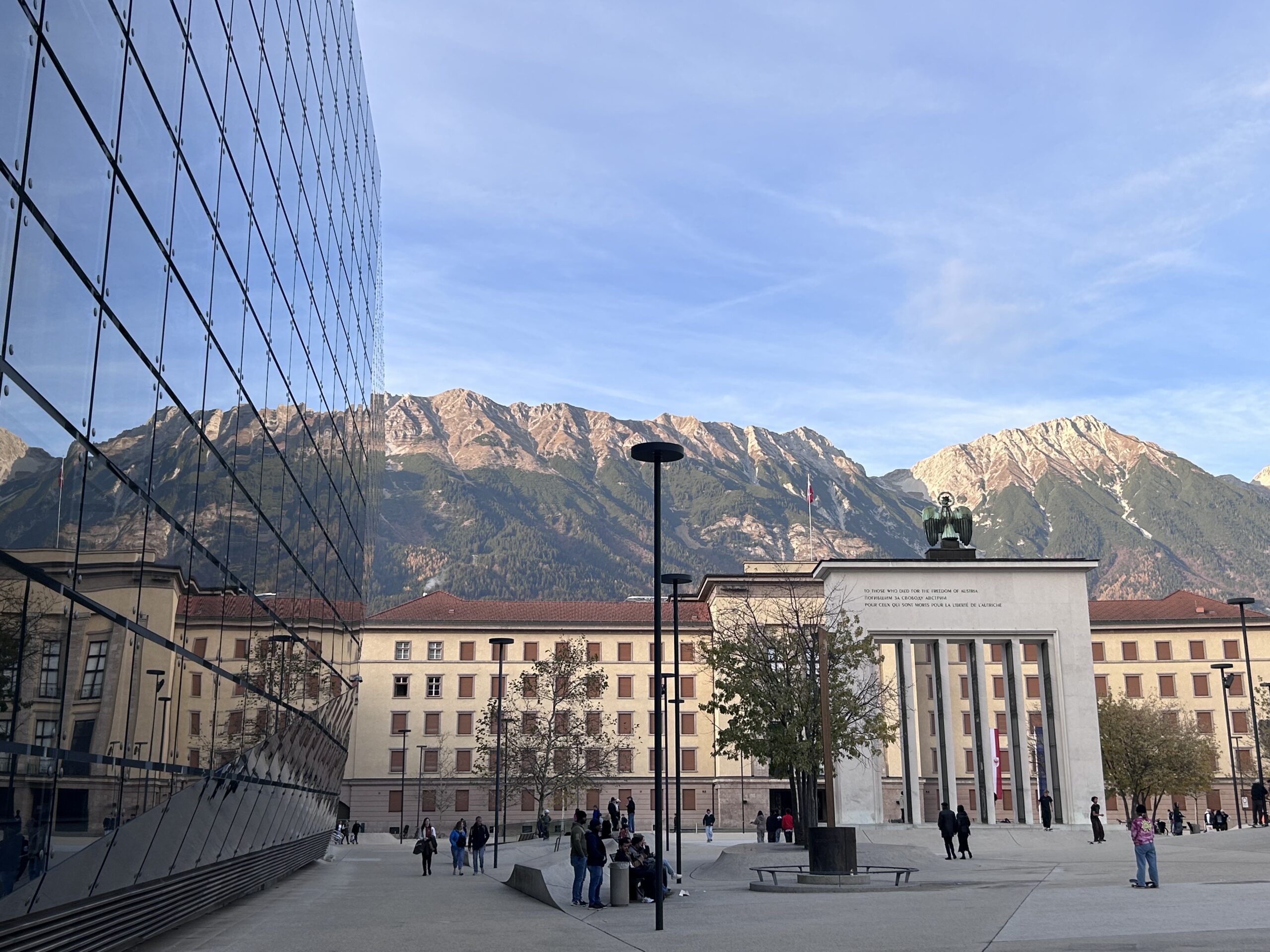
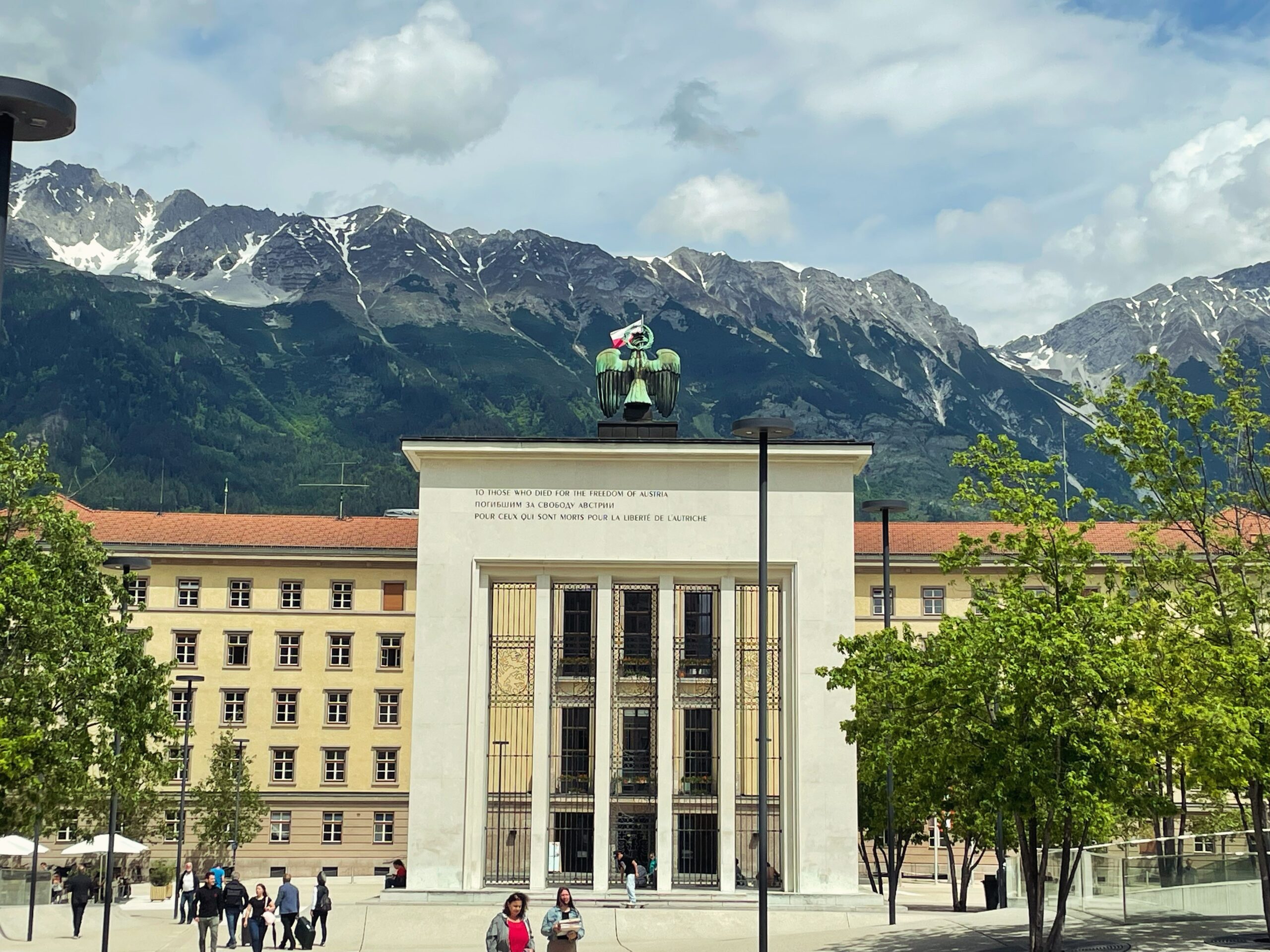
Das Tiroler Landhaus und der Eduard-Wallnöfer-Platz samt dem dazugehörigen „Franzosendenkmal“ are considered by many Innsbruck residents to be the city's biggest building sin. The chapter in Innsbruck's history that it symbolises is also unpleasant. Anyone who compares Landhausplatz before and after 1938 in old photographs will not recognise it. Hardly any other place in Innsbruck has changed so much. Photos from the time before the National Socialist building frenzy show lots of greenery, tall trees and individual buildings such as the Lohnkutscherei und Autovermietung Heinrich Menardi. On the north side of the square, the courtyard of Palais Fugger-Taxis extended as far as Wilhelm-Greil-Straße. The offices of the Tyrolean provincial government were housed here from 1905 to 1938. In the Fuggerhaus was home to the secondary school and the commercial academy. In 1938, the construction of the Reichsstatthalterei under Gauleiter Franz Hofer. The buildings were demolished and the square was completely redesigned and levelled. The new building was to adjoin the old Landhaus to the east in order to demonstrate a transition between the old and new centres of power. The south-eastern part of the Palais Fugger taxis was demolished for it. The buildings between today's Landhaus and the Bismarckplatz, where Lois Welzenbacher's skyscraper towered futuristically over everything, were to make way for a large area for political marches. This space was to be adorned with monuments and sacrificial columns in memory of the Tyroleans who died for National Socialism. The Gauhaus and the square in front of it was to become a symbol of the new ideology, a kind of church for faith in the Führer and the liberation of the German people. In fact, only the northern part of Landhausplatz was redesigned during the war years. The tender was won by the two architects Walter and Ewald Guth. Seen from the front, the shape of the façade is intended to remind the observer of an eagle about to take flight. As was the case with many buildings under the National Socialist regime, the Gauhaus Neoclassicism and modernism blended together. The columns at the entrance complemented the smooth surfaces and symmetrical forms. During the amateurish construction phase, supervised by Hofer himself, there were repeated delays and problems due to the war and the construction work on the blocks of flats for the South Tyrolean optants. What actually remained of the grandiose plans was a dull functional building, which even people in faraway Berlin were not really happy with.
In this Reichsstatthalterei mitten in der Stadt wurden keine Verhöre oder Misshandlungen durchgeführt, dafür war die Zentrale der Gestapo (Anm.: Geheime Staatspolizei im Nationalsozialismus) in Innsbruck mit Sitz in der Herrengasse zuständig. Im heutigen Tiroler Landhaus wurden Verbrechen geplant und Gesetzesbeschlüsse und Befehle aus Berlin umgesetzt. Dass die sterblichen Überreste der Opfer eines Luftangriffes vom 15. Dezember 1943 am heutigen Landhausplatz aufgebahrt wurden zeugt von trauriger Ironie des Schicksals. In einigen Zimmern des Landhauses sind bis heute Symbole der NS-Zeit sichtbar. Wie genau man mit diesen stummen Zeugen des Nationalsozialismus umgehen soll, ist noch immer Inhalt reger Diskussionen. Die Kanzlei von Gauleiter Franz Hofer war lange Zeit das Sitzungszimmer der Tiroler Landesregierung.
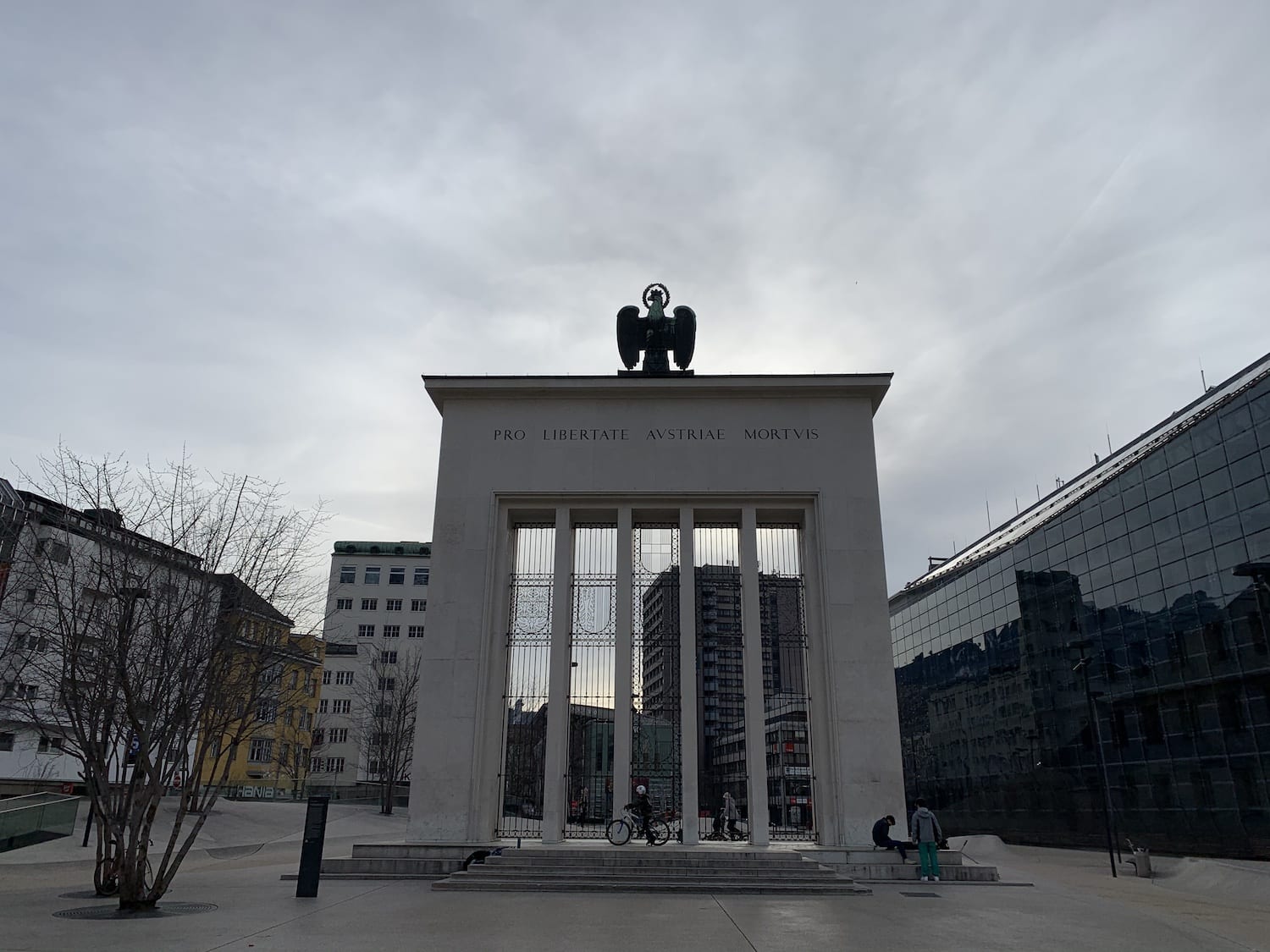
The southern part of Landhausplatz was not designed until 1945. Houses like the Haidenburg residence had been destroyed during the air raids. The contaminated site was redesigned. Dominated by the Eduard Wallnöfer Square from the Liberation Monumentcommissioned by the French occupation in 1946. The monument is intended to represent a more modern version of the nearby Triumphal Gate and commemorate the "Freedom of the Dead of Austria" (Pro Libertate Austriae Mortuis). The commander-in-chief, General Emile Bethouart, refrained from using the French language and thus patronisingly considered the Allies' share in the liberation of Austria to be smaller than it actually was in favour of the Austrian resistance. After the plan to erect a memorial to those who died for National Socialism in 1938, only seven years later the resistance fighters were to be commemorated in the same way as the fallen soldiers.
Although the grille shows the coats of arms of Austria's new federal states, it is hard to deny its similarity to various fascist monuments, not least because of the classicist style and the enthroned eagle with laurel wreath designed by Emmerich Kerle. The erection of the „French monument", as the people of Innsbruck called it, was largely carried out by prisoners of war who were assigned to the construction company carrying out the work. Mayreder, Kraus & Co were made available. In addition to labour, the required raw materials also caused problems in the barren post-war period. A liberation memorial imposed by the occupying power was difficult to sell to the population, especially with the housing shortage that still prevailed in the city after the air raids. In order not to fuel the resentment of the population in the first post-war years over the construction, the French also refrained from a ceremonial inauguration.
In the decades that followed, the entire square eked out a dreary existence without seating. For a long time, Landhausplatz served as a parking area for the increasing traffic in the city centre. Only gradually did it free itself from the post-war stench. An inconspicuous memorial at the southern end of Landhausplatz commemorates the Jewish victims of the pogroms of the Reichskristallnacht from 1938. Menorah was consecrated in June 1997 by the Chief Rabbi of the Jewish Community for Tyrol and Vorarlberg, Chaim Eisenberg.
Anyone crossing Landhausplatz today seems to find a well-planned, lively inner-city fun park for skaters and BMXers. It has had its current appearance since 2011, after the LAAC architecture firm won a tender to redesign the square in 2008. In the first few years after its opening, cycling and skating were strictly forbidden on the barren Landhausplatz with its inviting concrete waves, after the dispute between the state government and skateboarders had already led to heated discussions in the 1990s. However, young people have not been deterred by this to this day and have persevered, conquering the square in front of the seat of the Tyrolean state government for themselves. Currently, the hustle and bustle has been put to an end by less than praiseworthy measures.
Risen from the ruins
Nach Kriegsende kontrollierten US-Truppen für zwei Monate Tirol. Anschließend übernahm die Siegermacht Frankreich die Verwaltung. Den Tirolern blieb die sowjetische Besatzung, die über Ostösterreich hereinbrach, erspart. Besonders in den ersten drei Nachkriegsjahren war der Hunger der größte Feind der Menschen. Der Mai 1945 brachte nicht nur das Kriegsende, sondern auch Schnee. Der Winter 1946/47 ging als besonders kalt und lang in die Tiroler Klimageschichte ein, der Sommer als besonders heiß und trocken. Es kam zu Ernteausfällen von bis zu 50%. Die Versorgungslage war vor allem in der Stadt in der unmittelbaren Nachkriegszeit katastrophal. Die tägliche Nahrungsmittelbeschaffung wurde zur lebensgefährlichen Sorge im Alltag der Innsbrucker. Neben den eigenen Bürgern mussten auch tausende von Displaced PersonsThe Tyrolean government had to feed a large number of people, freed forced labourers and occupying soldiers. To accomplish this task, the Tyrolean provincial government had to rely on outside help. The chairman of the UNRRA (Note: United Nations Relief and Rehabilitation Administration), which supplied war zones with essentials, Fiorello La Guardia counted Austria "to those peoples of the world who are closest to starvation." Milk, bread, eggs, sugar, flour, fat - there was too little of everything. The French occupation was unable to meet the demand for the required kilocalories per capita, as the local population and the emergency services often lacked supplies. Until 1946, they even took goods from the Tyrolean economy.
Die Lebensmittelversorgung erfolgte schon wenige Wochen nach Kriegsende über Lebensmittelkarten. Erwachsene mussten eine Bestätigung des Arbeitsamtes vorlegen, um an diese Karten zu kommen. Die Rationen unterschieden sich je nach Kategorie der Arbeiter. Schwerstarbeiter, Schwangere und stillende Mütter erhielten Lebensmittel im „Wert“ von 2700 Kalorien. Handwerker mit leichten Berufen, Beamte und Freiberufler erhielten 1850 Kilokalorien, Angestellte 1450 Kalorien. Hausfrauen und andere „Normalverbraucher“ konnten nur 1200 Kalorien beziehen. Zusätzlich gab es Initiativen wie Volksküchen oder Ausspeisungen für Schulkinder, die von ausländischen Hilfsorganisationen übernommen wurden. Aus Amerika kamen Carepakete von der Wohlfahrtsorganisation Cooperative for American Remittances to Europe. Many children were sent to foster homes in Switzerland in the summer to regain their strength and put a few extra kilos on their ribs.
However, all these measures were not enough for everyone. Housewives and other "normal consumers" in particular suffered from the low allocations. Despite the risk of being arrested, many Innsbruck residents travelled to the surrounding villages to hoard. Those who had money paid sometimes utopian prices to the farmers. Those who had none had to beg for food. In extreme cases, women whose husbands had been killed, captured or were missing saw no other way out than to prostitute themselves. These women, especially the unfortunate ones who became pregnant, had to endure the worst abuse for themselves and their offspring. Austria was still 30 years away from legalised abortion.
Politicians were largely powerless in the face of this. Even in normal times, it was impossible to pacify all interests. Many decisions between the parliament in Vienna, the Tyrolean provincial parliament and Innsbruck town hall were incomprehensible to the people. While children had to do without fruit and vitamins, some farmers legally distilled profitable schnapps. Official buildings and commercial enterprises were given free rein by the Innsbruck electricity company, while private households were restricted access to electricity at several times of the day from October 1945. The same disadvantage for households compared to businesses applied to the supply of coal. The old rifts between town and country grew wider and more hateful. Innsbruckers accused the surrounding population of deliberately withholding food for the black market. There were robberies, thefts and woodcutting. Transports at the railway station were guarded by armed units. Obtaining food from a camp was both illegal and commonplace. Children and young people roamed the city hungry and took every opportunity to get something to eat or fuel. The first Tyrolean governor Gruber, himself an illegal member of the resistance during the war, understood the situation of the people who rebelled against the system, but was unable to do anything about it. The mayor of Innsbruck, Anton Melzer, also had his hands tied. Not only was it difficult to reconcile the needs of all interest groups, there were repeated cases of corruption and favours to relatives and acquaintances among the civil servants. Gruber's successor in the provincial governor's chair, Alfons Weißgatterer, had to survive several small riots when popular anger was vented and stones were thrown in the direction of the Landhaus. Tiroler Tageszeitung. The paper was founded in 1945 under the administration of the US armed forces for the purposes of democratisation and denazification, but was transferred the following year to Schlüssel GmbH under the management of ÖVP politician Joseph Moser. Thanks to the high circulation and its almost direct influence on the content, the Tyrolean provincial government was able to steer the public mood:
„Are the broken windows that clattered from the country house into the street yesterday suitable arguments to prove our will to rebuild? Shouldn't we remember that economic difficulties have never been resolved by demonstrations and rallies in any country?“
The housing situation was at least as bad. An estimated 30,000 Innsbruck residents were homeless, living in cramped conditions with relatives or in shanty towns such as the former labour camp in Reichenau, the shanty town for displaced persons from the former German territories of Europe, popularly known as the "Ausländerlager", or the "Ausländerlager". Bocksiedlung. Weniges erinnert noch an den desaströsen Zustand, in dem sich Innsbruck nach den Luftangriffen der letzten Kriegsjahre in den ersten Nachkriegsjahren befand. Zehntausende Bürger halfen mit, Schutt und Trümmer von den Straßen zu schaffen. Die Maria-Theresien-Straße, die Museumstraße, das Bahnhofsviertel, Wilten oder die Pradlerstraße wären wohl um einiges ansehnlicher, hätte man nicht die Löcher im Straßenbild schnell stopfen müssen, um so schnell als möglich Wohnraum für die vielen Obdachlosen und Rückkehrer zu schaffen. Ästhetik aber war ein Luxus, den man sich in dieser Situation nicht leisten konnte. Die ausgezehrte Bevölkerung benötigte neuen Wohnraum, um den gesundheitsschädlichen Lebensbedingungen, in denen Großfamilien teils in Einraumwohnungen einquartiert waren, zu entfliehen.
"The emergency situation jeopardises the comfort of the home. It eats away at the roots of joie de vivre. No one suffers more than the woman whose happiness is to see a contented, cosy family circle around her. What a strain on mental strength is required by the daily gruelling struggle for a little shopping, the hardship of queuing, the disappointment of rejections and refusals and the look of discouragement on the faces of loved ones tormented by deprivation."
What is in the Tiroler Tageszeitung was only part of the harsh reality of everyday life. As after the First World War, when the Spanish flu claimed many victims, there was also an increase in dangerous infections in 1945. Vaccines against tuberculosis could not be delivered in the first winter. Hospital beds were also in short supply. Even though the situation eased after 1947, living conditions in Tyrol remained precarious. It took years before there were any noticeable improvements. Food rationing was discontinued on 1 July 1953. In the same year, Mayor Greiter was able to announce that all the buildings destroyed during the air raids had been repaired.
This was also thanks to the occupying forces. The French troops under Emile Bethouart behaved very mildly and co-operatively towards the former enemy and were friendly and open-minded towards the Tyrolean culture and population. Initially hostile towards the occupying power - yet another war had been lost - the scepticism of the people of Innsbruck gradually gave way. The soldiers were particularly popular with the children because of the chocolates and sweets they handed out. Many people were given jobs within the French administration. Thanks to the uniformed soldiers, many a Tyrolean saw of the 4th Moroccan Mountain Division, die bis September 1945 den Großteil der Soldaten stellten, zum ersten Mal dunkelhäutige Menschen. Die Besatzer stellten, soweit dies in ihren Möglichkeiten lag, auch die Versorgung sicher. Zeitzeugen erinnern sich mit Grauen an die Konservendosen, die sie als Hauptnahrungsmittel erhielten. Um die Logistik zu erleichtern legten die Franzosen bereits 1946 den Grundstein für den neuen Flughafen auf der Ulfiswiese in der Höttinger Au, der den 20 Jahre zuvor eröffneten in der Reichenau nach zwei Jahren Bauzeit ersetzte. Das Franzosendenkmal am Landhausplatz erinnert an die französische Besatzungszeit. Am Emile Bethouart footbridgeThe memorial plaque on the river Inn, which connects St. Nikolaus and the city centre, is a good expression of the relationship between the occupation and the population:
"Arrived as a winner.
Remained as a protector.
Returned home as a friend."
In addition to material hardship, society was characterised by the collective trauma of war. The adults of the 1950s were products of the education of the interwar period and National Socialism. Men who had fought at the front could only talk about their horrific experiences in certain circles as war losers; women usually had no forum at all to process their fears and worries. Domestic violence and alcoholism were widespread. Teachers, police officers, politicians and civil servants often came from National Socialist supporters, who did not simply disappear with the end of the war, but were merely hushed up in public. On Innsbruck People's Court Although there were a large number of trials against National Socialists under the direction of the victorious powers, the number of convictions did not reflect the extent of what had happened. The majority of those accused went free. Particularly incriminated representatives of the system were sent to prison for some time, but were able to resume their old lives relatively undisturbed after serving their sentences, at least professionally. It was not just a question of drawing a line under the past decades; yesterday's perpetrators were needed to keep today's society running.
The problem with this strategy of suppression was that no one took responsibility for what had happened, even if there was great enthusiasm and support for National Socialism, especially at the beginning. There was hardly a family that did not have at least one member with a less than glorious history between 1933 and 1945. Shame about what had happened since 1938 and in Austria's politics over the years was mixed with the fear of being treated as a war culprit by the occupying powers of the USA, Great Britain, France and the USSR in a similar way to 1918. A climate arose in which no one, neither those involved nor the following generation, spoke about what had happened. For a long time, this attitude prevented people from coming to terms with what had happened since 1933. The myth of Austria as the first victim of National Socialism, which only began to slowly crumble with the Waldheim affair in the 1980s, was born. Police officers, teachers, judges - they were all left in their jobs despite their political views. Society needed them to keep going.
An example of the generously spread cloak of oblivion with a strong connection to Innsbruck is the life of the doctor Burghard Breitner (1884-1956). Breitner grew up in a well-to-do middle-class household. The Villa Breitner at Mattsee was home to a museum about the German nationalist poet Josef Viktor Scheffel, who was honoured by his father. After graduating from high school, Breitner decided against a career in literature in favour of studying medicine. He then decided to do his military service and began his career as a doctor. In 1912/13 he served as a military doctor in the Balkan War. In 1914, he was sent to the Eastern Front, where he was taken prisoner of war by the Russians. As a doctor, he sacrificially cared for his comrades in the prison camp. It was not until 1920 that he was recognised as a hero and "Angel of Siberia" returned to Austria from the prison camp. In 1932, he began his career at the University of Innsbruck. In 1938, Breitner was faced with the problem that, due to his paternal grandmother's Jewish background, he had to take the "Great Aryan proof" could not provide. However, thanks to his good relationship with the Rector of Innsbruck University and important National Socialists, he was ultimately able to continue working at the university hospital. During the Nazi regime, Breitner was responsible for forced sterilisations and "Voluntary emasculation", even though he probably did not personally carry out any of the operations. After the war, the "Angel of Siberia" managed to wriggle through the denazification process with some difficulty. In 1951, he was nominated as a candidate for the VDUa political rallying point for staunch National Socialists, as a candidate for the federal presidential election. Breitner became Rector of the University of Innsbruck in 1952. After his death, the city of Innsbruck dedicated a grave of honour to him at Innsbruck West Cemetery. In Reichenau, a street is dedicated to him in the immediate vicinity of the site of the former concentration camp.
Art in architecture: the post-war period in Innsbruck
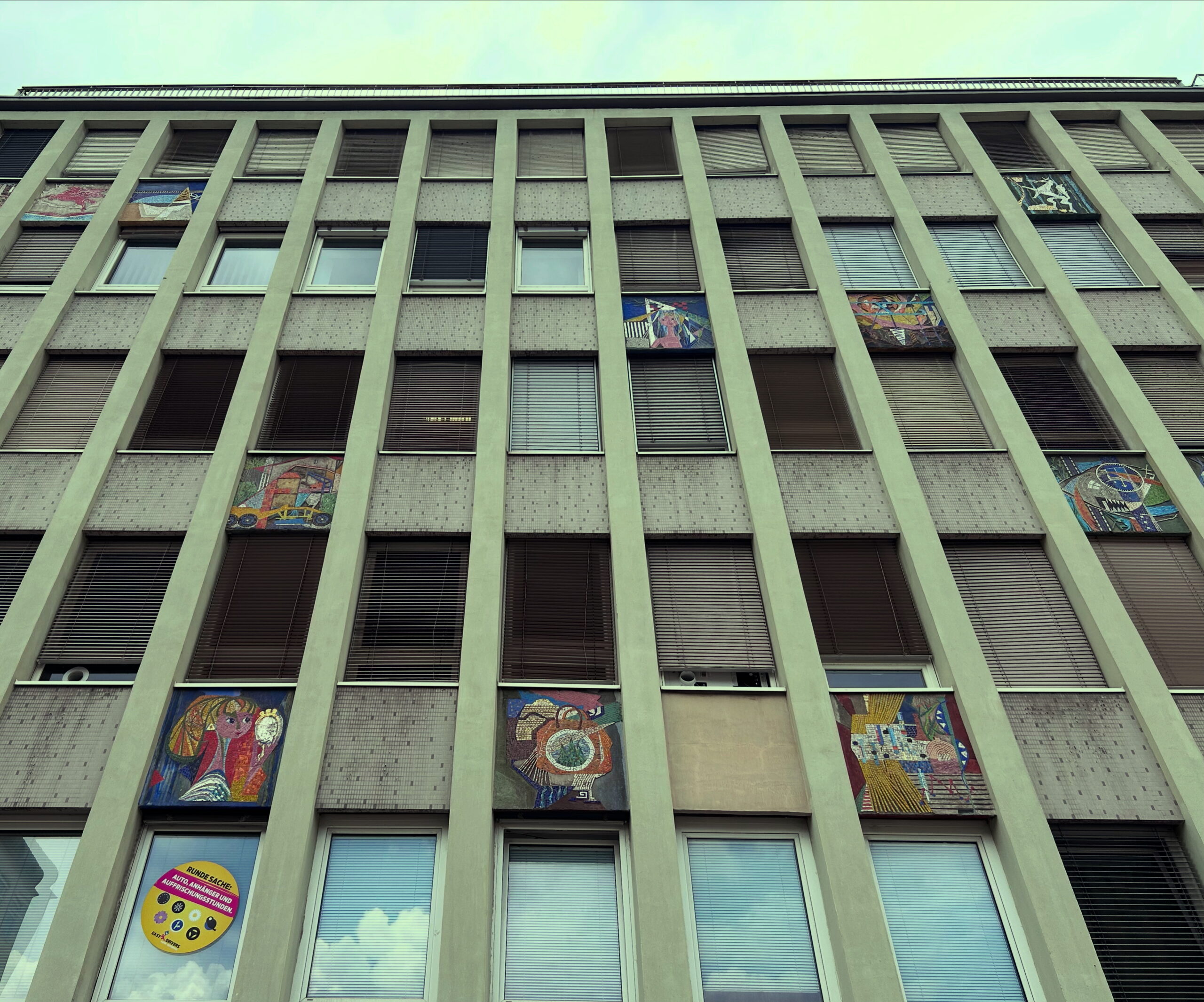
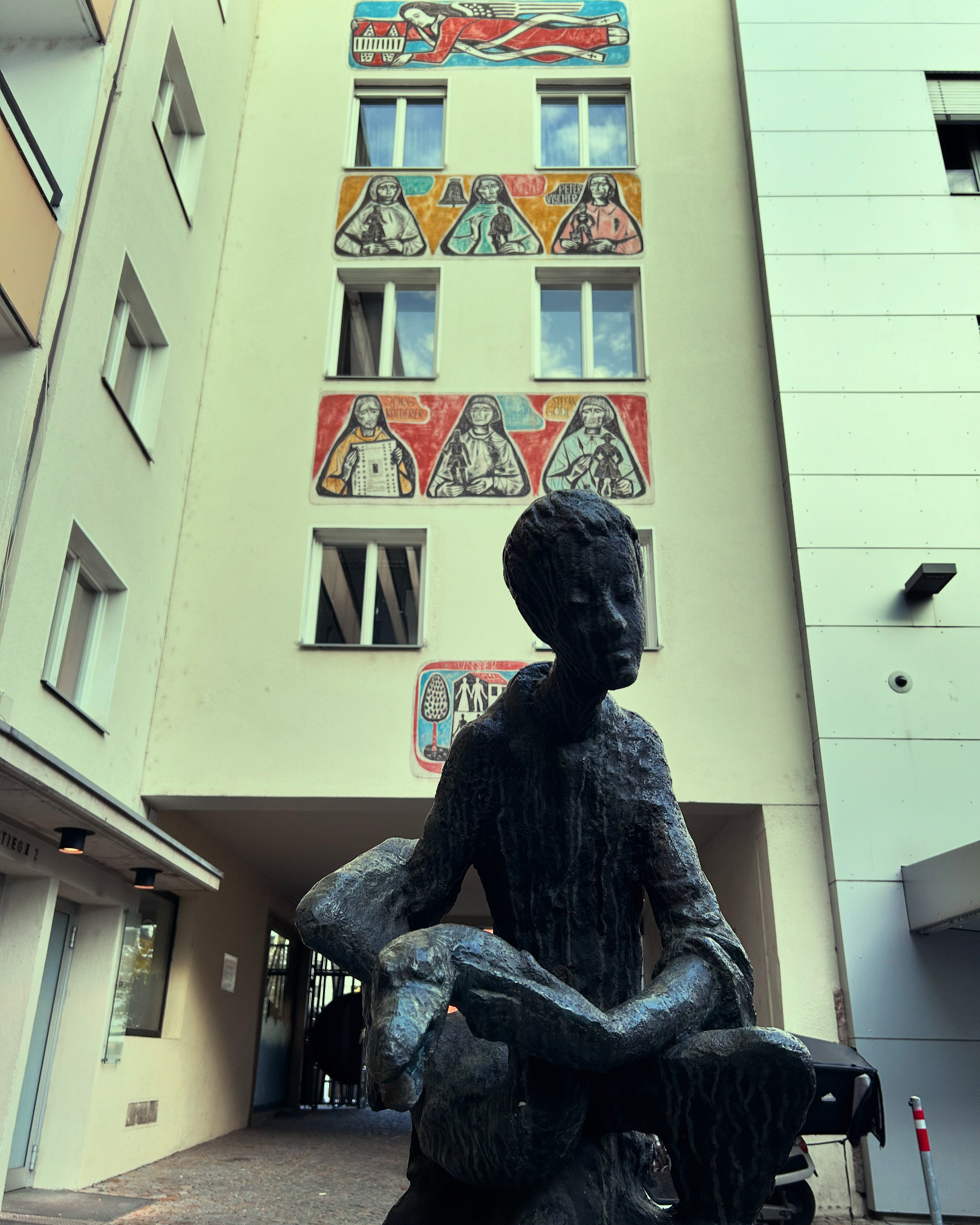
As after World War I, housing shortages were one of the most pressing problems after 1945. Innsbruck had suffered heavy damage during air raids, and money for new construction was scarce. When the first housing complexes were built in the 1950s, thrift was the order of the day. Many of the buildings erected from the 1950s onward may be architecturally unattractive, but they contain interesting artworks. From 1949 onward, Austria implemented the “Art in Architecture” project (Kunst am Bau). For state-funded construction projects, 2% of total expenditures were to be allocated to artistic design. The implementation of building regulations and thus the management of budgets was, as then and now, the responsibility of the federal states. Through these public commissions, artists were to be financially supported. In the lean post-war years, even successful and practically minded artists such as Oswald Haller (1908–1981), who earned money with commercial graphics and tourism posters, faced difficulties. The idea first appeared in 1919 in the Weimar Republic and was continued by the National Socialists from 1934 onward. Austria revived Kunst am Bau after the war to shape public spaces during reconstruction. The public sector, which replaced aristocracy and bourgeoisie as builders of previous centuries, was under massive financial pressure. Nevertheless, the primarily functional housing projects were not to appear entirely without ornamentation. Tyrolean artists entrusted with designing the artworks were selected through public competitions. The most famous among them was Max Weiler, perhaps the most prominent artist in post-war Tyrol, responsible for the frescoes in the Theresienkirche on the Hungerburg in Innsbruck. Other notable names include Helmut Rehm (1911–1991), Walter Honeder (1906–2006), Fritz Berger (1916–2002), and Emmerich Kerle (1916–2010). Many of these artists were shaped not only by the Federal Trade School in Innsbruck (today’s HTL) and the Academy of Fine Arts in Vienna but also by the collective experience of National Socialism and the war. Fritz Berger had lost his right arm and an eye and had to learn to work with his left hand. Kerle served in Finland as a war painter and was taught at the Academy by Josef Müllner, an artist who entered art history with busts of Adolf Hitler, Siegfried from the Nibelungen saga, and the still controversial Karl Lueger monument in Vienna. Like much of the Tyrolean population, these artists—as well as politicians and officials—wanted peace and quiet after the harsh and painful war years, to let the grass grow over the events of the past decades. The works created under Kunst am Bau reflect this attitude toward a new moral order. It was the first time abstract, formless art entered Innsbruck’s public space, albeit only in an uncritical context. Fairy tales, legends, and religious symbols were popular motifs immortalized in sgraffitos, mosaics, murals, and statues. One could speak of a kind of second wave of Biedermeier art, symbolizing the petty-bourgeois lifestyle of people after the war. Art was also intended to create a new awareness and image of what was considered typically Austrian. As late as 1955, every second Austrian still regarded themselves as German. The various motifs depict leisure activities, clothing styles, and notions of social order and norms of the post-war era. Women were often shown in traditional dress and dirndls, men in lederhosen. Conservative ideals of gender roles were reflected in the art: hardworking fathers, dutiful wives caring for home and hearth, and children diligently learning at school were the ideal image well into the 1970s—a life like in a Peter Alexander film. Those who walk attentively through the city will find many of these still-visible artworks on houses in Pradl and Wilten. The mix of unremarkable architecture and contemporary artworks from the often-suppressed, long-idealized post-war era is worth seeing. Particularly beautiful examples can be found on façades in Pacherstraße, Hunoldstraße, Ing.-Thommenstraße, Innrain, at the Landesberufsschule Mandelsbergerstraße, or in the courtyard between Landhausplatz and Maria-Theresien-Straße.
Operation Greenup - Innsbrooklyn's rebirth
After smaller battles in the Außerfern and at the Porta Claudia in Scharnitz near Seefeld, the Cactus Division of the US armed forces stood in Zirl at the gates of the Gau capital Innsbruck on 3 May 1945. A handful of resistance fighters led by Fritz Molden and the later Tyrolean governor Karl Gruber had occupied barracks and official facilities in Innsbruck after the Gau leadership, Gestapo and SS had fled the scene. Nevertheless, the GI's did not know what to expect in Innsbruck, as Adolf Hitler had declared Tyrol to be part of the Alpine fortress, the retreat that was to be defended to the last man. If Innsbruck were to become a battlefield, as had been the case in many cities, this would result in the destruction of the city. The fact that it did not come to that and Innsbruck was surrendered without a fight is due to a group of young people who were involved in the US espionage operation Operation Greenup laid the foundations for peaceful capitulation.
The male protagonists of this cinematic coup were Friedrich "Fred" Mayer, Hans Wijnberg, Franz Weber and Anna Niederkircher. The two Jews Mayer and Wijnberg had landed in New York while fleeing National Socialism. They had volunteered for service in Europe and were deployed with the OSS, the US military intelligence service. Weber had been stranded in a prison camp in southern Italy as a deserter from the Wehrmacht. After his war experiences, the staunch Catholic wanted to help overthrow the Nazi regime in his Tyrolean homeland. Together, they were to spy on the supply line over the Brenner Pass from Innsbruck as well as war-relevant infrastructure and industry such as the Messeschmitt factories in Kematen.
On 26 February, the three men and their equipment were dropped by plane over the Ötztal Alps in the wintery high mountains. Using sledges and public transport, they made their way to Oberperfuß, Franz Weber's home village, in the middle of enemy territory with all their equipment. Here they did not encounter Hitler's feared Alpine fortress, but rather support from the community of Oberperfuß, which had always been strictly Catholic, conservative and critical of the regime. Above all, those close to Weber, his sisters Eva, Margarete and Luise, his neighbour Maria Hörtnagl, but above all his fiancée Anni Niederkircher and her mother Anna, the landlady of the Gasthof zur Krone, played invaluable roles in providing supplies, camouflage and accommodation.
Franz Weber was the group's local guide. Fred Mayer mingled with the population in Oberperfuß, Innsbruck and Kematen under various identities, as a Wehrmacht soldier in the officers' mess, as a worker at the Messerschmitt factories or as a French forced labourer. He forged links with other resistance groups and gathered information. Weber's sisters harboured him and provided him with all sorts of things, such as forged papers or a stolen Wehrmacht uniform. Anni Niederkircher was the link between Oberperfuß and Innsbruck. Hans Wijnberg, as a radio operator, maintained communication with the US army base in Bari.
Everyone knew that if their risky operation was discovered, they and their families would be condemned to death. This happened at the end of April. Robert Moser, the radio dealer and resister who had employed Fred Mayer in his shop, was exposed. He was interrogated, tortured and finally beaten and whipped to death at the Gestapo headquarters in Innsbruck's Herrengasse. On 20 April, Fred Mayer was also arrested and tortured in Herrengasse. But he held out, and even more: after revealing himself to be a member of the US secret service, he was able to negotiate with Gauleiter Hofer to have Innsbruck handed over as a free city without a fight. In return for Mayer's assurance that he would be treated as a prisoner of war, Hofer issued an order to the population in a radio address on 2 May to refrain from any fighting.
At 2 pm on 3 May, Fred Mayer, still scarred from his treatment by the Gestapo, reached the US troops near Zirl with this message. A few hours later, the ceasefire came into effect. The vehicles and soldiers were able to enter the town without further bloodshed and destruction.
The memory of the Operation Greenup and the heroic actions of all those involved under extreme danger were not remembered for a long time in favour of the story of self-liberation by the brave Tyrolean people. It was not until 2010 that Fred Mayer, who was honoured with the Purple Heart who had received the US military's highest medal for valour, was honoured by the state of Tyrol late but still at the age of almost 90. Hans Wijnberg received a Medal of Merit from the City of Innsbruck ten years after his death. Franz Weber, who served as a member of the provincial and national councils after the war, was honoured with the Decoration of honour of the province of Tyrol und das Decoration of Honour in Gold of the Republic of Austria. A hard-to-find bronze plaque at the former Gestapo headquarters in Herrengasse commemorates Robert Moser, who was tortured to death. There is a small information plaque at the house at Anichstraße 19, where Mayer was housed during his stay in Innsbruck. This perhaps most impressive episode in Innsbruck's city history only became known to a wider audience with the publication of the gripping book "Codename Brooklyn" by Peter Pirker, which received a great deal of international attention. However, Innsbruck perhaps owes its most enduring legacy to Wijnberg's radio messages: the code name for the city was after the New York neighbourhood where Mayer and he spent a long time, Brooklyn. Innsbruck was reborn after National Socialism as Innsbrooklyn.
Franz Hofer: The Gauleiter of Tyrol
Under National Socialism, many political posts and positions in the civil service were reallocated. The Führer cult and the ideas of the National Socialist Party were structurally cemented at all levels. Innsbruck's mayor Franz Fischer was replaced by Egon Denz when the Nazis came to power. Edmund Christoph also replaced Governor Josef Schumacher (1894 - 1971) overnight, before Franz Hofer (1902 - 1975) took his place as Gauleiter in May 1938 and Reich Governor from 1940.
Franz Hofer was born into a family of hoteliers in Bad Hofgastein, Salzburg. After attending school in Innsbruck, he ran a radio business. He became a member of the NSDAP in Austria as early as 1931. When the National Socialist Party was banned in Austria, Hofer was imprisoned as its Gauleiter in 1933, but was freed by members of the SA. He was shot during this escape, but was able to flee to Italy. He then travelled to Germany, where he became a German citizen and had a stellar career within the party.
Shortly after the annexation of Austria, Hofer was appointed Gauleiter of Tyrol and Vorarlberg at Hitler's behest on 24 May 1938. In 1940, he was appointed Reich Governor of Tyrol-Vorarlberg. The plans of the leader-loyal Hofer were ambitious; Tyrol was a good breeding ground, if one excludes strict Catholics. Nowhere else in the Austrian districts were there more party members in proportion to the population than here. Hofer was already quite close to his goal of having the first completely Jew-free Gau in 1939. One year later, only one Jew was still registered in Tyrol. Hofer also generously enriched himself personally with aryanised assets. This is how the Villa Schindler of the operator of the Cafe Schindler at Rennweg 10 into his possession, as well as the Lachhof in Kleinvolderberg near Innsbruck, where he set up a kind of command centre outside the city.
Hofer, an anti-Catholic, also took action against church organisations. Wilten Boys' Choir were just as much a thorn in the flesh as the ubiquitous depictions of the Virgin Mary in Innsbruck. Socialist and communist organisations played no role in Tyrolean society and there was less need to be wary of them than of stubborn Catholics. All religious orders were closed and Catholic youth groups and associations were incorporated into the National Socialist system. 119 out of 570 priests were taken into custody at least once between 1938 and 1945, eleven were executed or did not survive the prison conditions.
When Italy finally came under German control in 1943, Hofer was appointed Supreme Commissioner of the Operational zone Alpine foothills appointed. This zone consisted of Tyrol-Vorarlberg and the Upper Italian provinces. It was also Franz Hofer who came up with the idea of the so-called Alpine fortress, the last bastion of the German people against the enemy. On 12 April 1945, less than a month before the end of the war, he personally submitted this proposal to Adolf Hitler, who then appointed him Reich Defence Commissioner of the Alpine fortress made.
made. After negotiations with the approaching Allied forces, Innsbruck was handed over as an open city without a fight on 3 May 1945 and thus spared the devastating fighting at the end of the war. Despite this sensible measure, Hofer remained a fanatical National Socialist even in defeat, as his speech on the radio on 30 April shows:
"However, should the enemy, despite heroic fighting, be at the gates of Innsbruck, a defence of the Gau capital under the given circumstances would by no means save the worst, but rather destroy the last.... But we want to claw our way into our mountains all the more tenaciously..."
Hofer was arrested a few days later. In October 1948, he escaped from the Dachau internment camp and fled to Germany, where he went into hiding in Mühlheim an der Ruhr under a false name. It is not certain, but quite possible, that the American and British secret services helped his former adversary to escape in order to protect their methods against National Socialism on Tyrolean soil, which were now in use against the Soviet Union, had they been openly discussed at a trial. In 1949, a court in Munich sentenced him in absentia to 10 years in prison. In July 1953, this judgement was confirmed in Munich, but the sentence was reduced to three years. However, Hofer remained at large due to the crediting of previous prison terms. A court in Austria sentenced him to death in 1949. However, he was not prosecuted. His advocates included the Bishop of Brixen, Johannes Baptist Geisler, and the Tyrolean governor Alfons Weißgatterer. His assets were confiscated by the Republic of Austria in proceedings in Innsbruck in 1950.
From 1954, Hofer lived in Germany under his real name. He ran the Ruhr Armatur GmbHa company specialising in sanitary equipment. Its participation in the Action T4 in Tyrol, the "Destruction of life unworthy of life"Although proceedings were initiated in court, the case was dropped in 1963. Despite his emigration, the former Gauleiter remained loyal to the province of Tyrol in the truest sense of the word until his death. Hofer was a lover of Tyrolean tradition. During his time in Tyrol, he promoted folk music, traditional costumes and Tyrolean marksmen. These associations were officially disbanded in 1938, but under his leadership they were reorganised in the Professional marksmen's association transferred. The leader of the Stadtmusikkapelle Wilten-Innsbruck, Sepp Tanzer, whom he appointed leader of the Department of Folk Music in the Reich Chamber of Music composed for him the Standschützenmarsch. At Hofer's funeral 30 years after the end of the war in Mühlhausen, a delegation of Tyrolean marksmen was present to pay their last respects to Hofer, who remained a staunch National Socialist until his death. The Tiroler Landhaus, which is still the seat of the Tyrolean provincial government today, was built under Hofer and is still a stone reminder of the Gauleiter of Tyrol.
Innsbruck and National Socialism
In the 1920s and 30s, the NSDAP also grew and prospered in Tyrol. The first local branch of the NSDAP in Innsbruck was founded in 1923. With "Der Nationalsozialist - Combat Gazette for Tyrol and Vorarlberg“ published its own weekly newspaper. In 1933, the NSDAP also experienced a meteoric rise in Innsbruck with the tailwind from Germany. The general dissatisfaction and disenchantment with politics among the citizens and theatrically staged torchlight processions through the city, including swastika-shaped bonfires on the Nordkette mountain range during the election campaign, helped the party to make huge gains. Over 1800 Innsbruck residents were members of the SA, which had its headquarters at Bürgerstraße 10. While the National Socialists were only able to win 2.8% of the vote in their first municipal council election in 1921, this figure had already risen to 41% by the 1933 elections. Nine mandataries, including the later mayor Egon Denz and the Gauleiter of Tyrol Franz Hofer, were elected to the municipal council. It was not only Hitler's election as Reich Chancellor in Germany, but also campaigns and manifestations in Innsbruck that helped the party, which had been banned in Austria since 1934, to achieve this result. As everywhere else, it was mainly young people in Innsbruck who were enthusiastic about National Socialism. They were attracted by the new, the clearing away of old hierarchies and structures such as the Catholic Church, the upheaval and the unprecedented style. National Socialism was particularly popular among the big German-minded lads of the student fraternities and often also among professors.
When the annexation of Austria to Germany took place in March 1938, civil war-like scenes ensued. Already in the run-up to the invasion, there had been repeated marches and rallies by the National Socialists after the ban on the party had been lifted. Even before Federal Chancellor Schuschnigg gave his last speech to the people before handing over power to the National Socialists with the words "God bless Austria" had closed on 11 March 1938, the National Socialists were already gathering in the city centre to celebrate the invasion of the German troops. The police of the corporative state were partly sympathetic to the riots of the organised manifestations and partly powerless in the face of the goings-on. Although the Landhaus and Maria-Theresien-Straße were cordoned off and secured with machine-gun posts, there was no question of any crackdown by the executive. "One people - one empire - one leader" echoed through the city. The threat of the German military and the deployment of SA troops dispelled the last doubts. More and more of the enthusiastic population joined in. At the Tiroler Landhaus, then still in Maria-Theresienstraße, and at the provisional headquarters of the National Socialists in the Gasthaus Old Innspruggthe swastika flag was hoisted.
On 12 March, the people of Innsbruck gave the German military a frenetic welcome. To ensure hospitality towards the National Socialists, Mayor Egon Denz had each worker paid a week's wages. On 5 April, Adolf Hitler personally visited Innsbruck to be celebrated by the crowd. Archive photos show a euphoric crowd awaiting the Führer, the promise of salvation. Mountain fires in the shape of swastikas were lit on the Nordkette. The referendum on 10 April resulted in a vote of over 99% in favour of Austria's annexation to Germany. After the economic hardship of the interwar period, the economic crisis and the governments under Dollfuß and Schuschnigg, people were tired and wanted change. What kind of change was initially less important than the change itself. "Showing them up there", that was Hitler's promise. The Wehrmacht and industry offered young people a perspective, even those who had little to do with the ideology of National Socialism in and of itself. The fact that there were repeated outbreaks of violence was not unusual for the interwar period in Austria anyway. Unlike today, democracy was not something that anyone could have got used to in the short period between the monarchy in 1918 and the elimination of parliament under Dollfuß in 1933, which was characterised by political extremes. There is no need to abolish something that does not actually exist in the minds of the population.
Tyrol and Vorarlberg were combined into a Reichsgau with Innsbruck as its capital. Even though National Socialism was viewed sceptically by a large part of the population, there was hardly any organised or even armed resistance, as the Catholic resistance OE5 and the left in Tyrol were not strong enough for this. There were isolated instances of unorganised subversive behaviour by the population, especially in the arch-Catholic rural communities around Innsbruck. The power apparatus dominated people's everyday lives too comprehensively. Many jobs and other comforts of life were tied to an at least outwardly loyal attitude to the party. The majority of the population was spared imprisonment, but the fear of it was omnipresent.
The regime under Hofer and Gestapo chief Werner Hilliges also did a great job of suppression. In Tyrol, the church was the biggest obstacle. During National Socialism, the Catholic Church was systematically combated. Catholic schools were converted, youth organisations and associations were banned, monasteries were closed, religious education was abolished and a church tax was introduced. Particularly stubborn priests such as Otto Neururer were sent to concentration camps. Local politicians such as the later Innsbruck mayors Anton Melzer and Franz Greiter also had to flee or were arrested. It would go beyond the scope of this article to summarise the violence and crimes committed against the Jewish population, the clergy, political suspects, civilians and prisoners of war. The Gestapo headquarters were located at Herrengasse 1, where suspects were severely abused and sometimes beaten to death with fists. In 1941, the Reichenau labour camp was set up in Rossau near the Innsbruck building yard. Suspects of all kinds were kept here for forced labour in shabby barracks. Over 130 people died in this camp consisting of 20 barracks due to illness, the poor conditions, labour accidents or executions. Prisoners were also forced to work at the Messerschmitt factory in the village of Kematen, 10 kilometres from Innsbruck. These included political prisoners, Russian prisoners of war and Jews. The forced labour included, among other things, the construction of the South Tyrolean settlements in the final phase or the tunnels to protect against air raids in the south of Innsbruck. In the Innsbruck clinic, disabled people and those deemed unacceptable by the system, such as homosexuals, were forcibly sterilised.
The memorials to the National Socialist era are few and far between. The Tiroler Landhaus with the Liberation Monument and the building of the Old University are the two most striking memorials. The forecourt of the university and a small column at the southern entrance to the hospital were also designed to commemorate what was probably the darkest chapter in Austria's history.
Air raids on Innsbruck
Like the course of the city's history, its appearance is also subject to constant change. The years around 1500 and between 1850 and 1900, when political, economic and social changes took place at a particularly rapid pace, produced particularly visible changes in the cityscape. However, the most drastic event with the greatest impact on the cityscape was probably the air raids on the city during the Second World War.
In addition to the food shortage, people suffered from what the National Socialists called the "Heimatfront" in the city were particularly affected by the Allied air raids. Innsbruck was an important supply station for supplies on the Italian front.
The first Allied air raid on the ill-prepared city took place on the night of 15-16 December 1943. 269 people fell victim to the bombs, 500 were injured and more than 1500 were left homeless. Over 300 buildings, mainly in Wilten and the city centre, were destroyed and damaged. On Monday 18 December, the following were found in the Innsbrucker Nachrichten, dem Vorgänger der Tiroler Tageszeitung, auf der Titelseite allerhand propagandistische Meldungen vom erfolgreichen und heroischen Abwehrkampf der Deutschen Wehrmacht an allen Fronten gegenüber dem Bündnis aus Anglo-Amerikanern und dem Russen, nicht aber vom Bombenangriff auf Innsbruck.
Bombenterror über Innsbruck
Innsbruck, 17. Dez. Der 16. Dezember wird in der Geschichte Innsbrucks als der Tag vermerkt bleiben, an dem der Luftterror der Anglo-Amerikaner die Gauhauptstadt mit der ganzen Schwere dieser gemeinen und brutalen Kampfweise, die man nicht mehr Kriegführung nennen kann, getroffen hat. In mehreren Wellen flogen feindliche Kampfverbände die Stadt an und richteten ihre Angriffe mit zahlreichen Spreng- und Brandbomben gegen die Wohngebiete. Schwerste Schäden an Wohngebäuden, an Krankenhäusern und anderen Gemeinschaftseinrichtungen waren das traurige, alle bisherigen Schäden übersteigende Ergebnis dieses verbrecherischen Überfalles, der über zahlreiche Familien unserer Stadt schwerste Leiden und empfindliche Belastung der Lebensführung, das bittere Los der Vernichtung liebgewordenen Besitzes, der Zerstörung von Heim und Herd und der Heimatlosigkeit gebracht hat. Grenzenloser Haß und das glühende Verlangen diese unmenschliche Untat mit schonungsloser Schärfe zu vergelten, sind die einzige Empfindung, die außer der Auseinandersetzung mit den eigenen und den Gemeinschaftssorgen alle Gemüter bewegt. Wir alle blicken voll Vertrauen auf unsere Soldaten und erwarten mit Zuversicht den Tag, an dem der Führer den Befehl geben wird, ihre geballte Kraft mit neuen Waffen gegen den Feind im Westen einzusetzen, der durch seinen Mord- und Brandterror gegen Wehrlose neuerdings bewiesen hat, daß er sich von den asiatischen Bestien im Osten durch nichts unterscheidet – es wäre denn durch größere Feigheit. Die Luftschutzeinrichtungen der Stadt haben sich ebenso bewährt, wie die Luftschutzdisziplin der Bevölkerung. Bis zur Stunde sind 26 Gefallene gemeldet, deren Zahl sich aller Voraussicht nach nicht wesentlich erhöhen dürfte. Die Hilfsmaßnahmen haben unter Führung der Partei und tatkräftigen Mitarbeit der Wehrmacht sofort und wirkungsvoll eingesetzt.
This news item, which was imaginatively designed by censorship and media synchronisation, barely made it onto page 3. There was probably no more prominent way of presenting the city's poor preparation for the foreseeable bombardment to the public. The enthusiasm for National Socialism was no longer quite as great as in 1938 after the Anschluss, when Hitler was enthusiastically welcomed by 100,000 people in Innsbruck on 5 April. The damage to the city and the personal, tragic losses among the population were too great. In January 1944, the construction of air-raid tunnels and other protective measures began. The work was largely carried out by prisoners from the Reichenau concentration camp.
Innsbruck was attacked a total of twenty-two times between 1943 and 1945. Almost 3833, i.e. almost 50%, of the city's buildings were damaged and 504 people died. In the final months of the war, normality was out of the question. The population lived in constant fear. Schools were closed in the mornings. A regular everyday life was no longer conceivable.
Fortunately, the city was only the victim of targeted attacks. German cities such as Hamburg and Dresden were completely razed to the ground by the Allies with firestorms that claimed tens of thousands of lives within a few hours. Many buildings such as the Jesuit Church, Wilten Abbey, the Servite Church, the cathedral and the indoor swimming pool in Amraserstraße were hit.
Historic buildings and monuments received special treatment during the attacks. The Goldene Dachl was protected with a special construction, as was Maximilian's sarcophagus in the Hofkirche. The figures in the Hofkirche, the Schwarzen Mannderwere brought to Kundl. The Mother of Mercy, the famous picture from Innsbruck Cathedral, was transferred to Ötztal during the war.
The air-raid shelter tunnel south of Innsbruck on Brennerstrasse and the markings of houses with air-raid shelters with their black squares and white circles and arrows can still be seen today. In Pradl, where next to Wilten most of the buildings were damaged, bronze plaques on the affected houses indicate that they were hit by a bomb.
Innsbruck - city of bureaucrats and civil servants
Innsbruck is proud of its many titles. University city, Austria's capital of sport or home to the world's best hospital. If you take a look at the list of the region's largest employers or at its history, Innsbruck is one thing above all: a city of civil servants. The university and provincial hospital are the largest single employers. However, if you add up the public servants at all levels, city, state and federal, and include the outsourced companies owned by the public sector such as ÖBB, TIWAG or Innsbrucker Kommunalbetriebe as well as teachers and the police, the civil servants are clearly in the majority. At the latest since the relocation of the royal residence under Frederick IV, civil servants have not only made up a considerable proportion of the city's population in quantitative terms, they have also determined the fate of the city in an influential, albeit inconspicuous manner. To this day, it is civil servants who keep things running smoothly. They enforce laws, take care of the planning and maintenance of infrastructure, eagerly keep records of the population in order to collect taxes and draft soldiers.
The first notable bureaucracy probably came with the Roman Empire. The Romans were followed by the brothers of Wilten Abbey in the early Middle Ages. These men, who were well versed in writing, not only administered the ducal and their own estates through their Urbare and collected taxes from their peasant subjects, but also compiled baptismal registers, marriage registers and death registers. Although feudal rule required a panoramic view of what was happening within its domain, life in the city in particular was determined by the restrictions of the guilds rather than those of the authorities. There was only a superficial magistrate. There were laws but no police, taxes but no tax office. Urban infrastructure was practically non-existent, as there was no running water, electricity, sewage system, municipal kindergarten, labour office or health insurance. The municipality of Innsbruck, which was elevated to the status of a town, was governed for a long time by a municipal judge, and from the 14th century by a mayor with a municipal council. These were not full-time civil servants, but members of the city's elite. Only a few people such as tax collectors, corn measurers, clerks or tower guards were employed by the city.
In the 15th century, the professional world and society became more differentiated, the armies larger and the tax burdens higher. Traditional customary law was replaced by modern Roman law, which was more difficult for the uninitiated to understand. As the city grew, so did the civil service. Between the beginning of the 15th century and the reign of Leopold V, Innsbruck had developed from a trading and transport centre into a city of officials. Of the approximately 5500 inhabitants, more than half belonged to the court, the municipal civil service, the university or the clergy. The court, administration, customs, taxes, long-distance trade and finance required clerical staff. Administration had become the city's most important economic sector, ahead of crafts, transport and catering.
The citizens only came into contact with these foreign officials in unpleasant situations, if at all. Maximilian I tightened the reins particularly tightly. His centrally passed laws were implemented locally by the imperial districts. The salaried civil servants permeated the lives of individuals in a way that did not exist in the Middle Ages. To make matters worse, the officials often came from abroad. Italians and Burgundians in particular were in demand as key labourers, but they were alienated from the local population. Not only did they often not speak German, they could read and write, were employees and not subservient farmers. They had more money at their disposal, dressed differently, had different customs and ate different food. Unlike the ruler, they did not appeal to God, but to rules written by men and inspired by antiquity and reason. The laws changed depending on the fashions, customs and moral concepts of the time. Just as nature conservation or speed limits on motorways are repeatedly discussed today, even though they make sense, bans on spitting, disposing of the chamber pot, wooden buildings and keeping livestock within city walls were viewed critically at the time, even though they drastically improved hygiene and safety.
While it had long been customary for citizens to take certain liberties with logging, building, hunting and fishing in the absence of the ruler, the bureaucracy was always present. While the sovereign was seen as a good father to his subjects and bishops and abbots were strict landlords, but could at least offer salvation in return, the new authorities appeared anonymous, aloof, faceless, foreign and distant. The basis for negotiation that you had as a subject in direct contact with your landlord was buried by the merciless law, at least if you could not pay bribes or did not know anyone in a higher position. When unconditional faith in the increasingly corrupt clergy began to crumble and Ferdinand I appointed the Spaniard Salamanca as the country's chief financial administrator, the underlying dissatisfaction turned into open rebellion in 1525. The subjects did not demand the removal of the prince, but a change in the rule of the clergy and foreign officials. Even in the 17th century, it was the country's highest civil servant, Wilhelm Biener, whose head rolled and not that of the sovereign.
Bureaucracy, the rule of the administration, also had advantages for the subjects. It established fixed rules where arbitrariness often prevailed. The law, harmonised across different territories, was more predictable. And with a bit of luck and talent, it was possible to climb the social ladder by serving the public authorities, even without belonging to the nobility. Michael Gaismair, one of the leaders of the 1525 rebellion, was the son of a mining entrepreneur and had been in the service of the provincial governor before his career as a revolutionary.
The next modernisation of the administration took place in the 18th century. Under the enlightened, absolutist monarchs Maria Theresa and Joseph II, a new wind blew right down to the municipal level. Innsbruck was given a police force for the first time. The city administration was modernised in 1784. Instead of the old city council with Common was now ruled by a mayor supported by a council, but above all by civil servants. This magistrate consisted of salaried experts who, although still mainly made up of members of the lesser nobility, now had to pass examinations to qualify for their office. The bureaucracy was given more power at the operational political level. While the position of mayor was limited in time, civil servants enjoyed a lifelong, permanent position. This pragmatisation and a new wave of new laws, which often contradicted tradition, reinforced the reputation of civil servants as being aloof and distant from the people. When the Bavarian occupation of Tyrol added a foreign element, modelled on the French, another uprising broke out in 1809. The mass conscription of young men for military service, the regimentation of religious life and compulsory vaccination, enforced by Bavarian officials, was too much for the Tyrolean soul.
Nach 1809 hielt die Bürokratie im Rahmen der Industrialisierung und neuen Technologien in immer mehr Lebensbereichen Einzug. Nicht nur das Staatswesen über Steuern und Militär, auch Universität, Schulen, Bauwesen, Eisenbahn, Post und Institutionen wie die Kammer für Handel und Gewerbe bedurften Verwaltungsmitarbeitern. Die Stadt wuchs was Einwohner und Unternehmen anbelangte. Neue Infrastruktur wie Gas, Kanalisation und Elektrizität und neue Vorstellungen was Hygiene, Lebensmittelkontrolle, Gesundheit und Bildung anbelangte, verlangten nach neuen Mitarbeitern im Stadtmagistrat. Das alte Rathaus in der Altstadt wurde zu klein. Eine angedachte Erweiterung erwies sich als unmöglich. 1897 übersiedelten die Beamten in das neue Rathaus in der Maria-Theresien-Straße. Ermöglicht wurde der Umzug durch die großzügige Schenkung des Industriellen und Hoteliers Leonhard Lang. Er hatte aus dem ehemaligen Palais Künigl das Hotel d´Autriche gemacht, bevor der Bürgermeister und seine Entourage Einzug hielten.
When the monarchy collapsed in 1918, the transition was not seamless, but thanks to the structures in place, it was unimaginably smooth. However, it was no longer the emperor who carried the burden of the state, but a host of civil servants and guardians of order who provided water, electricity and a functioning railway network. With Eduard Klingler and Theodor Prachensky, two heads of building authorities in the first half of the 20th century left their mark on Innsbruck's cityscape, which is still clearly visible today. With agendas such as public housing, the labour office, education, urban infrastructure, road construction, public transport, registration and weddings, the Republic took over more or less all the tasks of daily life from the monarchy and the church. So for anyone who is annoyed by excessive officialdom and agonisingly slow bureaucracy on their next visit to the New Town Hall, it is worth remembering that the welfare state in the person of its civil servants manages the social welfare and public infrastructure of thousands of people from the cradle to the grave, mostly unnoticed.
The Tyrolean nation, "democracy" and the heart of Jesus
Many tyroleans see themselves as an own nation. With „Tirol isch lei oans“, „Zu Mantua in Banden“ and „Dem Land Tirol die Treue", the federal state has three more or less official anthems. As in other federal states, there are historical reasons for this pronounced local patriotism. Tyrolean freedom and independence are often invoked as a local shrine to underpin this. It is often referred to as the first democracy in mainland Europe, which is probably an exaggeration considering the feudal and hierarchical history of the country up until the 20th century. However, the country cannot be denied a certain peculiarity in its development, even if it was less about the participation of broad sections of the population and more about the local elites curtailing the power of the sovereign.
The first act was what the Innsbruck historian Otto Stolz (1881 - 1957) in the 1950s exuberantly described, in reference to English history, as the Magna Charta Libertatum celebrated. After the marriage of the Bavarian Ludwig von Wittelsbach to the Tyrolean princess Margarete von Tirol-Görz, the Bavarian Wittelsbachs were rulers of Tyrol for a short time. In order to win over the Tyrolean population to his side, Ludwig decided to offer the provincial estates a treat in the 14th century. In the Großen Freiheitsbrief of 1342, Louis promised the Tyroleans that he would not enact any laws or tax increases without first consulting the provincial estates. However, there can be no question of a democratic constitution as understood in the 21st century, as these provincial estates were primarily the aristocratic, landowning classes, who represented their interests accordingly. Although one copy of the document mentioned the inclusion of peasants as a class in the Diet, this version never became official.
As the towns and bourgeoisie gained more political clout in the 15th century due to their economic importance, a counterweight to the nobility developed within the estates. At the Diet of 1423 under Frederick IV, 18 members of the nobility met 18 members of the towns and peasantry for the first time. Gradually, a fixed composition developed in the provincial diets of the 15th and 16th centuries. The Tyrolean bishops of Brixen and Trento, the abbots of the Tyrolean monasteries, the nobility, representatives of the towns and the peasantry were all represented. The provincial governor presided over the meeting. Of course, the resolutions and wishes of the provincial parliament were not binding for the prince, but it was probably a reassuring feeling for the ruler to know that the representatives of the population were on his side or that difficult decisions were supported.
Another important document for the country was the Tiroler Landlibell. In 1511, Maximilian stipulated, among other things, that Tyrolean soldiers should only be called up for military service in defence of their own country. The reason for Maximilian's generosity was less his love for the Tyroleans than the need to keep the Tyrolean mines running instead of burning out the precious labourers and the peasantry that supplied them on the battlefields of Europe. The fact that in Landlibell At the same time, massive restrictions on the population and higher costs are often forgotten. The Landlibell regulated not only the strength of the troop contingents but also the special taxes that were levied. The nobility and clergy had to use the capital gains from their estates as a tax base, which often amounted to a rough estimate. Towns, on the other hand, were taxed according to the number of fireplaces in the houses, which could be calculated quite accurately. Coveted miners were exempt from these taxes and only had to serve in the army in extreme emergencies.
This special regulation for national defence, as laid down in the Landlibell, was one of the reasons for the uprising of 1809, when young Tyroleans were conscripted for the mobilisation of the armed forces as part of general conscription. To this day, the Napoleonic Wars, when the Catholic crown land was threatened by the "godless French" and the revolutionary social order, characterise the Tyrolean self-image. During this defensive struggle, an alliance was formed between Catholicism and Tyrol. The Tyrolean marksmen entrusted their fate to the heart of Jesus before a decisive battle against Napoleon's armies in June 1796 and entered into a covenant with God personally, which would protect their Heiliges Land Tirol was supposed to protect her. Another identity-forming legend from 1796 centres around a young woman from the village of Spinges. Katharina Lanz, who was known as the Jungfrau von Spinges went down in the history of the country as an identity-forming national heroine, is said to have motivated the almost defeated Tyrolean troops with her imperious demeanour in battle to such an extent that they were ultimately able to achieve victory over the French superiority. Depending on the account, she is said to have taught Napoleon's troops to fear with a pitchfork, a flail or a scythe similar to the French Maid Joan of Arc. Legends and traditions surrounding the marksmen and the feeling of being an independent nation chosen by God, which happened to be attached to the Republic of Austria, go back to these legends.
The particular identities of the individual crown lands did not correspond to what enlightened politicians imagined a modern state to be. Under Maria Theresa, the central state was strengthened vis-à-vis the crown lands and the local nobility. The subjects' sense of belonging should not be to the province of Tyrol, but to the House of Habsburg. In the 19th century, the aim was to strengthen identification with the monarchy and develop a national consciousness. The press, visits by the ruling family, monuments such as the Rudolfsbrunnen or the opening of Mount Isel with Hofer as a Tyrolean loyal to the emperor were intended to help turn the population into subjects loyal to the emperor.
When the Habsburg Empire collapsed after the First World War, the crown land of Tyrol also broke up. What had been known as South Tyrol until 1918, the Italian-speaking part of the province between Riva on Lake Garda and Salurn in the Adige Valley, became Trentino with Trento as its capital. The German-speaking part of the province between Neumarkt and the Brenner Pass is now South Tyrol / Alto Adige, an autonomous region of the Republic of Italy with the capital Bolzano.
Throughout the centuries, Innsbruckers have felt themselves to be Tyroleans, Germans, Catholics and subjects of the emperor. Before 1945, however, hardly anyone felt Austrian. It was only after the Second World War that a sense of belonging to Austria slowly began to develop in Tyrol. To this day, however, many Tyroleans are proud of their local identity and like to distinguish themselves from the inhabitants of other federal states and countries. For many Tyroleans, after more than 100 years, the Brenner Pass still represents a Injustice limit even if the Europa der Regionen cooperates politically across borders at EU level.
The legend of the Holy Landthe independent Tyrolean nation and the first mainland democracy has survived to this day. The bon mot "bisch a Tiroler bisch a Mensch, bisch koana, bisch a Oasch" summarises Tyrolean nationalism succinctly. The fact that the historic crown land of Tyrol was a multi-ethnic construct with Italians, Ladins, Cimbrians and Rhaeto-Romans is often overlooked in right-wing circles. Laws from the federal capital of Vienna or even the EU in Brussels are still viewed with scepticism today. Nationalists on both sides of the Brenner Pass still make use of the Jungfrau von Spingesthe heart of Jesus and Andreas Hofer, to publicise their concerns. The Säcularfeier des Bundes Tirols mit dem göttlichen Herzen Jesu was still celebrated in the 20th century with great participation from the political elite.
Reichskristallnacht in Innsbruck
Like many other German and Austrian cities, Innsbruck was also the scene of the events that took place on the night of 9 to 10 November 1938 and was known as the Reichskristallnacht and November pogroms form one of the saddest parts of recent history. The Nazi regime took the assassination attempt by a Polish-Jewish student on the German ambassador in Paris as an opportunity to organise pogroms. Starting from the party leadership around Adolf Hitler, orders were given to the local representatives in the cities of the German Reich to accelerate the de-Jewification of Germany and the Aryanisation, the expropriation of the Jewish population.
In contrast to the Jewish population and culture, anti-Semitism was a common tradition in Tyrol. Innsbruck was the centre of Jewish life in western Austria, but there was never a significant number of Jewish citizens. The first immigrants of the Jewish faith came to the city in the Middle Ages. At the beginning of the 16th century, the Jewish cemetery at the Judenbühel first mentioned in St Nicholas. In 1880, there were only 109 Jews registered in Innsbruck. In the days before the First World War, when Jewish soldiers served as regular subjects of the Habsburg Monarchy, Innsbruck had 500 Jewish citizens. Political factions based their programmes on anti-Semitism long before the rise of the National Socialists. The Christian Mittelstand party warned its voters of the "harmful Jews" in a leaflet ahead of the 1889 elections. In the churches, anti-Semitic sermons and the legend of the ritual murder in Tyrolean garb of the Anderle von Rinn the order of the day. Josef Seeber, a popular theologian in Tyrol, wrote his version of the Eternal Jews an epic, anti-Semitic ballad.
What was new in 1938 was the open violence. On 9 November, a celebration was held in the city theatre to commemorate the National Socialist coup attempt of 1923 in Munich. The audience was entertained with performances by the Hitler Youth and Richard Wagner's Lohengrin to the swearing-in of the SS members on Adolf Hitler Square in front of the theatre. After midnight, Gauleiter Hofer and high-ranking members of the SS gathered to discuss the details of the "spontaneous uprising of the German people against the Jews“ to go through. One of them was the mayor of Innsbruck, Egon Denz (1899 - 1979), who, as supreme commander of the fire brigade, did not allow the fires to be extinguished. Jewish homes and businesses were destroyed. Jewish citizens were abused and beaten up. Richard Berger, Wilhelm Bauer and Richard Graubart were killed. More or less the entire Jewish population was killed in the days following the Reichspogromnacht forcibly relocated to Vienna.
Considering the ratio of the small Jewish population to the number of victims, Innsbruck was one of the most brutal cities in the German Reich during the November pogroms. The murder of Richard Graubart is well documented. He ran a shoe shop in Museumstraße. He lived with his family in a villa in Gänsbacherstraße in the Saggen district. Under the direction of SS-Hauptsturmführer Hans Aichinger, his murderers, some of whom he knew personally, forced their way into the family home. Graubart was stabbed to death, and the doctor who arrived an hour later could only confirm his death. The villa had already been given to a Nazi party functionary before the crime, as had the rest of the Graubart family's property. In the Newest newspaper of 10 November:
"Synagogue in Innsbruck is destroyed... Similar to all cities in Germany, such protests also took place in Innsbruck.... With their anger, the crowd demonstrated their outrage at the cruel bloodshed and called for action against Jews.... To avoid further unrest, many Jews were arrested... Incidentally, the city of Innsbruck and our Gau are looking forward to being freed from the Jewish burden fairly soon, as a process of Aryanisation is being set in motion en masse."
When the riots were brought to trial before the People's Court at Innsbruck Provincial Court after the war, none of the defendants were convicted of murder. Rudolf Schwarz and Robert Huttig, two of the men who had murdered Richard Graubart, were sentenced to 11 and 10 years' imprisonment respectively in 1947, but were pardoned and released from prison in 1951. The trial against Mayor Egon Denz at the Innsbruck People's Court was discontinued in 1947. After his death in 1979, he was given a grave of honour at Innsbruck's West Cemetery. It was not until 1981 that the city of Innsbruck erected a memorial plaque at the site of the synagogue destroyed in 1938. In 1993, the new synagogue was opened on the same site in Sillgasse in the presence of Innsbruck's Bishop Reinhold Stecher (1921 - 2013). The small Jewish community of Tyrol and Vorarlberg received a special gift for the inauguration. In November 1938, the neighbours at the time had removed and kept the key to the destroyed door of the old synagogue, which was returned on this day.